




Safety Tip: Preventing Drowsy Driving
A new report from NHTSA stresses the need to better educate American drivers about the dangers of driving when sleep-deprived.

Infographic courtesy of AAA Foundation. Source of data: CDC.
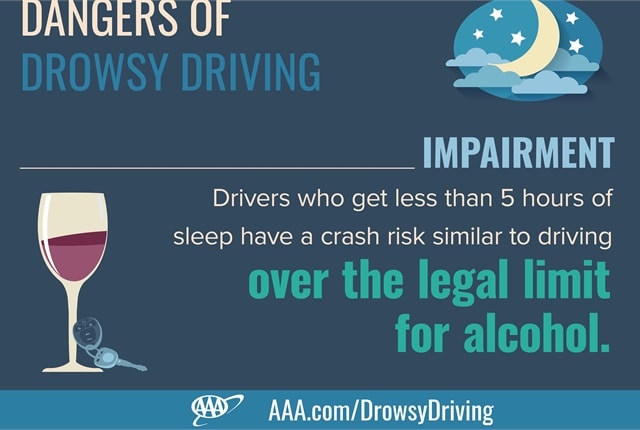
Infographic courtesy of AAA Foundation. Source of data: CDC.
The problem of drowsy driving is responsible for an estimated 16.5% of fatal crashes. But the driving public at large still hasn’t fully grasped the risks associated with getting too little sleep before driving.
Consider these two scenarios: A department manager has a few drinks at the office Christmas party and is too buzzed to drive. His colleagues make sure he gets a ride home. But are those same coworkers as willing to intervene if he pulls an office all-nighter to meet a tight deadline and starts to head for the parking lot? Maybe not.
The truth is, sleep-deprived drivers can be just as dangerous as drunken drivers. Fatigue impairs both cognition and driving performance, just as alcohol does. Sleep deprivation can lead to falling asleep at the wheel and to “microsleeps,” during which the driver’s head repeatedly drops down for a few seconds at a time.
Drowsy driving crashes usually involve well-meaning, sleep-deprived drivers who convince themselves they can fight through the fatigue and will themselves to stay awake and alert. Despite their best efforts, they nod off anyway because the rules of biology take over.
The fight against drowsy driving requires a cultural shift in how people view their responsibility to get enough sleep before they ever get behind the wheel, safety advocates argue. Adults ages 18 to 64 need seven to nine hours of sleep each day, according to the National Sleep Foundation. Adults 65 and older need seven to eight hours.
“Addressing these issues can be difficult when our values frequently do not align with avoiding drowsy driving,” a new NHTSA report on drowsy driving stated. “In a 24/7 society, with an emphasis on work, longer commutes, and exponential advancement of technology, many people do not get the sleep they need. Effectively dealing with the drowsy-driving problem requires fundamental changes to societal norms and especially attitudes about drowsy driving.”
To better combat the problem, the NHTSA report advocates for expanding and sharing crash risk research using various methodologies, improving crash reporting, documenting the economic impact of drowsy driving, and researching and developing new methods for detecting fatigue and sleep restriction.
Additionally, the federal agency recommends evaluating the effectiveness of new and existing laws, evaluating the effectiveness of corporate fatigue-management practices, developing fatigue risk management programs for high-risk professions, exploring the potential of graduated driver licensing laws for reducing drowsy driving, facilitating regular engagement of the sleep science community with corporations and the insurance industry, and providing technical assistance for state policy and program actions.
NHTSA is also working with automotive manufacturers, suppliers and aftermarket producers to advance development of drowsy driving detection systems. (To view a video news segment about the NHTSA report, click on the image or link below the headline.)
In the meantime, here are some drowsy driving-prevention tips from AAA Exchange that you can pass along to fleet drivers as a friendly reminder:
Get enough sleep the night before a long trip.
Travel at times when you’re normally awake. Stay overnight rather than drive straight through.
Schedule a break every two hours or every 100 miles.
Stop driving if you become sleepy.
Never plan to work all day and then drive all night.
Drink a caffeinated beverage. Since it takes about 30 minutes for caffeine to enter the bloodstream, find a safe place to take a 20- to 30-minute nap while you’re waiting for the caffeine to take effect.
Avoid driving during sleepy times of day, particularly between midnight and 6 a.m.
Travel with a passenger who’s awake, when possible.
More Safety

What’s Next for Fleet? Safety, AI & Industry Recognition | AF News Recap
Could your company's culture be encouraging distracted driving? This week, we're exploring how workplace expectations affect driver safety, what AI, EVs, and autonomous vehicles could mean for the future of fleet management, and how fleet professionals can strengthen their award nominations.
Read More →
Does Your Fleet's Culture Encourage Distracted Driving?
What happens when the people responsible for enforcing safety rules are the ones setting the wrong example? The answer may reveal why some of the biggest risks to fleet drivers have little to do with what's written in the employee handbook.
Read More →
Fleet Manager’s Ultimate Playbook: Navigating the New Standard in OEM Connectivity
Rising operating costs, driver safety concerns, and unplanned downtime are putting unprecedented pressure on modern fleets. Discover how fleet managers use embedded OEM connectivity and real-time vehicle data to cut TCO, prevent downtime, and protect drivers without aftermarket telematics hardware.
Read More →
From Driver Well-Being to EV Charging | AF News Recap
Mental health belongs in the fleet safety conversation. This week, we’re looking at five ways fleets can support employee well-being before a crisis, plus Holman’s expansion in Mexico, new one-day Fleet Forward passes, and why EV charging demand is outpacing infrastructure growth.
Read More →
Nexar-Nauto Merger Aims to Give Fleets Better Safety Intelligence Through Larger Driving Dataset
Stefan Heck tells Automotive Fleet that combining more than 10 billion miles of driving history with Nexar's AI models will give fleets deeper insights into driver risk and roadway conditions than either company could provide independently.
Read More →
Don't Wait for a Crisis: 5 Ways to Build Mental Health Into Your Fleet Safety Program
For Suicide Prevention Month, fleet and safety leaders have an opportunity to put mental health where it belongs: at the center of workplace safety.
Read More →
How Camera Data Can Strengthen a Fleet’s Insurance Renewal
Insights from a commercial insurance carrier and a broker show how fleets can turn video telematic data, driver coaching, and improved claims results into a stronger case at insurance renewal.
Read More →
The Safest Fleets Aren’t the Ones with the Most Technology
You’ve made the telematics investment. Here’s how to capture the other half of its value and build the safest fleet on the road.
Read More →
Hidden in Plain Sight: Fleet Compliance Risks
Fleet compliance isn't just about having policies — it's about consistently enforcing them. This practical guide reveals six hidden compliance risks common in public sector and shared fleet operations and outlines proven strategies to improve visibility, accountability, and audit readiness
Read More →
NETS Sets 2026 Fleet Safety Benchmark Conference for Indianapolis
The Sept. 15–17 program will feature fleet benchmarking data, case studies, emerging technologies, and implementation strategies while running alongside the NSC Safety Congress & Expo.
Read More →