




Safety Tip: Driving Near Rail Crossings
September is National Rail Safety Month, so now is a good time to review some driving safety advice concerning railroad crossings.

September is National Rail Safety Month, so now is a good time to review some driving safety tips concerning railroad crossings.
Railroad crossings continue to be dangerous places, despite public service campaigns intended to educate the driving public. In 2015, there were 2,059 vehicle-train collisions in the U.S., according to preliminary data from the Federal Railroad Administration. These crashes resulted in 244 deaths and 967 injuries.
Here’s advice — culled from the Indiana Department of Transportation and California Department of Transportation — that you can pass along to fleet drivers as a friendly reminder:
Look in both directions and listen for trains when signs indicate you're approaching a rail crossing. Keep in mind that In rural areas, not all crossbucks have flashing lights and gates that come down. Cross only when it's safe to do so.
Never stop on railroad tracks. Remember that a train cannot stop quickly or swerve out of the way. If you're stopped on the tracks, you risk injury or death.
Watch for vehicles that must stop before they cross train tracks. These vehicles include buses, school buses, and trucks transporting hazardous loads.
Remember that flashing red traffic signal lights mean STOP! Stop at least 20 feet, but no more than 50 feet, from the nearest track. Always stop if you see a train coming or you hear the whistle, horn, or bell of an approaching train.
Never go under lowering gates or around lowered gates. Flashing red warning lights indicate you must stop and wait. Don't proceed over the railroad tracks until the red lights stop flashing, even if the gate rises. If the gates are lowered and you don't see a train approaching, call the posted railroad emergency toll-free number or 9-1-1. Be ready to give a detailed description of your location.
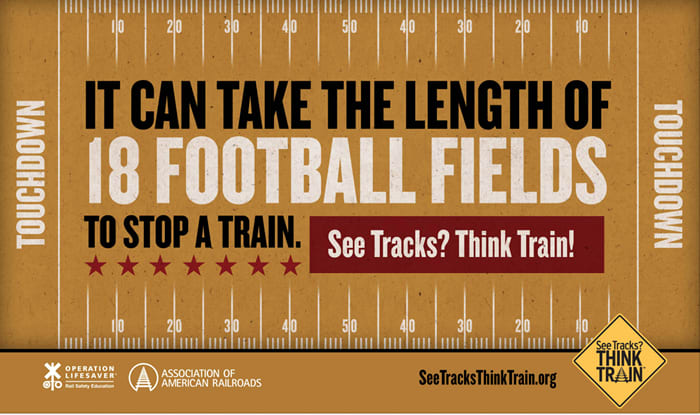
Always expect a train. Trains don’t run on set schedules. They can be on any track, at any time, going in either direction. When locomotive engineers see a vehicle or person on the tracks in the path of their train, they can only sound the warning horn and apply the emergency brakes. A train in emergency braking will stop, but not in time to avoid this collision. The average freight train takes over a mile to stop in emergency braking.
Always yield the right of way to the train. The train cannot yield to you. More than half of all motor vehicle-train collisions occur at crossings equipped with automatic signals. It’s because some drivers choose to drive around the gates or through flashing red lights because they think they can beat the train or they assume either a stopped train has activated the signals or the signals are malfunctioning.
Never ignore active warnings at crossings because of what you think you see. Locomotives are huge — 17 feet high and 10 feet wide. As a result, they appear to be traveling much slower than you think when viewed from a slight angle at the crossing. The combination of the size and angle creates this illusion. The parallel lines of the rails converging toward the horizon contribute to the illusion and fool your mind into thinking the train is farther away than it actually is.
Keep in mind that trains will arrive at a crossing faster than you anticipate. One in four crashes occurring at highway-rail crossings takes place when drivers run into the side of the train. Often, it’s because the driver is traveling too fast for conditions, such as darkness, rainy weather, or fog. Also, many drivers “overdrive their headlights” — drive too fast to be able to stop in the distance illuminated.
Don't try to pass another vehicle when you see advance-warning signs indicating a rail-highway crossing ahead. The vehicle being passed may obstruct a clear view of the tracks, or vehicle speed while passing may be too great to stop in time.
Before starting across the tracks, be sure there's room to get completely across. Many crossings are on a surface higher than the roadway. Shifting gears with a manual transmission while going across this raised surface may cause the vehicle to stall on the tracks. If your vehicle is ever stalled or trapped on the tracks and a train is approaching, quickly get yourself and all other passengers out! Don’t try to take any other items with you.
When running away from a vehicle stuck on tracks, run away from the tracks at an angle in the direction of the approaching train. When the train strikes the vehicle, it will send flying metal and glass ahead of and outward from the locomotive. If a train is not approaching when a vehicle is stuck on the tracks, you still need to get yourself and all other passengers out of the vehicle and to a safe location. At crossings there are signs with a toll-free number to call the railroad directly and warn employees of stalled vehicles or other problems at the crossing.
When a crossing has more than one track, don’t try to cross immediately after the end of the train passes — there may be another train approaching on the second track. Many crossing crashes have resulted because of impatience or inattentiveness at multiple-track crossings. You’ll always know how many tracks are at the crossing by observing a sign posted under the crossbuck.
More Safety

Fleet Manager’s Ultimate Playbook: Navigating the New Standard in OEM Connectivity
Rising operating costs, driver safety concerns, and unplanned downtime are putting unprecedented pressure on modern fleets. Discover how fleet managers use embedded OEM connectivity and real-time vehicle data to cut TCO, prevent downtime, and protect drivers without aftermarket telematics hardware.
Read More →
From Driver Well-Being to EV Charging | AF News Recap
Mental health belongs in the fleet safety conversation. This week, we’re looking at five ways fleets can support employee well-being before a crisis, plus Holman’s expansion in Mexico, new one-day Fleet Forward passes, and why EV charging demand is outpacing infrastructure growth.
Read More →
Nexar-Nauto Merger Aims to Give Fleets Better Safety Intelligence Through Larger Driving Dataset
Stefan Heck tells Automotive Fleet that combining more than 10 billion miles of driving history with Nexar's AI models will give fleets deeper insights into driver risk and roadway conditions than either company could provide independently.
Read More →
Don't Wait for a Crisis: 5 Ways to Build Mental Health Into Your Fleet Safety Program
For Suicide Prevention Month, fleet and safety leaders have an opportunity to put mental health where it belongs: at the center of workplace safety.
Read More →
How Camera Data Can Strengthen a Fleet’s Insurance Renewal
Insights from a commercial insurance carrier and a broker show how fleets can turn video telematic data, driver coaching, and improved claims results into a stronger case at insurance renewal.
Read More →
The Safest Fleets Aren’t the Ones with the Most Technology
You’ve made the telematics investment. Here’s how to capture the other half of its value and build the safest fleet on the road.
Read More →
Hidden in Plain Sight: Fleet Compliance Risks
Fleet compliance isn't just about having policies — it's about consistently enforcing them. This practical guide reveals six hidden compliance risks common in public sector and shared fleet operations and outlines proven strategies to improve visibility, accountability, and audit readiness
Read More →
NETS Sets 2026 Fleet Safety Benchmark Conference for Indianapolis
The Sept. 15–17 program will feature fleet benchmarking data, case studies, emerging technologies, and implementation strategies while running alongside the NSC Safety Congress & Expo.
Read More →
Off-the-Job Crashes Account for 43% of Employers’ $61.7 Billion Crash Burden
NETS quantifies costs dispersed across fleet, risk, HR, and other departments while providing new per-crash benchmarks for employers.
Read More →
Ram Recalls More Than 1.27 Million 1500 Pickups for Seat Belt Anchor Issue
The recall affects certain 2019-2026 Ram 1500 pickups that may have improperly attached second-row seat belt buckle anchors.
Read More →