




Research Raises Concerns Over Aftermarket Crash Parts
PROSSER, WA - New collision-repair research is raising concerns about the safety of some aftermarket crash parts requested by some insurance companies to settle claims, according to the Society of Collision Repair Specialists (SCRS).
PROSSER, WA - New collision-repair research is raising concerns about the safety of some aftermarket crash parts requested by some insurance companies to settle claims, according to the Society of Collision Repair Specialists (SCRS).
The research, overseen by SCRS National Director Toby Chess, compared randomly selected OEM parts with aftermarket structural replacement parts, including front and rear bumper reinforcement beams, radiator core supports, bumper brackets and bumper energy absorbers.
According to SCRS, tests revealed "significant differences" in the aftermarket parts' construction and materials used, compared to the OEM parts. These differences were reflected in the parts' effectiveness in the transfer of energy resulting from a collision, SCRS said.
The aftermarket parts also had an impact on the effectiveness and response of the vehicle safety restraint system, potentially affecting airbag functionality, SCRS added. However, the research also found that when aftermarket crash parts manufacturers pay particular attention to using the same materials as the OEM and employ credible third-party testing, the parts perform much better in crash tests.
"This is a serious issue that has not received enough attention from the industry in the past," Chess said. "These parts are critically affecting the structural design of a vehicle in its post-repair state."
[PAGEBREAK]
As a result of the research, the Auto Body Parts Association has advised its members to distribute and supply only aftermarket crash parts that have been sufficiently tested. For parts that lack such testing, ABPA recommends "discontinuation of the production and sale of these part types as well as immediate notification to the estimating systems to eliminate these parts from their database."
A presentation summarizing the research is available at www.scrs.com. Chess has made a number of presentations about the research at recent industry conferences.
Chess stressed that the collision repair industry needs to hold parts manufacturers accountable for the quality and safety of their products.
"The OEMs put a lot of money into research and development to ensure that the end product operates, reacts and sustains damage in a very specific way," Chess explained. "Any replacement part made available to the market should be required to have that same expectation of performance."
SCRS Executive Director Aaron Schulenburg said a system needs to be in place so that aftermarket parts installed but later deemed unsafe can be readily recalled through consumer notification. "It is not enough to accept that suppliers will deal with the issue on a case-by-case basis if or when there is a problem," Schulenburg said. "If the process and infrastructure are not in place to support the ability to notify consumers when a problem has been identified, then we need to significantly fix that infrastructure before more parts are sold."
Efforts to bring attention to such concerns about aftermarket crash parts seem to be having an impact. Insurance company GEICO last week implemented a policy shift, announcing it would no longer specify aftermarket replacement parts for bumper reinforcements, energy absorbers and brackets in the repair of customers' vehicles.
The company said it planned to gather additional information about aftermarket bumper reinforcements, absorbers and brackets; GEICO didn't rule out eventually returning to its previous policy if its own research supported that decision.
More Safety

Nexar-Nauto Merger Aims to Give Fleets Better Safety Intelligence Through Larger Driving Dataset
Stefan Heck tells Automotive Fleet that combining more than 10 billion miles of driving history with Nexar's AI models will give fleets deeper insights into driver risk and roadway conditions than either company could provide independently.
Read More →
Don't Wait for a Crisis: 5 Ways to Build Mental Health Into Your Fleet Safety Program
For Suicide Prevention Month, fleet and safety leaders have an opportunity to put mental health where it belongs: at the center of workplace safety.
Read More →
How Camera Data Can Strengthen a Fleet’s Insurance Renewal
Insights from a commercial insurance carrier and a broker show how fleets can turn video telematic data, driver coaching, and improved claims results into a stronger case at insurance renewal.
Read More →
The Safest Fleets Aren’t the Ones with the Most Technology
You’ve made the telematics investment. Here’s how to capture the other half of its value and build the safest fleet on the road.
Read More →
Hidden in Plain Sight: Fleet Compliance Risks
Fleet compliance isn't just about having policies — it's about consistently enforcing them. This practical guide reveals six hidden compliance risks common in public sector and shared fleet operations and outlines proven strategies to improve visibility, accountability, and audit readiness
Read More →
NETS Sets 2026 Fleet Safety Benchmark Conference for Indianapolis
The Sept. 15–17 program will feature fleet benchmarking data, case studies, emerging technologies, and implementation strategies while running alongside the NSC Safety Congress & Expo.
Read More →
Off-the-Job Crashes Account for 43% of Employers’ $61.7 Billion Crash Burden
NETS quantifies costs dispersed across fleet, risk, HR, and other departments while providing new per-crash benchmarks for employers.
Read More →
Ram Recalls More Than 1.27 Million 1500 Pickups for Seat Belt Anchor Issue
The recall affects certain 2019-2026 Ram 1500 pickups that may have improperly attached second-row seat belt buckle anchors.
Read More →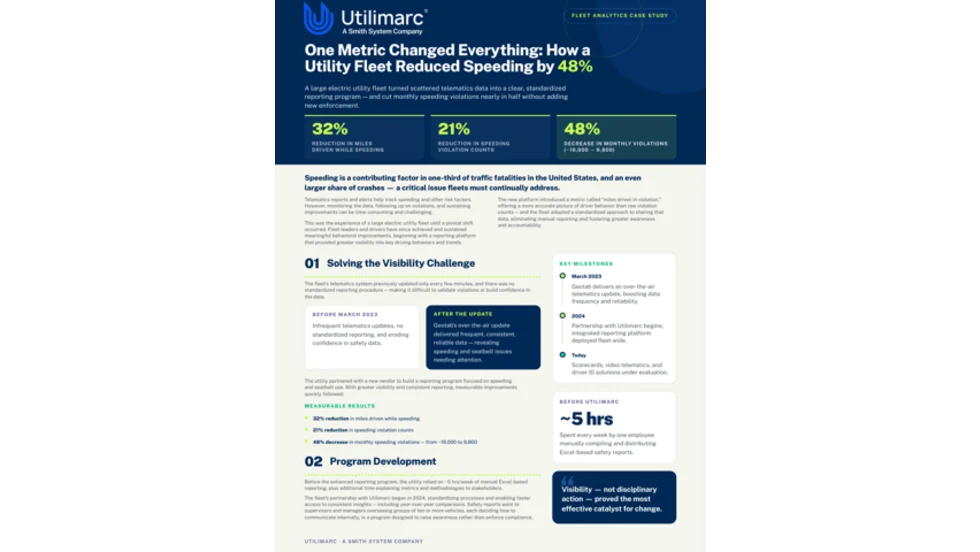
How Better Visibility Cut Speeding Violations by 48%
Fleet leaders don't need more data, they need clearer visibility into what the data is saying. This case study explores how one utility replaced speeding-event counts with a single metric — miles driven in violation — to strengthen safety and significantly reduce speeding violations.
Read More →
Operation Safe Driver Week: Why the Industry's Oldest Safety Campaign Still Matters to Fleets
A look at how a 2007 enforcement initiative became one of the most consequential weeks on the fleet safety calendar, and what it means for your drivers in 2026.
Read More →