




Remembering Volvo's Role in Seat Belt Development
IRVINE, Calif. --- Pioneered by laws in New York and Texas in 1985, safety belts are now a requirement in all states. What many motorists don't know, however, is the role that Volvo played in developing seat belts.
IRVINE, Calif. --- Pioneered by laws in New York and Texas in 1985, safety belts are now a requirement in all states. What many motorists don't know, however, is the role that Volvo played in developing seat belts.
"There's a little bit of 'Volvo' in every vehicle on the American road," says Doug Speck, president and CEO of Volvo Cars of North America. Such a bold assertion is based on Nils Bohlin's development of the three-point safety belt. No single safety devise has saved more lives than the three-point safety belt. So, as the heavy-driving Memorial Day holiday weekend approaches and the national "Click it or Ticket" campaign continues, it's appropriate to take a look at the origins of this life-saving devise.
In the 1950s Bohlin, a passionate inventor, brought his background with aviation concepts for pilots and his concern for human safety to the Swedish automaker. During this time the lap belt -- a safety belt anchored at two points for use across the occupant's thighs/hips -- was the technology of the day. These crude implements managed to hold vehicle occupants in place, but were plagued by a variety of health issues resulting from the forces against the body during a crash. Lap belts were mostly used by race car drivers at that time, and were only available to average automotive consumer as an option, and a not very popular one at that. In fact, given the chose between lap belts and white wall tires, white walls won.
The ideas of Nils Bohlin came to the attention of Gunnar Engellau, then president of Volvo Car Corporation in Sweden. Gunnar, who lost a relative in a car crash, brought Bohlin into Volvo and supported the continuation of his work. Applying the concepts of pilot restraint in the cockpit of a plane, Bohlin engineered a system combating "decelerative" forces, such as the effect of abrupt stops characteristic in a car crash.
In 1958 Nils Bohlin, Volvo design engineer, patented the "Basics of Proper Restraint Systems for Car Occupants," better known as a three-point safety belt. A year later, Bohlin's lap-and-shoulder belt was introduced by Volvo as standard equipment on all of its cars, in Sweden. Today, the three-point safety belt -- not the first but the modern seatbelt -- is now a standard safety device in all cars and trucks.
The three-point safety belt was unique in that it encompassed both a lap and a shoulder portion with three attachment points (one shoulder, two hips). Volvo's design allowed for the single belt to "slip" through the center attaching point, thereby increasing comfort and making adjusting a simple task.
In 1959 Volvo introduced the three-point safety belt into the United States, a year after a British study strongly advocated belt wearing, revealing that a "first survey" of their effectiveness in the United Kingdom showed they would reduce the likelihood of death and serious injury by 60 percent.
Fast-forward almost 20 years when gradually states began to make the use of safety belts mandatory within their borders.
Tens, if not hundreds, of thousands of lives have been saved. In fact, according to United States National Highway Traffic Safety Administration (NHTSA), safety belts have saved over 200,000 lives.
"Statistics clearly indicate that safety belts save lives," said Speck. "As we approach the Memorial Day weekend, one of the busiest driving periods of the year, initiatives like 'Click It or Ticket' bring awareness that we must do everything that we can to encourage people to wear them."
Nationally, nearly one in five Americans (18 percent nationally) still fail to regularly wear their seatbelts when driving or riding in a motor vehicle.
) -
More Safety
The Safest Fleets Aren’t the Ones with the Most Technology
You’ve made the telematics investment. Here’s how to capture the other half of its value and build the safest fleet on the road.
Read More →
Hidden in Plain Sight: Fleet Compliance Risks
Fleet compliance isn't just about having policies — it's about consistently enforcing them. This practical guide reveals six hidden compliance risks common in public sector and shared fleet operations and outlines proven strategies to improve visibility, accountability, and audit readiness
Read More →
NETS Sets 2026 Fleet Safety Benchmark Conference for Indianapolis
The Sept. 15–17 program will feature fleet benchmarking data, case studies, emerging technologies, and implementation strategies while running alongside the NSC Safety Congress & Expo.
Read More →
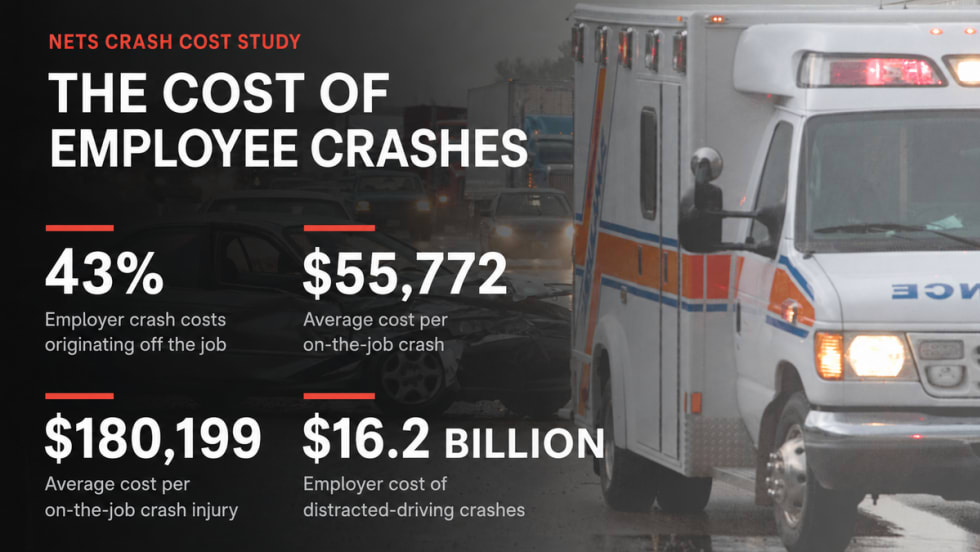
Off-the-Job Crashes Account for 43% of Employers’ $61.7 Billion Crash Burden
NETS quantifies costs dispersed across fleet, risk, HR, and other departments while providing new per-crash benchmarks for employers.
Read More →
Ram Recalls More Than 1.27 Million 1500 Pickups for Seat Belt Anchor Issue
The recall affects certain 2019-2026 Ram 1500 pickups that may have improperly attached second-row seat belt buckle anchors.
Read More →
How Better Visibility Cut Speeding Violations by 48%
Fleet leaders don't need more data, they need clearer visibility into what the data is saying. This case study explores how one utility replaced speeding-event counts with a single metric — miles driven in violation — to strengthen safety and significantly reduce speeding violations.
Read More →
Operation Safe Driver Week: Why the Industry's Oldest Safety Campaign Still Matters to Fleets
A look at how a 2007 enforcement initiative became one of the most consequential weeks on the fleet safety calendar, and what it means for your drivers in 2026.
Read More →
Nexar-Nauto Merger Aims to Give Fleets Better Safety Intelligence Through Larger Driving Dataset
Stefan Heck tells Automotive Fleet that combining more than 10 billion miles of driving history with Nexar's AI models will give fleets deeper insights into driver risk and roadway conditions than either company could provide independently.
Read More →
From Silos to Solutions: Relationship Management for Safer Fleets
From telematics adoption and driver accountability to policy consistency and risk mitigation, this episode breaks down what it really takes to build a safer fleet culture without slowing business down.
Read More →
IIHS Launches First Commercial Vehicle Safety Evaluations
The Insurance Institute for Highway Safety has begun evaluating heavy-duty pickups and cargo vans for driver protection. Which models earned top marks?
Read More →