




Protective ‘Sixth Sense’ Abandons Drivers While Texting
Researchers at the University of Houston and Texas A&M study and compare the driving performances of volunteers in different distraction-laden scenarios.
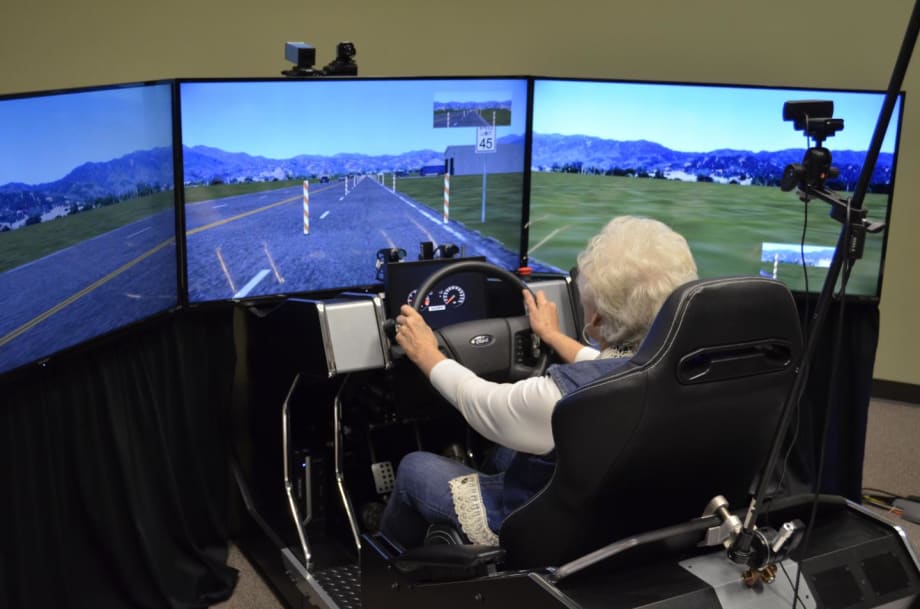
One of the study's 59 volunteers sits in a high-fidelity driving simulator. Photo by Malcolm Dcosta. Photo courtesy of the University of Houston.
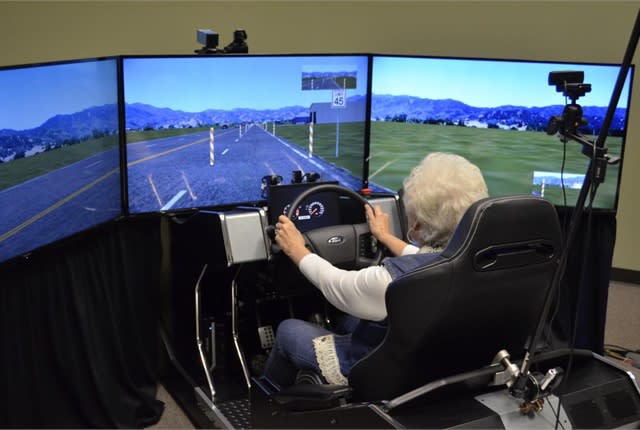
One of the study's 59 volunteers sits in a high-fidelity driving simulator. Photo by Malcolm Dcosta. Photo courtesy of the University of Houston.
On the unsafe driving spectrum, how does texting while driving compare to driving while emotionally upset? Or driving while lost in your own thoughts and daydreams?
While much has been made about the dangers of texting and driving, less attention has been focused on the age-old distractions of being absent minded or upset while driving. A team of researchers from the University of Houston (UH) and the Texas A&M Transportation Institute (TTI) set out to focus on all three of these important factors.
Led by Ioannis Pavlidis from UH and Robert Wunderlich of TTI, the research studied how drivers behave when they’re absent minded, emotionally charged, or engaged in texting. The work was funded, in part, by the Toyota Class Action Settlement Safety Research and Education Program.
The study looked at 59 volunteers who were asked to drive the same segment of highway four times — under “normal conditions” while being focused on driving, while distracted with cognitively challenging questions, while distracted with emotionally charged questions, and while preoccupied with texting trivialities. To avoid bias, the order of the drives was randomized.
In all three interventions — absent minded, emotional, and texting — the researchers found that the drivers’ handling of the wheel became jittery. But this jittery handling resulted in significant lane deviations and unsafe driving only in the case of texting distractions. In the case of absent-minded and emotionally charged distractions, jittery steering resulted in straighter trajectories with respect to a normal drive and safer driving.
“A likely explanation for this paradox is the function performed by a part of the brain called the anterior cingulate cortex, or ACC,” Pavlidis said. “ACC is known to automatically intervene as an error corrector when there is conflict. In this case, the conflict comes from the cognitive, emotional and sensorimotor, or texting, stressors. This raises the levels of physiological stress, funneling ‘fight or flight’ energy to the driver’s arms, resulting in jittery handling of the steering wheel.”
What happens when the brain’s ACC automatically intervenes, Pavlidis said, is that it counterbalances any strong jitter to the left with an instant equally strong jitter to the right and vice versa. The end effect of this forceful action is nullification of any veering to the left or the right of the lane and, thus, very straight driving.
For ACC to perform this corrective function, it needs support from the driver’s eye-hand coordination loop. If this loop breaks, which it does when the driver texts, then ACC fails and the jittery handling of the steering wheel is left unchecked, resulting in a significant lane deviation and possible accident.
“The driver’s mind can wander and his or her feelings may boil, but a sixth sense keeps a person safe at least in terms of veering off course,” Pavlidis said. “What makes texting so dangerous is that it wreaks havoc into this sixth sense. Self-driving cars may bypass this and other problems, but the moral of the story is that humans have their own auto systems that work wonders, until they break.”
Pavlidis and Wunderlich indicated they think the scientific and manufacturing communities can benefit from their team’s study. Their research uncovers the mechanism that makes moderate cognitive and emotional distractions relatively safe — as long as the driver’s natural tendency to handle multiple tasks isn't overwhelmed.
“Following up on the results of our science study, we are currently looking into the development of a car system to monitor outward driving behaviors, such as steering jitter or lane deviation, as well as the internal state of the driver that causes them,” Pavlidis said. “This system, which I call ‘stressalyzer,’ a play on the word breathalyzer, may serve not only as a ‘black box’ in car accidents, but also as a driver alert and prevention mechanism, since it will continuously sense a driver drifting to distracted mode.”
To access the full scientific study, click here.
More Safety
Tips for Driving Safely on Halloween Night
This video features a reminder from the Connecticut Department of Transportation (DOT) and the Connecticut Police Chiefs Association, urging drivers to prioritize safety this Halloween.
Read More →
IIHS Crash Avoidance Tests Reveal Safety Gaps in Cargo Vans and Work Trucks
New crash-avoidance ratings from the Insurance Institute for Highway Safety reveal inconsistent performance among commercial vehicles, with several popular cargo vans and heavy-duty pickups struggling to avoid collisions with other vehicles and pedestrians.
Read More →
What’s Next for Fleet? Safety, AI & Industry Recognition | AF News Recap
Could your company's culture be encouraging distracted driving? This week, we're exploring how workplace expectations affect driver safety, what AI, EVs, and autonomous vehicles could mean for the future of fleet management, and how fleet professionals can strengthen their award nominations.
Read More →
Does Your Fleet's Culture Encourage Distracted Driving?
What happens when the people responsible for enforcing safety rules are the ones setting the wrong example? The answer may reveal why some of the biggest risks to fleet drivers have little to do with what's written in the employee handbook.
Read More →
Fleet Manager’s Ultimate Playbook: Navigating the New Standard in OEM Connectivity
Rising operating costs, driver safety concerns, and unplanned downtime are putting unprecedented pressure on modern fleets. Discover how fleet managers use embedded OEM connectivity and real-time vehicle data to cut TCO, prevent downtime, and protect drivers without aftermarket telematics hardware.
Read More →
From Driver Well-Being to EV Charging | AF News Recap
Mental health belongs in the fleet safety conversation. This week, we’re looking at five ways fleets can support employee well-being before a crisis, plus Holman’s expansion in Mexico, new one-day Fleet Forward passes, and why EV charging demand is outpacing infrastructure growth.
Read More →
Nexar-Nauto Merger Aims to Give Fleets Better Safety Intelligence Through Larger Driving Dataset
Stefan Heck tells Automotive Fleet that combining more than 10 billion miles of driving history with Nexar's AI models will give fleets deeper insights into driver risk and roadway conditions than either company could provide independently.
Read More →
Don't Wait for a Crisis: 5 Ways to Build Mental Health Into Your Fleet Safety Program
For Suicide Prevention Month, fleet and safety leaders have an opportunity to put mental health where it belongs: at the center of workplace safety.
Read More →
How Camera Data Can Strengthen a Fleet’s Insurance Renewal
Insights from a commercial insurance carrier and a broker show how fleets can turn video telematic data, driver coaching, and improved claims results into a stronger case at insurance renewal.
Read More →
The Safest Fleets Aren’t the Ones with the Most Technology
You’ve made the telematics investment. Here’s how to capture the other half of its value and build the safest fleet on the road.
Read More →