




Police See More Cases of Extreme Drunk Driving
PROVIDENCE, RI --- Across the country, police are seeing more incidents of extreme drunk driving, with recorded blood-alcohol levels reaching limits that doctors say would be lethal to most people, ABC News reported.
PROVIDENCE, RI --- Across the country, police are seeing more incidents of extreme drunk driving, with recorded blood-alcohol levels reaching limits that doctors say would be lethal to most people, ABC News reported.
A Rhode Island man arrested this week for drunk driving had a potentially lethal blood-alcohol level that set a new state record. Stanley Kobierowski, 34, was arrested in Providence, R.I., after smashing his car into an electronic message sign, ABC News reported. According to state police, he allegedly blew a .489 and .491 on a Breathalyzer at the accident scene. That's more than six times the state's legal limit. He was transferred to a local hospital and held for two days until he was deemed sober enough to be arraigned, police said.
There are no national statistics on BAC levels at time of arrest. But record-breaking levels have spurred some states to require convicted drunk drivers who have tested well over the legal limit to install ignition interlock devices. States with interlock laws are divided between those that require the device for repeat offenders and those based on high BAC levels even for first-time offenders. Earlier this month, Florida joined Kansas, Virginia and West Virginia in requiring first-time convicted drunk drivers arrested with blood alcohol content levels of more than .15 to install the devices in their cars, ABC News reported.
The trend raises the question: How do these drivers even make it into the driver's seat?
In November 2007, a 130-pound woman was arrested in Oregon with a blood-alcohol level of .55. That's seven times the state's legal limit and above the .4 concentration considered lethal. An Oregon judge set bail for Meagan Harper, 30, at $50,000.
A BAC level of .55, according to the Rutgers University Center of Alcohol Studies, would require a 100-pound man or woman to consume roughly 10 drinks in an hour or a 200-pound man to drink about six drinks each hour for four hours.
In December 2007, Terri Comer, a 42-year-old Oregonian, was arrested with a .72 blood alcohol level, nine times the state's legal limit. Klanath County sheriff's deputies discovered the woman behind the wheel of her Toyota in a coma. Police said they brought her to a local hospital for treatment. Photos of the scene show her car parked in a snow bank just feet from an electronic sign warning drivers not to drink and drive.
"Levels between .4 and .5 are fatal in most cases," said Dr. Nicholas Pace, a professor at NYU School of Medicine. "These situations involve people with incredibly high BAC levels but who nevertheless are functioning enough to get behind a wheel. For someone to be walking around with that much alcohol in their body, he has got to have an increased tolerance, which probably means he's an alcoholic.
"If a naïve drinker, an inexperienced drinker, had a BAC approaching those levels, he would normally die," he said.
A 100-pound male who consumes 10 drinks (12 oz. beers) in one hour still would only have a BAC of .374, just under the average level of lethality. Pace estimated Kobierowski, the Rhode Island man, consumed 10 to 14 drinks over the course of an hour or two.
"A .1 might be after five drinks in an hour, reaction is greatly slowed, muscle control is impaired, they're uncoordinated. Seven to 10 drinks in an hour, you're losing bladder control. Somebody that drinks 10 to 14 drinks in an hour can really get into trouble, they're approaching the lethal range of .4 to .5," he told ABC News.
Other factors that can affect BAC include weight, gender, underlying medical conditions and the amount of food consumed while drinking.
Perhaps the highest recorded BAC level in a person who lived was reported in 2005 in the southern Bulgarian city of Plovdiv. According to the CBC and other media reports, doctors tested a man's blood-alcohol level five times before accepting it was .914 -- twice the amount considered to be fatal.
More Safety

Nexar-Nauto Merger Aims to Give Fleets Better Safety Intelligence Through Larger Driving Dataset
Stefan Heck tells Automotive Fleet that combining more than 10 billion miles of driving history with Nexar's AI models will give fleets deeper insights into driver risk and roadway conditions than either company could provide independently.
Read More →
Don't Wait for a Crisis: 5 Ways to Build Mental Health Into Your Fleet Safety Program
For Suicide Prevention Month, fleet and safety leaders have an opportunity to put mental health where it belongs: at the center of workplace safety.
Read More →
How Camera Data Can Strengthen a Fleet’s Insurance Renewal
Insights from a commercial insurance carrier and a broker show how fleets can turn video telematic data, driver coaching, and improved claims results into a stronger case at insurance renewal.
Read More →
The Safest Fleets Aren’t the Ones with the Most Technology
You’ve made the telematics investment. Here’s how to capture the other half of its value and build the safest fleet on the road.
Read More →
Hidden in Plain Sight: Fleet Compliance Risks
Fleet compliance isn't just about having policies — it's about consistently enforcing them. This practical guide reveals six hidden compliance risks common in public sector and shared fleet operations and outlines proven strategies to improve visibility, accountability, and audit readiness
Read More →
NETS Sets 2026 Fleet Safety Benchmark Conference for Indianapolis
The Sept. 15–17 program will feature fleet benchmarking data, case studies, emerging technologies, and implementation strategies while running alongside the NSC Safety Congress & Expo.
Read More →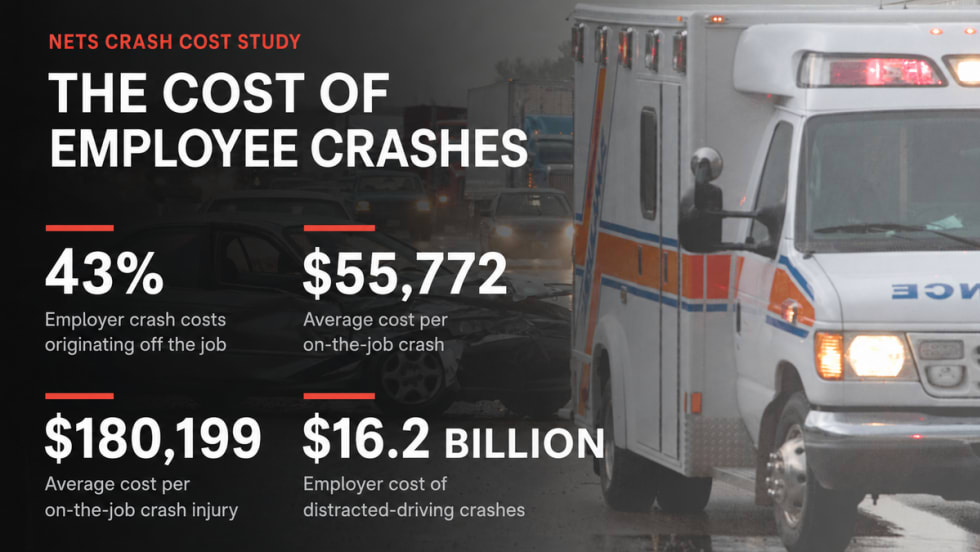
Off-the-Job Crashes Account for 43% of Employers’ $61.7 Billion Crash Burden
NETS quantifies costs dispersed across fleet, risk, HR, and other departments while providing new per-crash benchmarks for employers.
Read More →
Ram Recalls More Than 1.27 Million 1500 Pickups for Seat Belt Anchor Issue
The recall affects certain 2019-2026 Ram 1500 pickups that may have improperly attached second-row seat belt buckle anchors.
Read More →
How Better Visibility Cut Speeding Violations by 48%
Fleet leaders don't need more data, they need clearer visibility into what the data is saying. This case study explores how one utility replaced speeding-event counts with a single metric — miles driven in violation — to strengthen safety and significantly reduce speeding violations.
Read More →
Operation Safe Driver Week: Why the Industry's Oldest Safety Campaign Still Matters to Fleets
A look at how a 2007 enforcement initiative became one of the most consequential weeks on the fleet safety calendar, and what it means for your drivers in 2026.
Read More →