





See Also: 11% of Drivers Confess to Extreme Speeding During Darkest Days of Pandemic
Pilot Project Succeeds at Curbing Speeding
A trial anti-speeding project used a combination of tactics — enforcement, engineering, and public outreach — to reduce speeding on a rural road in Maryland.
June 17, 2022
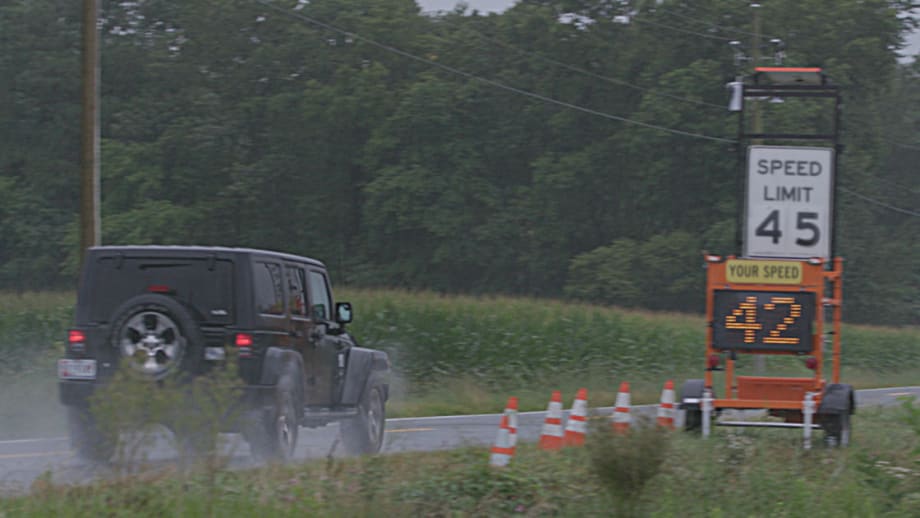
A pilot project on a rural road used multiple strategies to slow traffic including speed feedback signs, which show drivers how fast they are going as they pass.
Photo: IIHS
2 min to read
During a multi-pronged, anti-speeding pilot project on a rural road in Maryland, researchers found that average speeds fell 9% and there was a 78% reduction in the odds that a vehicle exceeded the speed limit by any amount. In addition, there was an 80% reduction in the odds of a driver going more than 10 mph over the limit.
The Governors Highway Safety Association (GHSA), the Insurance Institute for Highway Safety (IIHS), and the National Road Safety Foundation (NRSF) joined forces to fund and spearhead the project.
The project used a combination of tactics — enforcement, engineering, and public outreach — to test solutions aimed at curbing speeding, one of the most persistent and dangerous hazards on U.S. roadways.
The multipronged effort took place on MD 367, a two-lane road in Bishopville on Maryland’s Eastern Shore. It focused on a 2.4-mile section of the road that is a popular route for beachgoers in the summer and is known to have a speeding problem.
Step one of the pilot involved infrastructure engineering. In July 2021, the lanes of the road were narrowed by doubling the width of the painted edge and center lines to 10 inches to help slow traffic. In addition, speed feedback signs, which show drivers how fast they are going as they pass, were installed in two locations.
Simultaneously, state highway officials launched a public outreach campaign. Flyers highlighting the lane narrowing, planned speed enforcement, and messaging were distributed to local residents and businesses. Signs announcing the enforcement and encouraging drivers to slow down went up along the corridor.
The third prong — enforcement — began in August 2021. Officials conducted four five-day waves of enhanced, high-visibility enforcement, which resulted in more than 120 speeding citations. The enforcement was accompanied by paid advertising that included social media messages, billboards, and advertisements in newspapers and on the navigation app Waze.
The results during the trial were encouraging: Average speeds fell 9% and the odds that a vehicle on the road was speeding dropped by three-quarters.
However, the effects of the three-pronged pilot program were temporary. The publicity and high-visibility enforcement efforts concluded at the end of August. Afterward, average speeds were just 2% lower than before the program began. And while the odds of speeding by any amount were 37% lower, the odds of a driver going more than 10 mph over the posted limit were actually 12% higher.
The study demonstrates that enforcement, engineering, and education go hand-in-hand when it comes to reducing speeding, say experts at all three organizations. The trio is planning a similar pilot project for an urban area for later this year.
More Safety

Sponsored•October 1, 2026
Fleet Manager’s Ultimate Playbook: Navigating the New Standard in OEM Connectivity
Rising operating costs, driver safety concerns, and unplanned downtime are putting unprecedented pressure on modern fleets. Discover how fleet managers use embedded OEM connectivity and real-time vehicle data to cut TCO, prevent downtime, and protect drivers without aftermarket telematics hardware.
Read More →
From Driver Well-Being to EV Charging | AF News Recap
Mental health belongs in the fleet safety conversation. This week, we’re looking at five ways fleets can support employee well-being before a crisis, plus Holman’s expansion in Mexico, new one-day Fleet Forward passes, and why EV charging demand is outpacing infrastructure growth.
Read More →
Nexar-Nauto Merger Aims to Give Fleets Better Safety Intelligence Through Larger Driving Dataset
Stefan Heck tells Automotive Fleet that combining more than 10 billion miles of driving history with Nexar's AI models will give fleets deeper insights into driver risk and roadway conditions than either company could provide independently.
Read More →
Don't Wait for a Crisis: 5 Ways to Build Mental Health Into Your Fleet Safety Program
For Suicide Prevention Month, fleet and safety leaders have an opportunity to put mental health where it belongs: at the center of workplace safety.
Read More →
How Camera Data Can Strengthen a Fleet’s Insurance Renewal
Insights from a commercial insurance carrier and a broker show how fleets can turn video telematic data, driver coaching, and improved claims results into a stronger case at insurance renewal.
Read More →
The Safest Fleets Aren’t the Ones with the Most Technology
You’ve made the telematics investment. Here’s how to capture the other half of its value and build the safest fleet on the road.
Read More →
Sponsored•August 7, 2026
Hidden in Plain Sight: Fleet Compliance Risks
Fleet compliance isn't just about having policies — it's about consistently enforcing them. This practical guide reveals six hidden compliance risks common in public sector and shared fleet operations and outlines proven strategies to improve visibility, accountability, and audit readiness
Read More →
NETS Sets 2026 Fleet Safety Benchmark Conference for Indianapolis
The Sept. 15–17 program will feature fleet benchmarking data, case studies, emerging technologies, and implementation strategies while running alongside the NSC Safety Congress & Expo.
Read More →
Off-the-Job Crashes Account for 43% of Employers’ $61.7 Billion Crash Burden
NETS quantifies costs dispersed across fleet, risk, HR, and other departments while providing new per-crash benchmarks for employers.
Read More →
Ram Recalls More Than 1.27 Million 1500 Pickups for Seat Belt Anchor Issue
The recall affects certain 2019-2026 Ram 1500 pickups that may have improperly attached second-row seat belt buckle anchors.
Read More →