




NY Investigation Finds General Compliance With State's Anti-Steering Rules for Insurers
ALBANY, NY --- Auto insurance companies operating in New York have not systematically violated the state's insurance law that gives consumers the right to choose where they want their vehicles repaired after a collision, Insurance Superintendent Eric Dinallo said last week.
ALBANY, NY --- Auto insurance companies operating in New York have not systematically violated the state's insurance law that gives consumers the right to choose where they want their vehicles repaired after a collision, Insurance Superintendent Eric Dinallo said last week.
However, in some isolated instances, representatives of some insurance companies engaged in practices that could be considered violations of the state's insurance law or regulations by providing improper or inaccurate information, Dinallo said. His announcement was based on an investigation by the New York State Insurance Department. The probe was launched after a statewide collision-repair trade association complained that insurance companies were illegally "steering" customers to designated collision repair shops.
Auto insurers are not permitted to require customers to choose "in network" providers.
"This very thorough investigation is reassuring in that it shows auto insurers are largely complying with the laws that preserve consumer choice," Dinallo said. "But it does raise some issues which the department is addressing directly with certain individual insurance companies. Consumers have the right to choose where they want their cars repaired after an accident. Companies are allowed to discuss the benefits of their programs, but they are not allowed to use the claims process to lead or mislead consumers into making a particular choice at what is usually a stressful time."
In addition to forbidding insurance companies from requiring consumers to repair their cars at a specific shop, Section 2610 of the Insurance Law also prohibits companies from recommending or suggesting to their insureds that repairs be done at a particular place or shop unless their insured expressly asks for a recommendation. That means a company cannot make a referral -- to its preferred program or repair shop, for example -- during the claims process unless and until their insured asks for one.
While most companies were found to comply fully with the Insurance Law and related regulations, the department found isolated instances of noncompliance, including where a company or its representative:
-- Required of some customers that a damaged vehicle be inspected at that company's drive-through facility, in apparent violation of a regulation requiring this inspection to take place at a time and place "reasonably convenient to the insured"
-- Set a "goal" of having 45-60 percent of repairable vehicles repaired at network shops and
-- Told an insured to bring his car to a network shop for inspection, and stated that the repairs could be done there, while another claim representative said repairs could be done at the network shop in half the time an out-of-network body shop would take.
"Consumers need to know their rights, and know that the Insurance Department stands ready to protect them," Dinallo said. "If your insurer tells you that you need to get your car inspected or repaired at a particular place, call the Insurance Department at 1-800-342-3736. If, unfortunately, you are in an accident and need to have your car repaired, call the department to find out your rights, or visit our website."
Dinallo said there are some basic rights of which consumers should be aware:
-- While an insurance company may discuss the benefits of its direct repair program, it cannot make you choose its auto repair shop. That choice is yours.
-- Except for window glass repair, an insurance company cannot recommend a particular shop unless you ask for a recommendation.
-- An insurance company cannot tell you to go to its shop to get your damaged car inspected. The insurer must meet you at some place and time reasonably convenient to you.
-- An insurance company cannot tell you that you have to repair your vehicle in order to get paid. If you have damage, the insurer must pay the cost of repairing that damage, whether or not you choose to repair the vehicle.
These New York state restrictions apply when a consumer files a claim with his or her own auto insurance company under his or her own policy. Claims filed with a third-party insurance company -- the insurance company covering a person who hit you, for example, even if that company is the same as yours -- are subject to different restrictions. A third-party company is allowed to recommend a particular repair shop, but still cannot require its use.
The Insurance Department's investigation began in May 2007 and was conducted by its Consumer Services Bureau, headed by Deputy Superintendent Steven Nachman and Assistant Deputy Superintendent Mitchel Gennaoui. The investigation was handled by Principal Insurance Examiner Barry Bistreich, Associate Insurance Examiners Daniel Bell and John Capuano, Senior Insurance Examiner Vince Palma and Insurance Examiner Golda Moore.
The investigation included a review of controls that insurers put in place to ensure compliance with the applicable laws, and of insurer tapes and file notes. It also included an on-site review of randomly sampled tapes and file notes from insurers, and of all complaints filed with the department related to alleged violations of the relevant laws.
More Safety

Nexar-Nauto Merger Aims to Give Fleets Better Safety Intelligence Through Larger Driving Dataset
Stefan Heck tells Automotive Fleet that combining more than 10 billion miles of driving history with Nexar's AI models will give fleets deeper insights into driver risk and roadway conditions than either company could provide independently.
Read More →
Don't Wait for a Crisis: 5 Ways to Build Mental Health Into Your Fleet Safety Program
For Suicide Prevention Month, fleet and safety leaders have an opportunity to put mental health where it belongs: at the center of workplace safety.
Read More →
How Camera Data Can Strengthen a Fleet’s Insurance Renewal
Insights from a commercial insurance carrier and a broker show how fleets can turn video telematic data, driver coaching, and improved claims results into a stronger case at insurance renewal.
Read More →
The Safest Fleets Aren’t the Ones with the Most Technology
You’ve made the telematics investment. Here’s how to capture the other half of its value and build the safest fleet on the road.
Read More →
Hidden in Plain Sight: Fleet Compliance Risks
Fleet compliance isn't just about having policies — it's about consistently enforcing them. This practical guide reveals six hidden compliance risks common in public sector and shared fleet operations and outlines proven strategies to improve visibility, accountability, and audit readiness
Read More →
NETS Sets 2026 Fleet Safety Benchmark Conference for Indianapolis
The Sept. 15–17 program will feature fleet benchmarking data, case studies, emerging technologies, and implementation strategies while running alongside the NSC Safety Congress & Expo.
Read More →
Off-the-Job Crashes Account for 43% of Employers’ $61.7 Billion Crash Burden
NETS quantifies costs dispersed across fleet, risk, HR, and other departments while providing new per-crash benchmarks for employers.
Read More →
Ram Recalls More Than 1.27 Million 1500 Pickups for Seat Belt Anchor Issue
The recall affects certain 2019-2026 Ram 1500 pickups that may have improperly attached second-row seat belt buckle anchors.
Read More →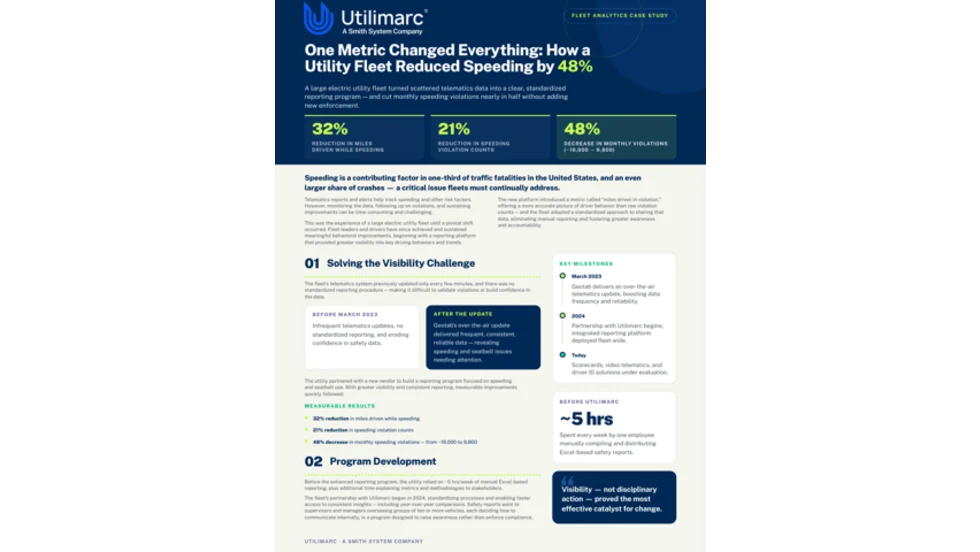
How Better Visibility Cut Speeding Violations by 48%
Fleet leaders don't need more data, they need clearer visibility into what the data is saying. This case study explores how one utility replaced speeding-event counts with a single metric — miles driven in violation — to strengthen safety and significantly reduce speeding violations.
Read More →
Operation Safe Driver Week: Why the Industry's Oldest Safety Campaign Still Matters to Fleets
A look at how a 2007 enforcement initiative became one of the most consequential weeks on the fleet safety calendar, and what it means for your drivers in 2026.
Read More →