


Related:
Video: Nissan Outlines Plans for Autonomous Drive Systems
Mercedes-Benz Shows Self-Driving Fuel-Cell Sedan Concept
Nissan Opens Silicon Valley Center to Focus on Autonomous Vehicle and Connected Car Technologies
 MENU
MENU SEARCH
Nissan and NASA have entered a five-year partnership to research and develop autonomous driving technology.
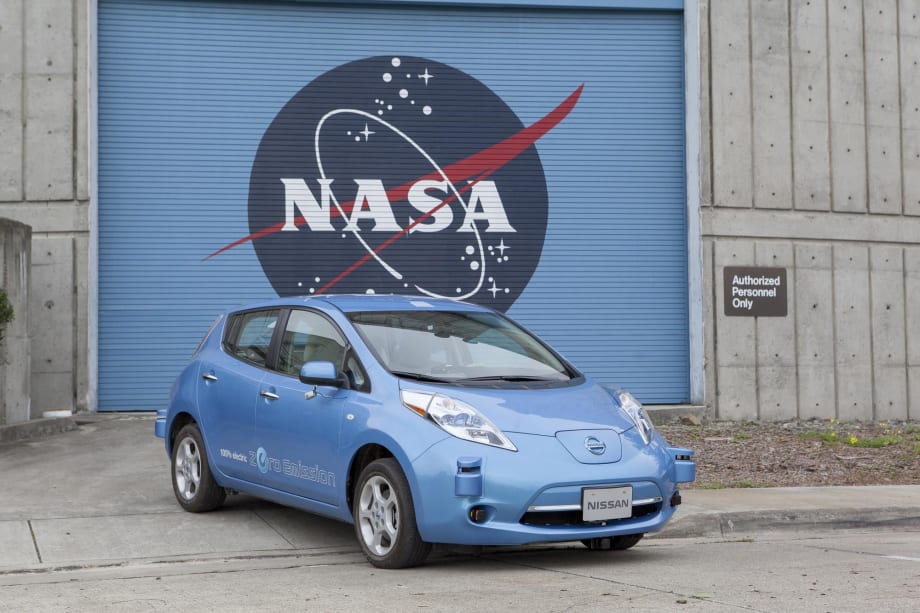
Photo courtesy of Nissan.
Photo courtesy of Nissan.
Nissan and NASA have entered a five-year partnership to research and develop autonomous driving technology.
The first vehicles to use the new systems will be zero emissions vehicles and tested at NASA’s Ames Research Center. More specifically the R&D program will focus on autonomous drive systems, human-machine interface solutions, network-enabled applications, and software analysis and verification.
NASA will use its data from its planetary rovers to develop various tests for the autonomous systems.
Nissan plans to introduce an autonomous driving vehicle by 2020, according to a press release from the car manufacturer.
"All of our potential topics of research collaboration with Nissan are areas in which Ames has strongly contributed to major NASA programs," said S. Pete Worden, Ames director. "Ames developed Mars rover planning software, robots onboard the International Space Station and Next Generation air traffic management systems to name a few. We look forward to applying knowledge developed during this partnership toward future space and aeronautics endeavors."

Rising operating costs, driver safety concerns, and unplanned downtime are putting unprecedented pressure on modern fleets. Discover how fleet managers use embedded OEM connectivity and real-time vehicle data to cut TCO, prevent downtime, and protect drivers without aftermarket telematics hardware.
Read More →
Mental health belongs in the fleet safety conversation. This week, we’re looking at five ways fleets can support employee well-being before a crisis, plus Holman’s expansion in Mexico, new one-day Fleet Forward passes, and why EV charging demand is outpacing infrastructure growth.
Read More →
Stefan Heck tells Automotive Fleet that combining more than 10 billion miles of driving history with Nexar's AI models will give fleets deeper insights into driver risk and roadway conditions than either company could provide independently.
Read More →
For Suicide Prevention Month, fleet and safety leaders have an opportunity to put mental health where it belongs: at the center of workplace safety.
Read More →
Insights from a commercial insurance carrier and a broker show how fleets can turn video telematic data, driver coaching, and improved claims results into a stronger case at insurance renewal.
Read More →
You’ve made the telematics investment. Here’s how to capture the other half of its value and build the safest fleet on the road.
Read More →
Fleet compliance isn't just about having policies — it's about consistently enforcing them. This practical guide reveals six hidden compliance risks common in public sector and shared fleet operations and outlines proven strategies to improve visibility, accountability, and audit readiness
Read More →
The Sept. 15–17 program will feature fleet benchmarking data, case studies, emerging technologies, and implementation strategies while running alongside the NSC Safety Congress & Expo.
Read More →
NETS quantifies costs dispersed across fleet, risk, HR, and other departments while providing new per-crash benchmarks for employers.
Read More →
The recall affects certain 2019-2026 Ram 1500 pickups that may have improperly attached second-row seat belt buckle anchors.
Read More →