




NHTSA Promotes Two Connected-Car Technologies to Prevent Crashes
The agency released a report assessing such connected-car applications as left turn assist and intersection movement assist, which could save as many as 1,083 lives annually, according to estimates.
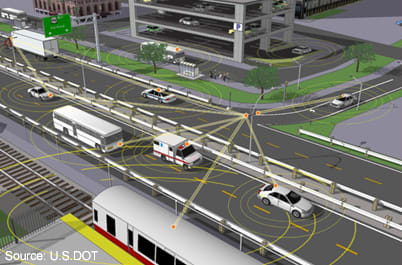
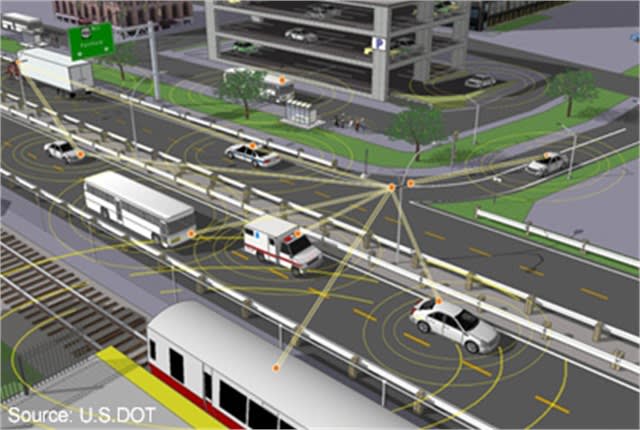
As part of its quest to mandate vehicle-to-vehicle (V2V) communications capability in light-duty vehicles, the National Highway Traffic Safety Administration has released a research report analyzing the technology’s feasibility, safety benefits, potential costs and legal issues.
The report's authors project that just two of many possible V2V communications applications — left turn assist and intersection movement assist — could save as many as 1,083 lives and prevent up to 592,000 crashes annually.
Left turn assist warns drivers not to turn left in front of another vehicle traveling in the opposite direction, and intersection movement assist warns them if it’s not safe to enter an intersection because of the likelihood of a collision. Additional applications could also help drivers avoid imminent danger through forward collision, blind spot, “do not pass,” and stop light/stop sign warnings.
V2V systems transmit basic safety information between vehicles via short-range radio communication devices.
NHTSA estimates that the V2V equipment and supporting functions would cost about $341 to $350 per vehicle in 2020. That cost might dip to approximately $209 to $227 by 2058, after manufacturers gain experience producing the equipment, according to the report.
NHTSA is seeking public and industry feedback on the report's findings. This input will aid in development of a new federal standard requiring V2V communication capability in new passenger cars and light-duty trucks.
"V2V begins to provide safety benefits only if a significant number of vehicles in the fleet are equipped with it and if there is a means to ensure secure and reliable communication between vehicles," according to the report. "NHTSA believes that no single manufacturer would have the incentive to build vehicles able to 'talk' to other vehicles, if there are no other vehicles to talk to — leading to likely market failure without the creation of a mandate to induce collective action."
V2V technology can combine with existing vehicle safety features and serve as a building block for development of driverless vehicles, supporters of the technology predict.
Vehicles equipped with V2V technology could also enable the development of a wide range of mobility and environmental benefits based on vehicle-to-infrastructure applications and other V2V applications that can enhance traffic flow in many ways, according to NHTSA.
The agency also stressed that V2V communications don't represent a threat to individual driver privacy.
"V2V technology does not involve collecting or exchanging personal information or tracking drivers or their vehicles," according to NHTSA. "The information sent between vehicles does not identify those vehicles, but merely contains basic safety data. In fact, the system as contemplated contains several layers of security and privacy protection to ensure that vehicles can rely on messages sent from other vehicles."
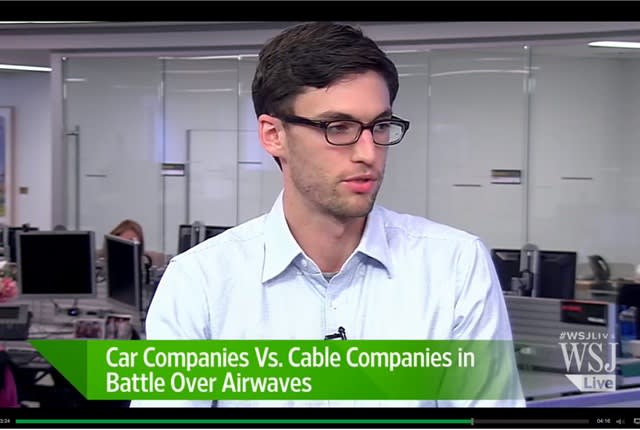
In responding to NHTSA's actions, two automaker associations — the Association of Global Automakers and the Alliance of Automobile Manufacturers — urged the federal government to reserve and protect the 5.9 GHz frequency band for eventual V2V communications. The Federal Communications Commission is exploring whether the spectrum should be shared to create more spectrum for Wi-Fi service.
"As we begin to move from the research lab to the actual deployment of vehicle-to-vehicle and vehicle-to-infrastructure communications technology, it remains critically important that the FCC preserve the ability to use the radio spectrum reserved for it," the Alliance of Automobile Manufacturers said in astatement.
The Association of Global Automakers echoed those concerns.
“There is no better use of this spectrum than to save lives," said John Bozzella, president and CEO of Global Automakers. "Communication delays of even thousandths of a single second matter when dealing with auto and highway safety."
Read "Vehicle-to-Vehicle Communications: Readiness of V2V Technology for Application" research report
The ANPRM will be available at the Regulations.gov docket (NHTSA-2014-0022) and members of the public will have the opportunity to comment for 60 days
Go to NHTSA's V2V Communications site for more information
To learn more about the lingering debate over the 5.9 GHz frequency band, click here or on the photo below.
More Safety

Nexar-Nauto Merger Aims to Give Fleets Better Safety Intelligence Through Larger Driving Dataset
Stefan Heck tells Automotive Fleet that combining more than 10 billion miles of driving history with Nexar's AI models will give fleets deeper insights into driver risk and roadway conditions than either company could provide independently.
Read More →
Don't Wait for a Crisis: 5 Ways to Build Mental Health Into Your Fleet Safety Program
For Suicide Prevention Month, fleet and safety leaders have an opportunity to put mental health where it belongs: at the center of workplace safety.
Read More →
How Camera Data Can Strengthen a Fleet’s Insurance Renewal
Insights from a commercial insurance carrier and a broker show how fleets can turn video telematic data, driver coaching, and improved claims results into a stronger case at insurance renewal.
Read More →
The Safest Fleets Aren’t the Ones with the Most Technology
You’ve made the telematics investment. Here’s how to capture the other half of its value and build the safest fleet on the road.
Read More →
Hidden in Plain Sight: Fleet Compliance Risks
Fleet compliance isn't just about having policies — it's about consistently enforcing them. This practical guide reveals six hidden compliance risks common in public sector and shared fleet operations and outlines proven strategies to improve visibility, accountability, and audit readiness
Read More →
NETS Sets 2026 Fleet Safety Benchmark Conference for Indianapolis
The Sept. 15–17 program will feature fleet benchmarking data, case studies, emerging technologies, and implementation strategies while running alongside the NSC Safety Congress & Expo.
Read More →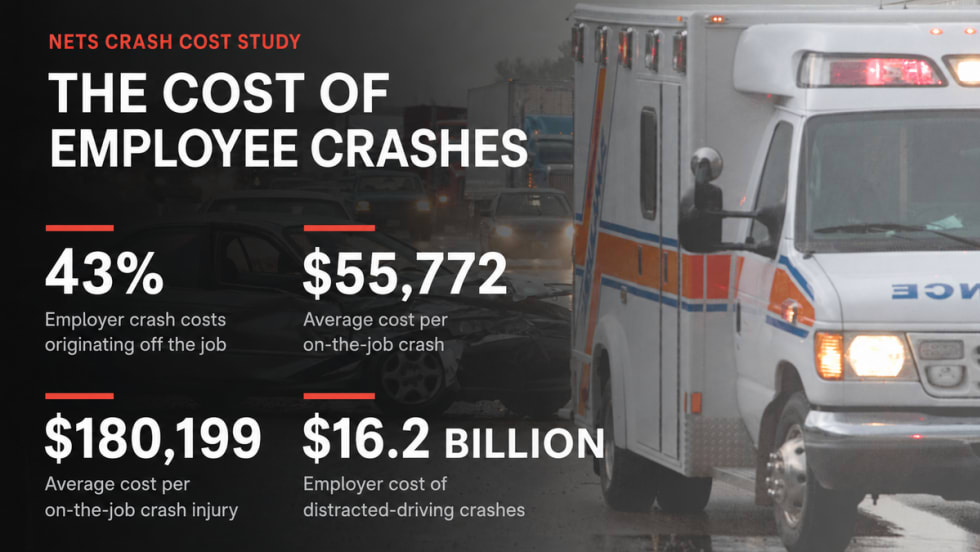
Off-the-Job Crashes Account for 43% of Employers’ $61.7 Billion Crash Burden
NETS quantifies costs dispersed across fleet, risk, HR, and other departments while providing new per-crash benchmarks for employers.
Read More →
Ram Recalls More Than 1.27 Million 1500 Pickups for Seat Belt Anchor Issue
The recall affects certain 2019-2026 Ram 1500 pickups that may have improperly attached second-row seat belt buckle anchors.
Read More →
How Better Visibility Cut Speeding Violations by 48%
Fleet leaders don't need more data, they need clearer visibility into what the data is saying. This case study explores how one utility replaced speeding-event counts with a single metric — miles driven in violation — to strengthen safety and significantly reduce speeding violations.
Read More →
Operation Safe Driver Week: Why the Industry's Oldest Safety Campaign Still Matters to Fleets
A look at how a 2007 enforcement initiative became one of the most consequential weeks on the fleet safety calendar, and what it means for your drivers in 2026.
Read More →