




Neuroscience Fosters Insights into Driver Steering
Researchers at Chalmers University of Technology in Gothenburg, Sweden, say they have made a discovery that may influence future development of safety systems related to driver steering.
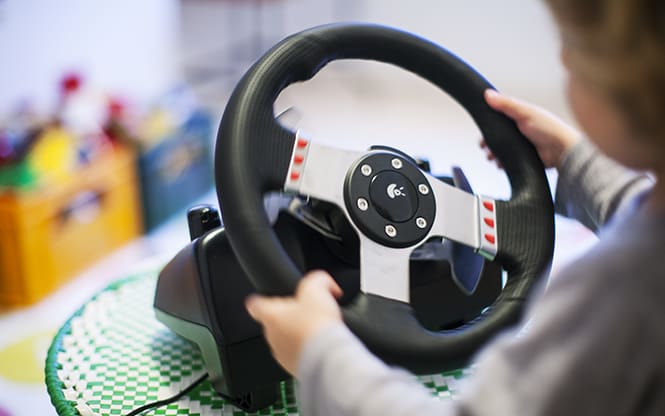
When maneuvering a steering wheel, both children and adults demonstrate a jerkiness that researchers have previously been unable to explain. New research suggests that the jerkiness is due to an innate behavior humans have when reaching for a target with their hand. Photo by Henrik Sandsjö/Chalmers.

When maneuvering a steering wheel, both children and adults demonstrate a jerkiness that researchers have previously been unable to explain. New research suggests that the jerkiness is due to an innate behavior humans have when reaching for a target with their hand. Photo by Henrik Sandsjö/Chalmers.
Researchers at Chalmers University of Technology in Gothenburg, Sweden, say they have solved a 70-year old mystery in traffic research: the inexplicable jerkiness that drivers exhibit while steering a vehicle.
The discovery may lead to safety systems in cars that can correct dangerous steering movements before they occur, researchers said. Applications include smarter anti-skid systems and systems for fatigued drivers.
“Imagine a fatigued driver on the verge of running off the road,” researcher Ola Benderius said. “He or she suddenly wakes up and reflexively initiates a very large corrective maneuver, a potential misjudgment that can lead to something very dangerous. Since we are now able to predict how far the driver is going to turn the wheel, the vehicle’s support systems can identify potential misjudgments and intervene, which means a serious accident, such as the car traveling into approaching traffic, can be avoided.”
The discovery is related to innate human behavior.
As early as 1947, British researcher Arnold Tustin produced the first model for how a person steers towards a target. He identified a continuous and linear control behavior. When a car is driven, this corresponds to the driver gently and continuously following the road with the steering wheel. This behavior theory, known as “tracking,”has been the prevailing theory for car driving ever since.
However, when comparing the linear model with actual measured data, some deviations become apparent – namely jerkiness in the steering signal. Tustin saw these deviations from the continuous prediction as well, but the mystery long remained unsolved.
Benderius and his colleague Gustav Markkula began to view the mystery differently while attending a lecture on neurocognition at Sahlgrenska University Hospital. The lecture addressed behavioral theory related to how people reach for something.
When studying how humans move their hand from Point A to pick up something from Point B, scientists have discovered that the speed of the movement has a direct relationship with the distance. The longer the distance, the quicker the movement. The interesting effect of this is that the time for the movement is the same, regardless of the distance.
”We immediately recognized this pattern from our measured steer signals,” Benderius said. ”It was a bit of a eureka moment. Was it possible that this basic human behavior also controlled how we steer a car?”
With the idea in mind, Benderius extracted over 1,000 hours of car and truck driving from real driving data, which resulted in 1.3 million steer corrections. It turned out that 95 percent of these correspond with the reaching theory.
Benderius and Markkula concluded that steering is not linear when the driver follows the road. Instead, the driver turns the wheel according to the special reaching pattern.
“Rather than looking upon steering as continuously following the road, steering corrections seem to be applied in a very predetermined manner,” Benderius explained. “The control behavior has also proven to be very natural. I saw this in an earlier study where I examined driving behavior in 12-year-olds and their parents.”
This revelation helped Benderius develop a mathematical model that can explain many observed steering behaviors. As a result, driver response to different situations can be predicted before it occurs. Benderius said he believes the discovery can have an impact on an entire research field.
“Control behavior has traditionally been studied on the basis of control theory and technical systems,” Benderius said. “If it is instead studied on the basis of neuroscience with focus on the human, an entire new world opens up. This could push the research field in an entirely different direction.”
More Safety

Operation Safe Driver Week: Why the Industry's Oldest Safety Campaign Still Matters to Fleets
A look at how a 2007 enforcement initiative became one of the most consequential weeks on the fleet safety calendar, and what it means for your drivers in 2026.
Read More →
Nexar-Nauto Merger Aims to Give Fleets Better Safety Intelligence Through Larger Driving Dataset
Stefan Heck tells Automotive Fleet that combining more than 10 billion miles of driving history with Nexar's AI models will give fleets deeper insights into driver risk and roadway conditions than either company could provide independently.
Read More →
From Silos to Solutions: Relationship Management for Safer Fleets
From telematics adoption and driver accountability to policy consistency and risk mitigation, this episode breaks down what it really takes to build a safer fleet culture without slowing business down.
Read More →
IIHS Launches First Commercial Vehicle Safety Evaluations
The Insurance Institute for Highway Safety has begun evaluating heavy-duty pickups and cargo vans for driver protection. Which models earned top marks?
Read More →
Reducing Risk by Eliminating Phone Use Behind the Wheel
Hosted with the cofounder of Lifesaver Mobile, this episode addresses phone use behind the wheel and how to design a driving environment that actually helps prevents accidents.
Read More →
Cameras, Safety and Insurance: From Reactive Claims to Real-Time Prevention (Part 2 of 2)
Part Two: Commercial auto remains one of the most challenging and costly lines of coverage for fleet operators and insurers alike. Continue learning more about how to effectively address these issues from Onur Aksan, Enterprise Business Development Executive, Geotab
Read More →
How 5-Second Telematics Data Is Changing Fleet Safety
This episode connects with Steve Santostasi of Ford Pro and covers how a few seconds of data can make a difference in fleet safety.
Read More →
Managing Road Risk at Scale: Why Fleet Safety Needs a Data-Driven Framework
Insights from the FIA Road and Driver Safety Indexes reveal how to manage road risk on a larger scale.
Read More →
Stellantis Recalls 1.3 Million Jeep Vehicles Worldwide Over Fire Risk
Stellantis is recalling more than 1.3 million Jeep Wrangler and Gladiator models worldwide over a fire risk linked to power steering pump wiring.
Read More →
Coaching Is Not Training, Even When AI Is Doing It
AI-powered safety platforms can detect risky behaviors and deliver immediate feedback. But effective driver development still requires a foundation of training followed by coaching that reinforces those skills.
Read More →