




Marijuana-Related Road Deaths Double in Washington
New AAA Foundation research raises concerns about marijuana-impaired driving and the misguided efforts of some states to prevent it.
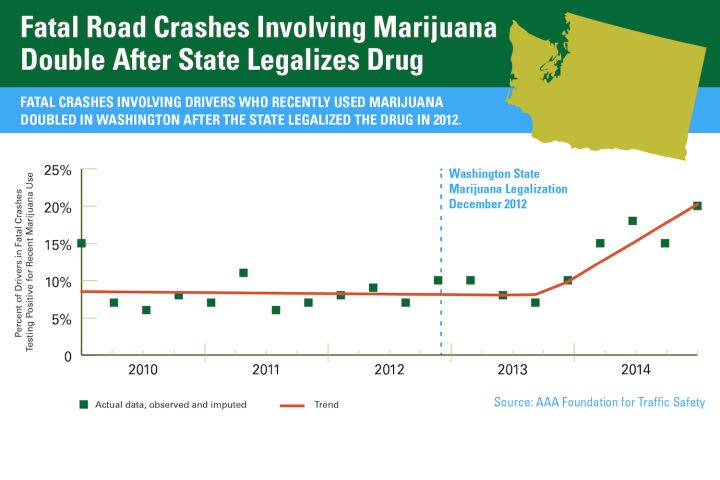
Chart courtesy of AAA.
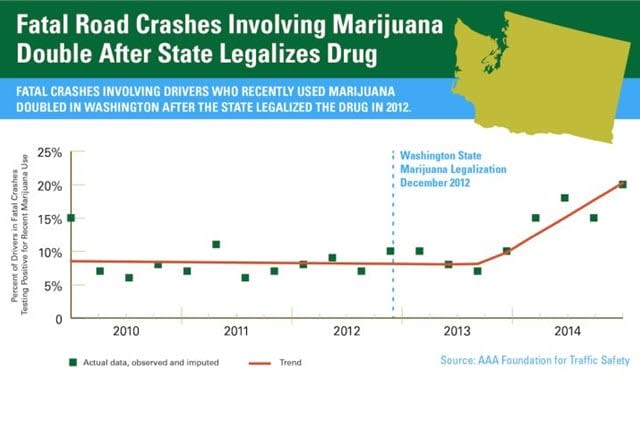
Chart courtesy of AAA.
In the state of Washington, the percentage of fatal crash-involved drivers who had recently used marijuana more than doubled after the drug became legal there, according to new research from the AAA Foundation for Traffic Safety.
The percentage jumped from 8% to 17% between 2013 and 2014, researchers found. The foundation examined drug tests and fatal crashes among drivers in Washington, a state that legalized marijuana in December 2012.
One in six drivers involved in fatal crashes in 2014 had recently used marijuana, according to the most recent data available.
Washington was one of the first two states to legalize the recreational use of marijuana. The new findings raise serious concerns about drug-impaired driving at a time when at least 20 states are considering marijuana legalization this year, the AAA Foundation for Traffic Safety said in a released statement.
“The significant increase in fatal crashes involving marijuana is alarming,” said Peter Kissinger, president and CEO of the AAA Foundation for Traffic Safety. “Washington serves as an eye-opening case study for what other states may experience with road safety after legalizing the drug.”
Moreover, new research indicates that legal limits for marijuana and driving are arbitrary and unsupported by science, which could result in unsafe motorists going free and others being wrongfully convicted for impaired driving, the foundation said.
In an attempt to combat drug-impaired driving, some states have created legal limits — also known as per se limits — which specify the maximum amount of active THC that drivers can have in their system based on a blood test.
THC is the main chemical component in marijuana that can impair driver performance and affect the mind, and the presence of active THC is generally suggestive of recent marijuana use. These limits are similar in concept to the .08 BAC limit for driving under the influence of alcohol.
Researchers examined the lab results of drivers arrested for impaired driving, and the results suggest that legal limits for marijuana and driving are problematic because of three major reasons.
First, there’s no science showing that drivers reliably become impaired at a specific level of marijuana in the blood. Depending on the individual, drivers with relatively high levels of marijuana in their system might not be impaired, while others with low levels may be unsafe behind the wheel. This finding is very different from alcohol, where it is clear that crash risk increases significantly at higher BAC levels.
Second, high THC levels may drop below legal thresholds before a test is administered to a suspected impaired driver. The average time to collect blood from a suspected driver is often more than two hours because taking a blood sample typically requires a warrant and transport to a facility. Active THC blood levels may decline significantly and could drop below legal limits during that time.
Third, marijuana affects people differently, making it challenging to develop consistent and fair guidelines. For example, frequent users of marijuana can exhibit persistent levels of the drug long after use, while drug levels can decline more rapidly among occasional users.
“There is understandably a strong desire by both lawmakers and the public to create legal limits for marijuana impairment, in the same manner as we do with alcohol,” said Marshall Doney, AAA’s president and CEO. “In the case of marijuana, this approach is flawed and not supported by scientific research. It’s simply not possible today to determine whether a driver is impaired based solely on the amount of the drug in their body.”
AAA said it is urging states to use more comprehensive enforcement measures to improve road safety.
Rather than relying on “arbitrary legal limits,” states should use a two-component system that requires a positive test for recent marijuana use, and most importantly, behavioral and physiological evidence of driver impairment, AAA said.
This system would rely heavily on two current law-enforcement training programs: Advanced Roadside Impaired Driving Enforcement (ARIDE) and the 50-state Drug Evaluation and Classification (DEC) program. These programs train law enforcement officers around the country to more effectively recognize drug-impaired driving.
“Marijuana can affect driver safety by impairing vehicle control and judgment,” continued Doney. “States need consistent, strong and fair enforcement measures to ensure that the increased use of marijuana does not impact road safety.”
Whether the use of marijuana is legal or not, all motorists should avoid driving while impaired, AAA stressed. Just because a drug is legal doesn't mean it's safe to use while operating a motor vehicle. Drivers who get behind the wheel while impaired put themselves and others on the road at risk.
Alaska, Colorado, Oregon, Washington, and Washington, D.C. have legalized the recreational use of marijuana, and 20 states have legalized it for therapeutic and medicinal use.
Montana and Washington have implemented a per se limit for marijuana at 5 ng/mL; Nevada and Ohio have set a limit at 2 ng/mL; and Pennsylvania’s is set at 1 ng/mL.
Twelve states have strict per se laws that forbid the presence of any levels of marijuana. In Colorado, a blood concentration of 5 ng/mL or more gives rise to permissible inference that a person was driving under the influence of the drug.
More Safety

Nexar-Nauto Merger Aims to Give Fleets Better Safety Intelligence Through Larger Driving Dataset
Stefan Heck tells Automotive Fleet that combining more than 10 billion miles of driving history with Nexar's AI models will give fleets deeper insights into driver risk and roadway conditions than either company could provide independently.
Read More →
Don't Wait for a Crisis: 5 Ways to Build Mental Health Into Your Fleet Safety Program
For Suicide Prevention Month, fleet and safety leaders have an opportunity to put mental health where it belongs: at the center of workplace safety.
Read More →
How Camera Data Can Strengthen a Fleet’s Insurance Renewal
Insights from a commercial insurance carrier and a broker show how fleets can turn video telematic data, driver coaching, and improved claims results into a stronger case at insurance renewal.
Read More →
The Safest Fleets Aren’t the Ones with the Most Technology
You’ve made the telematics investment. Here’s how to capture the other half of its value and build the safest fleet on the road.
Read More →
Hidden in Plain Sight: Fleet Compliance Risks
Fleet compliance isn't just about having policies — it's about consistently enforcing them. This practical guide reveals six hidden compliance risks common in public sector and shared fleet operations and outlines proven strategies to improve visibility, accountability, and audit readiness
Read More →
NETS Sets 2026 Fleet Safety Benchmark Conference for Indianapolis
The Sept. 15–17 program will feature fleet benchmarking data, case studies, emerging technologies, and implementation strategies while running alongside the NSC Safety Congress & Expo.
Read More →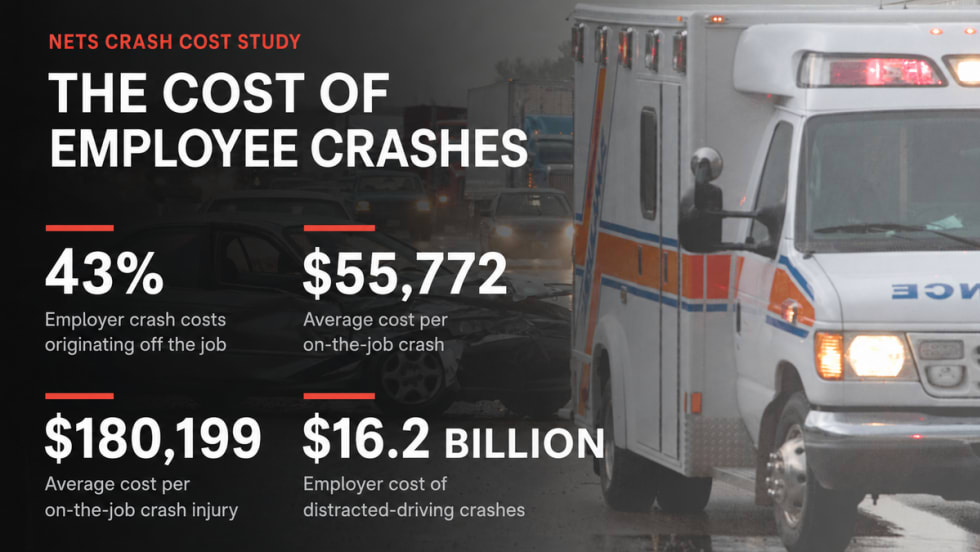
Off-the-Job Crashes Account for 43% of Employers’ $61.7 Billion Crash Burden
NETS quantifies costs dispersed across fleet, risk, HR, and other departments while providing new per-crash benchmarks for employers.
Read More →
Ram Recalls More Than 1.27 Million 1500 Pickups for Seat Belt Anchor Issue
The recall affects certain 2019-2026 Ram 1500 pickups that may have improperly attached second-row seat belt buckle anchors.
Read More →
How Better Visibility Cut Speeding Violations by 48%
Fleet leaders don't need more data, they need clearer visibility into what the data is saying. This case study explores how one utility replaced speeding-event counts with a single metric — miles driven in violation — to strengthen safety and significantly reduce speeding violations.
Read More →
Operation Safe Driver Week: Why the Industry's Oldest Safety Campaign Still Matters to Fleets
A look at how a 2007 enforcement initiative became one of the most consequential weeks on the fleet safety calendar, and what it means for your drivers in 2026.
Read More →