




Many Third-Party Auto Lights Fall Short of Quality Standards
WASHINGTON, D.C. --– Though collision repairers use thousands of independently manufactured lights, the Certified Automotive Part Association said that only 584 meet the association's quality standards.
WASHINGTON, D.C. --– Though collision repairers use thousands of independently manufactured lights, the Certified Automotive Part Association said that only 584 meet the association's quality standards.
The CAPA 301 Standard includes specifications for form and fit, appearance, composition, coating performance, mechanical properties, adhesives, fasteners and associated hardware.
CAPA’s 301 Standard requires full compliance with Federal Motor Vehicle Safety Standard 108. While all automotive lighting is required to comply with FMVSS 108, CAPA is the only independent certification body in the U.S. that tests for and confirms compliance with this safety standard.
Lighting products covered by the CAPA standard include: headlamps, tail lamps, turn signals, brake signals, reflectors, running lamps, fog lamps and high-mounted brake lamps.
"Lighting manufacturers who choose to comply with CAPA's comprehensive quality requirements have a way to clearly demonstrate product quality to repairers, insurers and consumers," said Jack Gillis, executive director of the non-profit association. Those parts that meet the CAPA standard are clearly marked with CAPA's tamper-proof quality seal.
"There will be no question in the marketplace as to which parts are genuine CAPA-certified products," said Gillis. This is an important distinction since only 584 part numbers currently comply with the CAPA Lighting Standard.
In addition to compliance with FMVSS 108, a key component of CAPA certification is passing CAPA's unique Vehicle Test Fit or "VTF."
"Repairers have told us time and again that they are tired of being the 'product test fitters,'" said Gillis, "so that's why the CAPA program conducts extensive test fits before certifying parts for quality."
CAPA now has six manufacturers approved for participation in the 301 Lighting program. They include DEPO, Eagle Eyes, Gordon, Great Bestcam, TYC Brother and Y.C.C.
The Certified Automotive Parts Association, founded in 1987, is the nation's only independent, nonprofit, third-party crash parts quality certification organization.
More Safety

Nexar-Nauto Merger Aims to Give Fleets Better Safety Intelligence Through Larger Driving Dataset
Stefan Heck tells Automotive Fleet that combining more than 10 billion miles of driving history with Nexar's AI models will give fleets deeper insights into driver risk and roadway conditions than either company could provide independently.
Read More →
Don't Wait for a Crisis: 5 Ways to Build Mental Health Into Your Fleet Safety Program
For Suicide Prevention Month, fleet and safety leaders have an opportunity to put mental health where it belongs: at the center of workplace safety.
Read More →
How Camera Data Can Strengthen a Fleet’s Insurance Renewal
Insights from a commercial insurance carrier and a broker show how fleets can turn video telematic data, driver coaching, and improved claims results into a stronger case at insurance renewal.
Read More →
The Safest Fleets Aren’t the Ones with the Most Technology
You’ve made the telematics investment. Here’s how to capture the other half of its value and build the safest fleet on the road.
Read More →
Hidden in Plain Sight: Fleet Compliance Risks
Fleet compliance isn't just about having policies — it's about consistently enforcing them. This practical guide reveals six hidden compliance risks common in public sector and shared fleet operations and outlines proven strategies to improve visibility, accountability, and audit readiness
Read More →
NETS Sets 2026 Fleet Safety Benchmark Conference for Indianapolis
The Sept. 15–17 program will feature fleet benchmarking data, case studies, emerging technologies, and implementation strategies while running alongside the NSC Safety Congress & Expo.
Read More →
Off-the-Job Crashes Account for 43% of Employers’ $61.7 Billion Crash Burden
NETS quantifies costs dispersed across fleet, risk, HR, and other departments while providing new per-crash benchmarks for employers.
Read More →
Ram Recalls More Than 1.27 Million 1500 Pickups for Seat Belt Anchor Issue
The recall affects certain 2019-2026 Ram 1500 pickups that may have improperly attached second-row seat belt buckle anchors.
Read More →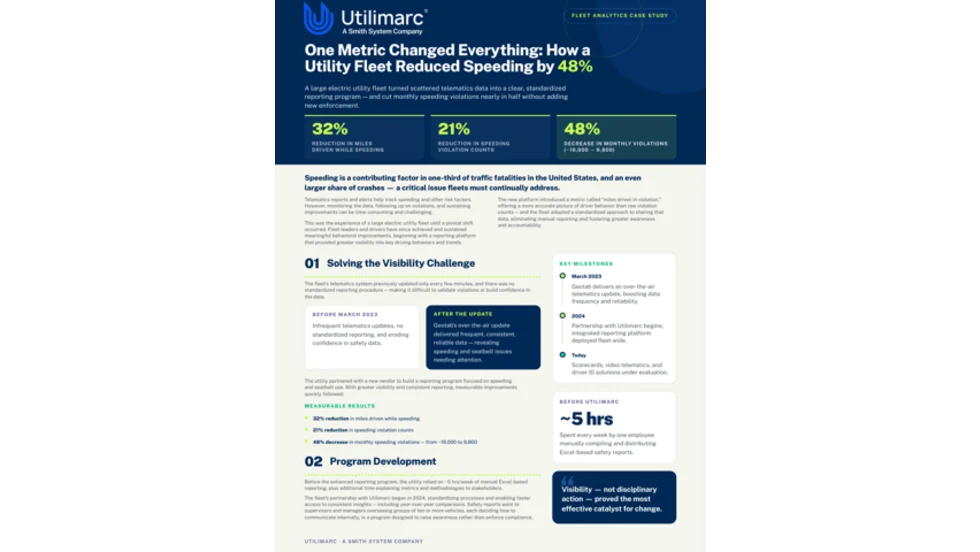
How Better Visibility Cut Speeding Violations by 48%
Fleet leaders don't need more data, they need clearer visibility into what the data is saying. This case study explores how one utility replaced speeding-event counts with a single metric — miles driven in violation — to strengthen safety and significantly reduce speeding violations.
Read More →
Operation Safe Driver Week: Why the Industry's Oldest Safety Campaign Still Matters to Fleets
A look at how a 2007 enforcement initiative became one of the most consequential weeks on the fleet safety calendar, and what it means for your drivers in 2026.
Read More →