




Legal Marijuana Tied to Crash Increase
Three states that have legalized recreational cannabis see a 3% overall increase in collision claim frequencies, according to the Highway Loss Data Institute.

Photo of retail marijuana courtesy of HLDI.

Photo of retail marijuana courtesy of HLDI.
After legalizing recreational use of marijuana, the states of Colorado, Oregon and Washington saw collision claim frequencies rise about 3% higher overall compared to neighboring states, according to a new analysis from the Highway Loss Data Institute (HLDI).
Washington and Colorado were the first states to legalize recreational use of marijuana for adults 21 and older, when voters approved a ballot measure in November 2012. Retail sales began in January 2014 in Colorado and in July 2014 in Washington. Oregon sales started in October 2015, after voters approved a measure in November 2014.
HLDI’s analysis relied on neighboring states as additional controls to evaluate the collision claims activity in Colorado, Oregon and Washington before and after law changes. The control states included Idaho, Montana, Nevada, Utah and Wyoming, in addition to Colorado, Oregon and Washington before the legalization of recreational cannabis use, the institute said.
Additionally, HLDI took into account loss results for each individual state and compared those numbers with loss results in adjacent states without legalized recreational marijuana use before November 2016. The data included collision claims filed from January 2012 to October 2016 for 1981 to 2017 model vehicles. HLDI noted that its analysts controlled for differences in the rated driver population, insured vehicle fleet, mix of urban versus rural exposure, unemployment, and weather and seasonality.
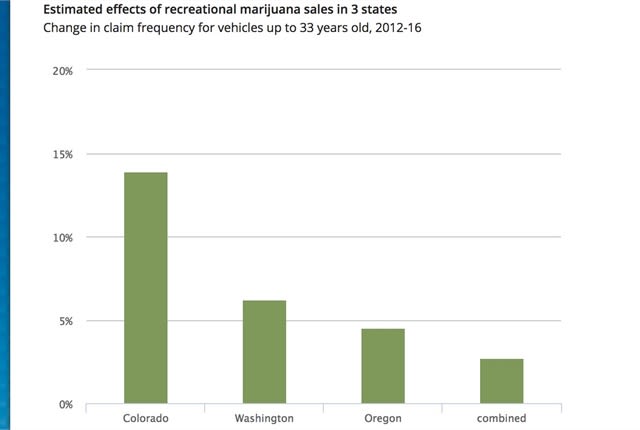
Graph courtesy of HLDI.
“The combined-state analysis shows that the first three states to legalize recreational marijuana have experienced more crashes,” said Matt Moore, senior vice president of HLDI. “The individual state analyses suggest that the size of the effect varies by state.”
According to HLDI, Colorado experienced the largest estimated jump in claim frequency, compared with its control states. After retail recreational pot sales began in the state, the collision claim frequency climbed to 14% higher than in nearby Nebraska, Utah and Wyoming. In Washington, the estimated increase in claim frequency was 6.2% higher than in Montana and Idaho. Oregon’s estimated increase was 4.5% higher than in Idaho, Montana and Nevada.
“The combined effect for the three states was smaller but still significant at 3%,” Moore said. “The combined analysis uses a bigger control group and is a good representation of the effect of marijuana legalization overall. The single-state analyses show how the effect differs by state.”
In response to the new analysis, Governors Highway Safety Association (GHSA) Executive Director Jonathan Adkins issued a statement reiterating the group’s stance that states should “consider the risk of marijuana-impaired driving as they move toward liberalizing marijuana laws.”
GHSA cited recent national data that found marijuana was present in 12.2% of all fatally injured drivers who tested for drugs.
A study earlier this year published in the American Journal of Public Health found that crash fatality rates were not statistically different three years after legalization in Washington and Colorado compared to states that have not legalized marijuana. Researchers in that study noted that future studies should be conducted looking at longer term data.
Other statistics have also seemed to indicate either no change or a slight decrease in accidents in states with legal marijuana, according to report in Governing.com. For example, numbers from the Colorado Highway Patrol, which were not used in the HDLI study, seemed to indicate a slight decrease in the number of impaired driving crashes in the past year.
Commercial vehicle drivers are still prohibited from using marijuana by Federal law, even in states that have legalized it, according to the Department of Transportation.
More Safety
Tips for Driving Safely on Halloween Night
This video features a reminder from the Connecticut Department of Transportation (DOT) and the Connecticut Police Chiefs Association, urging drivers to prioritize safety this Halloween.
Read More →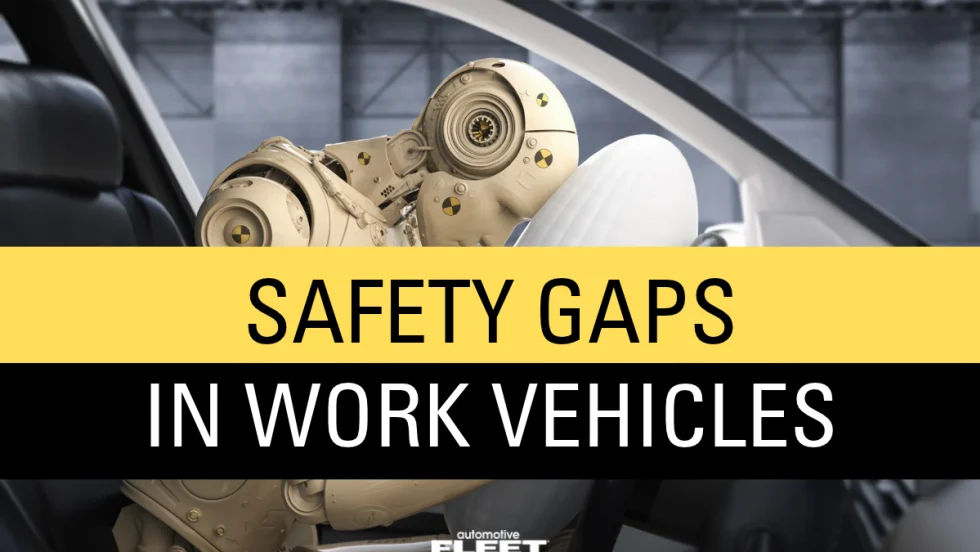
IIHS Crash Avoidance Tests Reveal Safety Gaps in Cargo Vans and Work Trucks
New crash-avoidance ratings from the Insurance Institute for Highway Safety reveal inconsistent performance among commercial vehicles, with several popular cargo vans and heavy-duty pickups struggling to avoid collisions with other vehicles and pedestrians.
Read More →
What’s Next for Fleet? Safety, AI & Industry Recognition | AF News Recap
Could your company's culture be encouraging distracted driving? This week, we're exploring how workplace expectations affect driver safety, what AI, EVs, and autonomous vehicles could mean for the future of fleet management, and how fleet professionals can strengthen their award nominations.
Read More →
Does Your Fleet's Culture Encourage Distracted Driving?
What happens when the people responsible for enforcing safety rules are the ones setting the wrong example? The answer may reveal why some of the biggest risks to fleet drivers have little to do with what's written in the employee handbook.
Read More →
Fleet Manager’s Ultimate Playbook: Navigating the New Standard in OEM Connectivity
Rising operating costs, driver safety concerns, and unplanned downtime are putting unprecedented pressure on modern fleets. Discover how fleet managers use embedded OEM connectivity and real-time vehicle data to cut TCO, prevent downtime, and protect drivers without aftermarket telematics hardware.
Read More →
From Driver Well-Being to EV Charging | AF News Recap
Mental health belongs in the fleet safety conversation. This week, we’re looking at five ways fleets can support employee well-being before a crisis, plus Holman’s expansion in Mexico, new one-day Fleet Forward passes, and why EV charging demand is outpacing infrastructure growth.
Read More →
Nexar-Nauto Merger Aims to Give Fleets Better Safety Intelligence Through Larger Driving Dataset
Stefan Heck tells Automotive Fleet that combining more than 10 billion miles of driving history with Nexar's AI models will give fleets deeper insights into driver risk and roadway conditions than either company could provide independently.
Read More →
Don't Wait for a Crisis: 5 Ways to Build Mental Health Into Your Fleet Safety Program
For Suicide Prevention Month, fleet and safety leaders have an opportunity to put mental health where it belongs: at the center of workplace safety.
Read More →
How Camera Data Can Strengthen a Fleet’s Insurance Renewal
Insights from a commercial insurance carrier and a broker show how fleets can turn video telematic data, driver coaching, and improved claims results into a stronger case at insurance renewal.
Read More →
The Safest Fleets Aren’t the Ones with the Most Technology
You’ve made the telematics investment. Here’s how to capture the other half of its value and build the safest fleet on the road.
Read More →