




Keys Left in Vehicles Spurring More Thefts
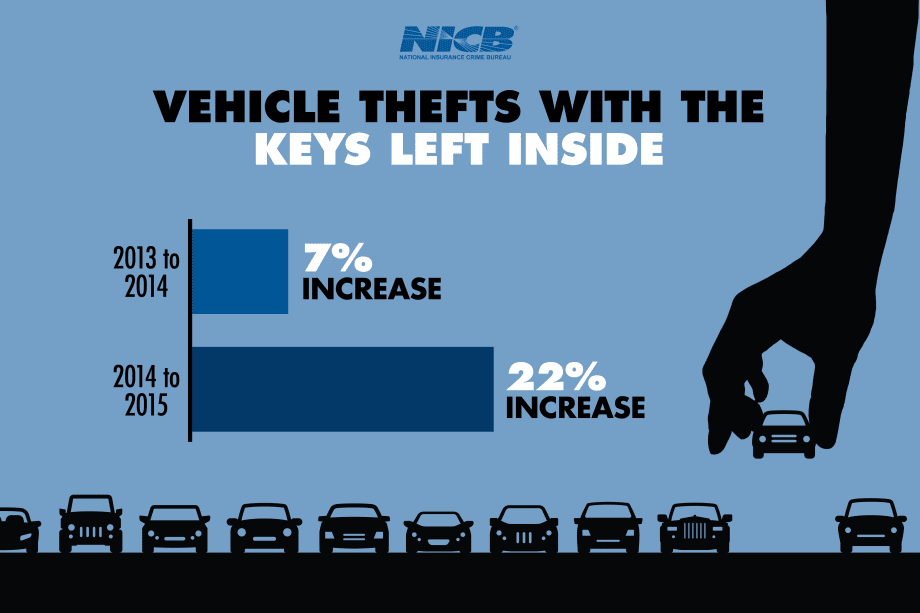
Last year, one of every eight vehicle thefts involved the driver leaving the keys or fob inside, according to the National Insurance Crime Bureau.
Graphic courtesy of the National Insurance Crime Bureau.
Graphic courtesy of the National Insurance Crime Bureau.
In 2015, a vehicle was reported stolen once every 45 seconds in the U.S. And there was a theft every 6.5 minutes in which the driver left the keys or fob inside the vehicle, according to the National Insurance Crime Bureau.
In fact, one out of every eight thefts was a freebie for the thief, with the keys or fob just waiting there for the taking.
It’s a growing problem, according to the latest report from the National Insurance Crime Bureau (NICB). The 57,096 thefts in 2015 amounted to a 22% increase over the previous year. Over the past three years, this kind of theft grew by 31%.
Since many people won’t admit to leaving their vehicle unlocked with the keys or fob inside, the actual numbers for these kinds of thefts may be considerably higher than the report indicates.
“Anti-theft technology has had a tremendous impact on reducing thefts over the past 25 years, but if you don’t lock it up, it’s not going to help,” said NICB President and CEO Joe Wehrle. “Complacency can lead to a huge financial loss and inconvenience for the vehicle owner. Leaving a vehicle unlocked or with the key or FOB inside gives a thief the opportunity to take not only the car, but also any possessions inside. It can also provide access to your personal information if the registration is left in the glove compartment.”
Law enforcement agencies have also reported incidents in which thieves have stolen a car, driven it to the residence, and burglarized the home before the owner even knew the vehicle was missing, Wehrle said.
NICB advises drivers to:
Lock the vehicle, set the alarm, and take all keys or fobs.
Don’t leave the garage door opener in the vehicle.
Take a photo of your registration on your cell phone and don’t leave the registration or other papers with personal information in the vehicle.
Never leave a car unlocked and running to warm it up or while stopping for a quick cup of coffee. It only takes a moment for the opportunistic thief to jump inside and drive off.
For the years 2013 through 2015, a total of 147,434 vehicles were reported stolen with the keys left inside. There were 43,643 thefts in 2013, 46,695 in 2014, and 57,096 in 2015. From 2013 to 2015, the increase was 31%.
The top five states that posted the most vehicle thefts with keys during this reporting period were California (22,580), Texas (11,003), Florida (9,952), Ohio (8,623), and Nevada (8,073).
The top five core-based statistical areas were Las Vegas-Henderson-Paradise, Nev. (7,815), Detroit-Warren-Dearborn, Mich. (4,380), Atlanta-Sandy Springs-Roswell, Ga. (4,118), Miami-Fort Lauderdale-West Palm Beach, Fla. (3,847), and Philadelphia-Camden-Wilmington, Pa.-N.J.-Del.-Md. (3,365).
One state — Hawaii — had a perfect record. There wasn't a single report of a vehicle theft with keys.
Looking at day-of-week data, NICB discovered that Saturday saw the most thefts (22,081), followed by Monday (21,851) and Friday (21,652).
More Safety

Nexar-Nauto Merger Aims to Give Fleets Better Safety Intelligence Through Larger Driving Dataset
Stefan Heck tells Automotive Fleet that combining more than 10 billion miles of driving history with Nexar's AI models will give fleets deeper insights into driver risk and roadway conditions than either company could provide independently.
Read More →
Don't Wait for a Crisis: 5 Ways to Build Mental Health Into Your Fleet Safety Program
For Suicide Prevention Month, fleet and safety leaders have an opportunity to put mental health where it belongs: at the center of workplace safety.
Read More →
How Camera Data Can Strengthen a Fleet’s Insurance Renewal
Insights from a commercial insurance carrier and a broker show how fleets can turn video telematic data, driver coaching, and improved claims results into a stronger case at insurance renewal.
Read More →
The Safest Fleets Aren’t the Ones with the Most Technology
You’ve made the telematics investment. Here’s how to capture the other half of its value and build the safest fleet on the road.
Read More →
Hidden in Plain Sight: Fleet Compliance Risks
Fleet compliance isn't just about having policies — it's about consistently enforcing them. This practical guide reveals six hidden compliance risks common in public sector and shared fleet operations and outlines proven strategies to improve visibility, accountability, and audit readiness
Read More →
NETS Sets 2026 Fleet Safety Benchmark Conference for Indianapolis
The Sept. 15–17 program will feature fleet benchmarking data, case studies, emerging technologies, and implementation strategies while running alongside the NSC Safety Congress & Expo.
Read More →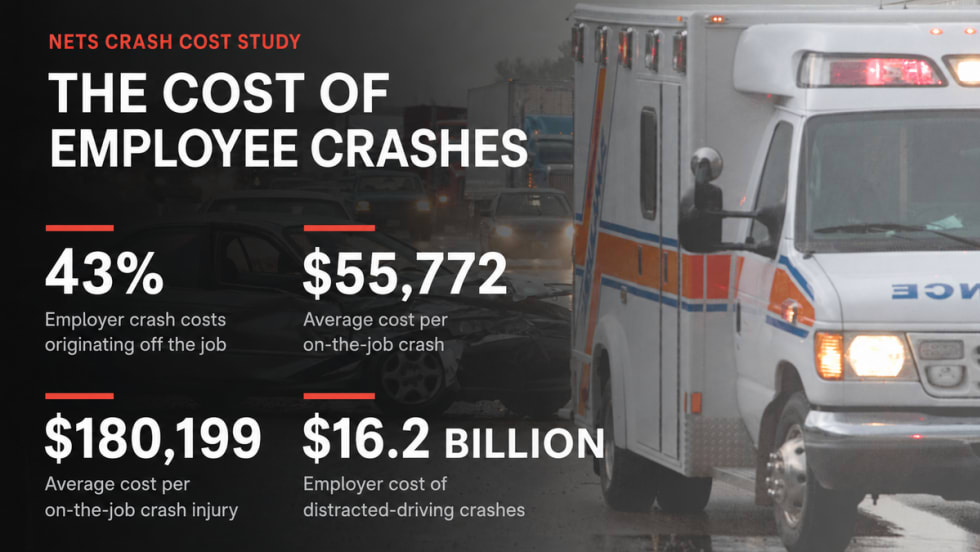
Off-the-Job Crashes Account for 43% of Employers’ $61.7 Billion Crash Burden
NETS quantifies costs dispersed across fleet, risk, HR, and other departments while providing new per-crash benchmarks for employers.
Read More →
Ram Recalls More Than 1.27 Million 1500 Pickups for Seat Belt Anchor Issue
The recall affects certain 2019-2026 Ram 1500 pickups that may have improperly attached second-row seat belt buckle anchors.
Read More →
How Better Visibility Cut Speeding Violations by 48%
Fleet leaders don't need more data, they need clearer visibility into what the data is saying. This case study explores how one utility replaced speeding-event counts with a single metric — miles driven in violation — to strengthen safety and significantly reduce speeding violations.
Read More →
Operation Safe Driver Week: Why the Industry's Oldest Safety Campaign Still Matters to Fleets
A look at how a 2007 enforcement initiative became one of the most consequential weeks on the fleet safety calendar, and what it means for your drivers in 2026.
Read More →