




Intelligent Cars Can Help Drivers Avoid Accidents
GOTHENBURG, SWEDEN - Volvo Cars developed technology that can alert a drowsy driver long before he or she dozes off behind the wheel.
GOTHENBURG, SWEDEN - Volvo Cars developed technology that can alert a drowsy driver long before he or she dozes off behind the wheel. The system is called Driver Alert Control and it immediately registers if the car is being driven in a controlled way by monitoring how the vehicle moves between the painted road markings, according to the manufacturer.
Driver Alert Control is aimed primarily at situations where the danger of losing concentration is biggest and where an accident would have serious consequences. This may for instance be on a straight, easy to drive and therefore monotonous stretch of road where the driver feels relaxed and the risk of dozing off increases.
Another common cause of accidents is distraction. A cell phone may suddenly ring or the driver may drop something in the car and start looking for it. According to the NHTSA, distracted drivers are the cause of 40 percent of all run-off-road accidents.
Run-offs account for just more than 20 percent of all U.S. accidents and almost 40 percent of all fatal U.S. accidents, according to NHTSA. Statistics from other countries also show that run-offs figure heavily in serious accidents.
In order to reduce the risk of run-off-road accidents Volvo has developed a system known as Lane Departure Warning which monitors the road via a camera fitted below the rear-view mirror. If a wheel accidentally strays beyond a lane marker, a warning signal automatically alerts the driver to respond.
Another system that can help reduce run-off-road accidents is Collision Avoidance By Auto Steering, which monitors oncoming traffic with the help of both cameras and radar. If the driver does not respond to the warning signal, the system boosts steering force to help bring the car back to its original lane.
The frontal collision is a difficult accident scenario that often leads to very serious consequences. In Germany, frontal collisions account for 5 percent of all accidents and a massive 20 percent of all fatal accidents.
Even when it comes to frontal collisions, Emergency Lane Assist can help reduce their frequency. This technology will be found in forthcoming Volvo models.
Rear-end collisions are a common occurrence and account for 29 percent of all car accidents reported to the police in the USA. In about half of all rear-end collisions, the driver has not braked at all prior to impact.
These accidents, which often take place at low speeds, do not always lead to serious injuries but they can give rise to neck injuries which may be long-lasting and result in major costs to society in general. Here a new Volvo system known as City Safety, which is active up to 30 km/h, can help avoid or reduce the consequences of rear-end collisions.
City Safety helps avoid or reduce the consequences of a collision at low speed by automatically braking the car and at the same time restricting the throttle. In addition, the brake lights are activated to warn following traffic. City Safety is already fitted as standard on the new Volvo XC60.
The system is programmed to respond to vehicles in front that are either stationary or are moving in the same direction.
Based on the car's own speed and the gap to the vehicle in front, the system calculates the braking speed needed to avoid a collision. If the calculated braking force exceeds a given level without the driver reacting, the danger of a collision is regarded as imminent and the system automatically steps in.
One of the more common causes of accidents in our cities is pedestrians stepping straight out into the roadway. In the U.S., more than 11 percent of all traffic fatalities are pedestrians and in Japan, this scenario accounts for about 30 percent of all fatal accidents.
Volvo Cars is currently working on advanced new technology to reduce or entirely avoid collisions with pedestrians in urban environments. The new approach utilises both radar and camera technology.
The aim is to identify pedestrians and alert the driver so that he or she can take the necessary action to avoid an accident. If the driver does not react in time, the system automatically brakes the car.
More Safety

Nexar-Nauto Merger Aims to Give Fleets Better Safety Intelligence Through Larger Driving Dataset
Stefan Heck tells Automotive Fleet that combining more than 10 billion miles of driving history with Nexar's AI models will give fleets deeper insights into driver risk and roadway conditions than either company could provide independently.
Read More →
Don't Wait for a Crisis: 5 Ways to Build Mental Health Into Your Fleet Safety Program
For Suicide Prevention Month, fleet and safety leaders have an opportunity to put mental health where it belongs: at the center of workplace safety.
Read More →
How Camera Data Can Strengthen a Fleet’s Insurance Renewal
Insights from a commercial insurance carrier and a broker show how fleets can turn video telematic data, driver coaching, and improved claims results into a stronger case at insurance renewal.
Read More →
The Safest Fleets Aren’t the Ones with the Most Technology
You’ve made the telematics investment. Here’s how to capture the other half of its value and build the safest fleet on the road.
Read More →
Hidden in Plain Sight: Fleet Compliance Risks
Fleet compliance isn't just about having policies — it's about consistently enforcing them. This practical guide reveals six hidden compliance risks common in public sector and shared fleet operations and outlines proven strategies to improve visibility, accountability, and audit readiness
Read More →
NETS Sets 2026 Fleet Safety Benchmark Conference for Indianapolis
The Sept. 15–17 program will feature fleet benchmarking data, case studies, emerging technologies, and implementation strategies while running alongside the NSC Safety Congress & Expo.
Read More →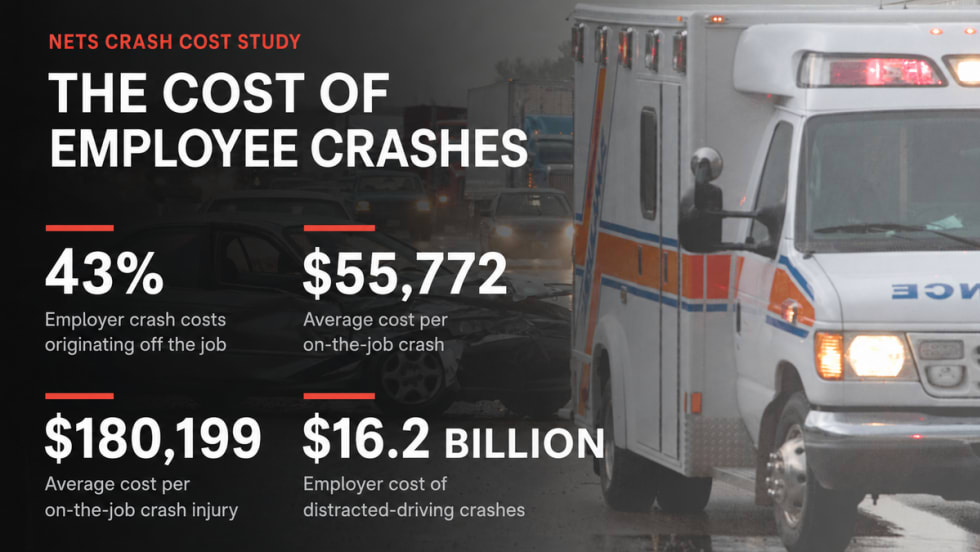
Off-the-Job Crashes Account for 43% of Employers’ $61.7 Billion Crash Burden
NETS quantifies costs dispersed across fleet, risk, HR, and other departments while providing new per-crash benchmarks for employers.
Read More →
Ram Recalls More Than 1.27 Million 1500 Pickups for Seat Belt Anchor Issue
The recall affects certain 2019-2026 Ram 1500 pickups that may have improperly attached second-row seat belt buckle anchors.
Read More →
How Better Visibility Cut Speeding Violations by 48%
Fleet leaders don't need more data, they need clearer visibility into what the data is saying. This case study explores how one utility replaced speeding-event counts with a single metric — miles driven in violation — to strengthen safety and significantly reduce speeding violations.
Read More →
Operation Safe Driver Week: Why the Industry's Oldest Safety Campaign Still Matters to Fleets
A look at how a 2007 enforcement initiative became one of the most consequential weeks on the fleet safety calendar, and what it means for your drivers in 2026.
Read More →