




Insurance Institute Stresses Importance of Side Airbags in SUV Collisions
ARLINGTON, Va. --- The Insurance Institute for Highway Safety this week released results of another round of SUV crash tests. The tests revealed significant differences in how well 2008 SUVs protect people in serious side crashes, the institute said.
ARLINGTON, Va. --- The Insurance Institute for Highway Safety this week released results of another round of SUV crash tests. The tests revealed significant differences in how well 2008 SUVs protect people in serious side crashes, the institute said. Performance varied considerably in the side test that replicates a 31 mph crash in which the striking vehicle is another SUV or pickup. Two Nissan SUVs, the Pathfinder and Xterra, were rated "good" for protection in side impacts, but only when they're equipped with optional side airbags. Without the option, these SUVs drew "marginal" ratings, the institute said. The Toyota 4Runner equipped with standard side airbags was rated "good." The Ford Explorer with standard side airbags drew an "acceptable" rating. The Jeep Grand Cherokee and Chevrolet TrailBlazer, both with standard side airbags, were judged "marginal." "The performance of some of these models in the side test was surprising," said the institute's Senior Vice President David Zuby. "SUVs should have an advantage in side crashes because the driver and passengers ride higher up than in cars. People often think they're safer in one of these vehicles, but many cars hold up better than some of these midsize SUVs in this test." The institute concluded that two of the six SUVs have side airbags that don't adequately protect the torso. The Grand Cherokee and TrailBlazer are equipped with standard curtain-style side airbags designed to protect the heads of occupants in front and rear seats. But unlike most cars with side airbags, these two SUVs don't have additional sets of airbags to protect front-seat occupants' chests and abdomens, the institute said. "Nearly every car with side airbags has both head and torso airbags, but the Grand Cherokee and TrailBlazer have head protection only," Zuby said. "Head protection is rated good in both vehicles, but the lack of chest protection and weak side structures that allowed a lot of intrusion contributed to high forces on the driver dummies' chests and abdomens." The side structures of the 4Runner, Pathfinder and Xterra performed better, allowing less intrusion into the occupant compartment, the institute said. The standard side airbags in the 4Runner and the optional ones in the Pathfinder and Xterra include torso as well as head protection. Torso and head curtain airbags also are standard in the Explorer. While head protection was judged "good" in the Explorer, intrusion into the occupant compartment contributed to the possibility that someone in a real-world crash of similar severity would sustain a broken pelvis, the institute said. Standard side airbags are becoming more common across the vehicle fleet, but they're standard in more cars than in SUVs. Among 2007 models, 71 percent of the cars have standard side airbags that protect both the head and chest while such protection is standard in only 48 percent of SUVs. In frontal crash tests, four models improved compared with their predecessor designs. The 1997-04 model Pathfinder, 1999-04 Grand Cherokee, and 2002-04 TrailBlazer were rated "marginal" for frontal crash protection. The 2000-04 Xterra was rated "acceptable." All four of the new versions improved to "good" except the TrailBlazer, which improved to "acceptable." The institute stressed that SUVs are safer now than they were even just a few years ago, especially with the addition of electronic stability control. ESC is standard on all the models in this group. Still, none of the six SUVs earned the institute’s Top Safety Pick designation because of low ratings for protection in side and/or rear impacts. Zuby cited the Ford Edge and Taurus X, Honda Pilot, Hyundai Santa Fe, and Subaru Tribeca as the safest choices, providing good protection in front and side crashes. Also, they have good seat/head restraint designs to protect occupants in rear-end crashes. "These five models, tested earlier this year, are our highest rated midsize SUVs, earning the Top Safety Pick award," he said. "If you're willing to spend a little more, the Acura MDX and RDX, Lincoln MKX, Mercedes M class, and Volvo XC90 also are Top Safety Pick choices." When contacted by AP, a GM spokesman stressed that the TrailBlazer meets or exceeds all federal motor vehicle safety standards. A Chrysler spokesman said the Grand Cherokee has performed well in internal and external safety testing, and that a single test cannot determine a vehicle's overall safety performance. A Nissan representative stressed that seat belts and vehicle structure, rather than air bag systems, provide the primary protection in crashes. The institute's frontal crashworthiness evaluations are based on results of 40 mph frontal offset crash tests. Each vehicle's overall evaluation is based on measurements of intrusion into the occupant compartment, injury measures recorded on a Hybrid III dummy in the driver seat, and analysis of slow-motion film to assess how well the restraint system controlled dummy movement during the test. Side evaluations are based on performance in a crash test in which the side of a vehicle is struck by a barrier moving at 31 mph. The barrier represents the front end of a pickup or SUV. Ratings reflect injury measures recorded on two instrumented SID-IIs dummies, assessment of head protection countermeasures, and the vehicle's structural performance during the impact. Injury measures obtained from the two dummies, one in the driver seat and the other in the back seat behind the driver, are used to determine the likelihood that a driver and/or passenger in a similar real-world crash would sustain serious injury to various parts of the body. The movements and contacts of the dummies' heads during the test also are evaluated. Structural performance is based on measurements indicating the amount of B-pillar intrusion into the occupant compartment.
More Safety

From Driver Well-Being to EV Charging | AF News Recap
Mental health belongs in the fleet safety conversation. This week, we’re looking at five ways fleets can support employee well-being before a crisis, plus Holman’s expansion in Mexico, new one-day Fleet Forward passes, and why EV charging demand is outpacing infrastructure growth.
Read More →
Nexar-Nauto Merger Aims to Give Fleets Better Safety Intelligence Through Larger Driving Dataset
Stefan Heck tells Automotive Fleet that combining more than 10 billion miles of driving history with Nexar's AI models will give fleets deeper insights into driver risk and roadway conditions than either company could provide independently.
Read More →
Don't Wait for a Crisis: 5 Ways to Build Mental Health Into Your Fleet Safety Program
For Suicide Prevention Month, fleet and safety leaders have an opportunity to put mental health where it belongs: at the center of workplace safety.
Read More →
How Camera Data Can Strengthen a Fleet’s Insurance Renewal
Insights from a commercial insurance carrier and a broker show how fleets can turn video telematic data, driver coaching, and improved claims results into a stronger case at insurance renewal.
Read More →
The Safest Fleets Aren’t the Ones with the Most Technology
You’ve made the telematics investment. Here’s how to capture the other half of its value and build the safest fleet on the road.
Read More →
Hidden in Plain Sight: Fleet Compliance Risks
Fleet compliance isn't just about having policies — it's about consistently enforcing them. This practical guide reveals six hidden compliance risks common in public sector and shared fleet operations and outlines proven strategies to improve visibility, accountability, and audit readiness
Read More →
NETS Sets 2026 Fleet Safety Benchmark Conference for Indianapolis
The Sept. 15–17 program will feature fleet benchmarking data, case studies, emerging technologies, and implementation strategies while running alongside the NSC Safety Congress & Expo.
Read More →
Off-the-Job Crashes Account for 43% of Employers’ $61.7 Billion Crash Burden
NETS quantifies costs dispersed across fleet, risk, HR, and other departments while providing new per-crash benchmarks for employers.
Read More →
Ram Recalls More Than 1.27 Million 1500 Pickups for Seat Belt Anchor Issue
The recall affects certain 2019-2026 Ram 1500 pickups that may have improperly attached second-row seat belt buckle anchors.
Read More →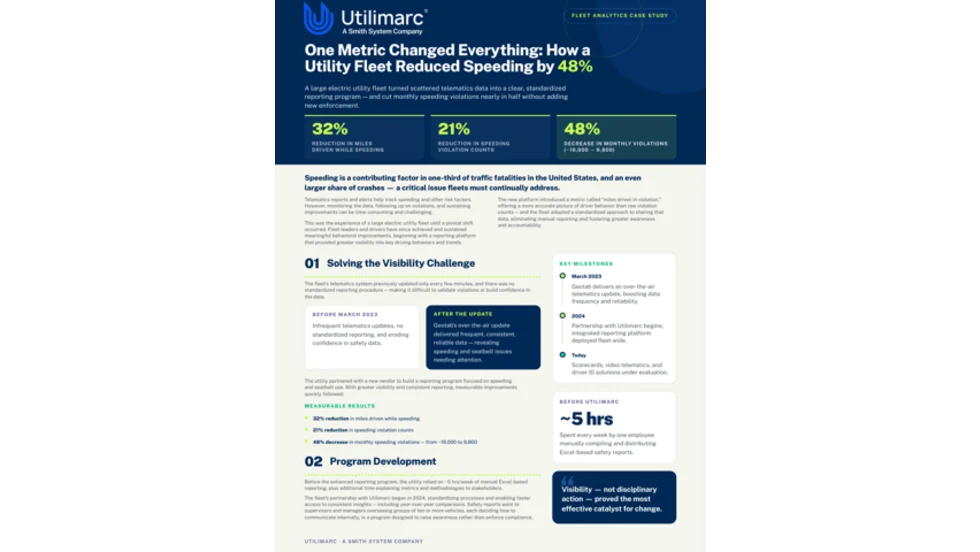
How Better Visibility Cut Speeding Violations by 48%
Fleet leaders don't need more data, they need clearer visibility into what the data is saying. This case study explores how one utility replaced speeding-event counts with a single metric — miles driven in violation — to strengthen safety and significantly reduce speeding violations.
Read More →