




DEARBORN, MI – In 1999, Ford Motor Company decided to further improve the compatibility of its larger vehicles in crashes with cars. The move has helped to significantly reduce fatalities in such collisions, according to a recent study by the Insurance Institute for Highway Safety (IIHS). The study supports Ford’s own findings that the number of passenger-car driver deaths in both front- and side-impact collisions between cars and SUVs or pickup trucks was substantially reduced when SUVs or pickup trucks were either lowered or equipped with special impact-absorbing bars below the front bumpers. The company’s patented BlockerBeam underride protection system, introduced on Excursion, is fashioned with less than 50 lbs. of steel. It is used on vehicles in which frame rails cannot be sufficiently lowered due to ground clearance and approach angle requirements for off-road use. Currently on the Ford F-250 and F-350 Super Duty models, the system allows a larger vehicle and a car to share energy during a crash, instead of the smaller car absorbing the bulk of the crash energy. The Ford BlockerBeam essentially is a hollow cross member attached to the frame approximately 2.5 inches below car bumpers and 6.5 inches behind the conventional front bumper. During a frontal collision with a car, the structure is designed to make contact with the frame rails of a car in an effort to help prevent the car from sliding beneath a higher-riding vehicle. To help manage crash energy from rear collisions, vehicles equipped with the BlockerBeam are fitted with Ford’s largest trailer hitch — standard on all models. The hitch spans more than three feet across the vehicle’s rear and attaches to the frame. The 3.5-square-inch hitch is designed to prevent lower-riding cars from sliding underneath the back of the F-250 and F350 Super Duty trucks. It also reduces the amount of intrusion into the passenger compartment of the car. The Volvo XC90 and Land Rover Range Rover and LR3 also are equipped with impact-absorbing bars. Ford has opted to lower the frame rails on other SUVs and pickups in order to provide better compatibility with cars. Those vehicles include the Ford Expedition, Explorer, Freestar, and F-150, Mercury Mountaineer and Monterey, Lincoln Navigator and Mark LT, and the Volvo XC70.
IIHS Study Affirms Ford's Vehicle Changes Reduce Fatalities
DEARBORN, MI – In 1999, Ford Motor Company decided to further improve the compatibility of its larger vehicles in crashes with cars. The move has helped to significantly reduce fatalities in such collisions, according to a recent study by the Insurance Institute for Highway Safety (IIHS).
More Safety

Reducing Risk by Eliminating Phone Use Behind the Wheel
Distracted driving remains one of the most persistent risks in fleet operations. New approaches focus on removing mobile device use entirely while adding real-time safety support.
Read More →
Distracted Driving in the Age of Smart Tech – Part 2
As distraction risks evolve, fleets are turning to smarter, more connected technologies to better understand what’s happening behind the wheel. Part 2 explores how these tools are helping identify risky behaviors and improve visibility across operations.
Read More →
Data Rights, Risks, and Responsibilities After a Crash
What fleets capture to improve safety can also expose them in litigation, forcing leaders to rethink how data is managed, stored, and shared.
Read More →
From Distraction to Detection: Strengthening Awareness in Fleet Drivers
Distracted driving is often measured by what we can see—phones in hand, eyes off the road. But what about the distractions we can’t? A recent incident raises a bigger question about awareness, attention, and why subtle risks so often go unnoticed.
Read More →
Lytx 2026 Road Safety Report
While serious crashes are declining, a rise in minor incidents and ongoing risk hotspots underscore the need for continued fleet safety investment.
Read More →
Behind-the-Wheel vs. Classroom Training: What Actually Changes Driver Behavior?
Fleets have more driver data than ever, so why isn't behavior changing? Training requires more than reports and coaching — it requires real-world practice.
Read More →
Distracted Driving in the Age of Smart Tech – Part 1
A two-part conversation with Stefan Heck on how AI is transforming the fight against distracted driving. As fleets adopt smarter tools, the focus shifts from reacting to preventing risk. In Part 1, we look at where AI is making an impact for fleets today.
Read More →
Pedestrian Safety Starts With the Driver
More people on foot means more risk for drivers. These pedestrian safety tips can help prevent serious injuries and keep everyone safer on the road.
Read More →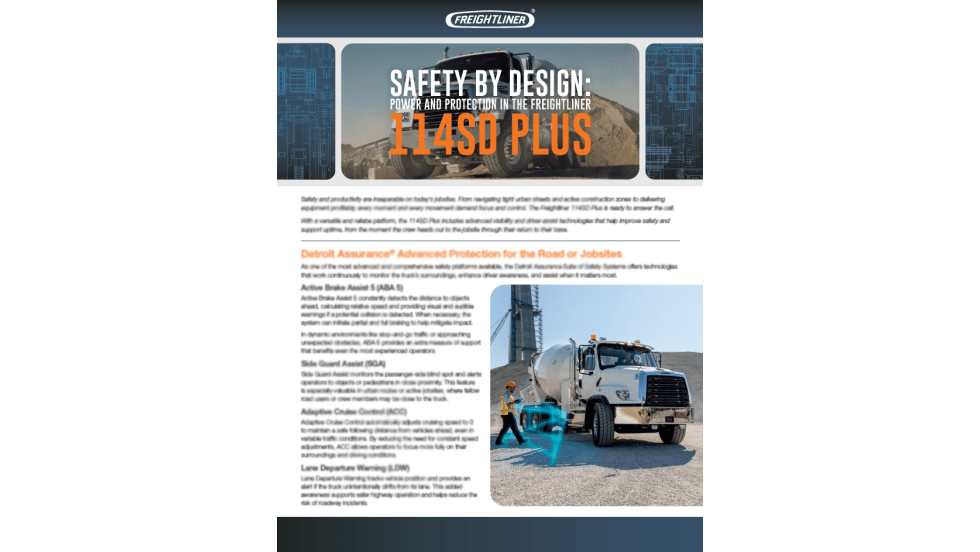
Safety by Design: Power and Protection in the Freightliner 114SD Plus
Fleet managers are under pressure to reduce accidents, control costs, and improve operational efficiency. See how advanced vehicle safety technologies are helping fleets operate smarter and safer.
Read More →
Pedestrian Deaths Drop in First Half of 2025, Marking Largest Decline in Years
An 11% drop in pedestrian fatalities in early 2025 signals progress in U.S. road safety, but elevated death rates and ongoing risks underscore the need for continued action from fleets and policymakers.
Read More →