





Looking for the latest insights on disaster preparation and response? Check out the Disaster Response Guide today!
How to Drive During an Earthquake [Video]
Earthquakes may not be common, but they can strike in every region of the country — and usually without warning. Drivers should know what to do if one hits when they're behind the wheel.
March 9, 2018
![How to Drive During an Earthquake [Video]](https://assets.bobitstudios.com/image/upload/f_auto,q_auto,dpr_auto,c_limit,w_920/Video-earthquake-driving-tip_1776004311743_rq00c1.jpg)
2 min to read
Earthquakes may not be common, but they can strike in every region of the country — and usually without warning. Drivers should know what to do if they hit something when they're behind the wheel.
Experts offer the following advice on driving during an earthquake:
Slow down, look for an open area, and pull over.
Avoid parking near bridges, overpasses, signs, building overhangs, power lines, trees, or anything that might fall onto your vehicle.
Turn off the engine, put the parking brake on, and keep seat-belted in your car until the earthquake is over.
Listen to your radio for official instructions, updates, warnings, and advice.
Look around for fallen trees and/or power lines. One of the most dangerous situations is when a power line falls on a vehicle. If this happens, stay inside the car and wait for emergency crews to arrive and remove it. In the meantime, do not touch windows, doors, or metal surfaces.
Finally, do not resume driving after an earthquake until authorities have officially cleared road travel.
Driving after an earthquake requires the utmost caution as well. Drivers should expect tremors and aftershocks that can easily dislodge concrete from damaged buildings. Allstate Insurance Company offers the following advice for driving after an earthquake:
Avoid roadways, ramps, and bridges that may have been damaged, even if there isn't any visible damage.
Look out for cracks and breaks in the pavement, and never drive over a fallen power line.
Be aware of traffic light outages and road obstructions.
Stay extra alert for panicked or distracted drivers on the road.
If driving in a mountainous or rocky area, be wary of the potential for landslides onto the road.
To learn more about what to do if you are behind the wheel when an earthquake hits, watch this video from the Southern California Earthquake Center.
More Safety

From Driver Well-Being to EV Charging | AF News Recap
Mental health belongs in the fleet safety conversation. This week, we’re looking at five ways fleets can support employee well-being before a crisis, plus Holman’s expansion in Mexico, new one-day Fleet Forward passes, and why EV charging demand is outpacing infrastructure growth.
Read More →
Nexar-Nauto Merger Aims to Give Fleets Better Safety Intelligence Through Larger Driving Dataset
Stefan Heck tells Automotive Fleet that combining more than 10 billion miles of driving history with Nexar's AI models will give fleets deeper insights into driver risk and roadway conditions than either company could provide independently.
Read More →
Don't Wait for a Crisis: 5 Ways to Build Mental Health Into Your Fleet Safety Program
For Suicide Prevention Month, fleet and safety leaders have an opportunity to put mental health where it belongs: at the center of workplace safety.
Read More →
How Camera Data Can Strengthen a Fleet’s Insurance Renewal
Insights from a commercial insurance carrier and a broker show how fleets can turn video telematic data, driver coaching, and improved claims results into a stronger case at insurance renewal.
Read More →
The Safest Fleets Aren’t the Ones with the Most Technology
You’ve made the telematics investment. Here’s how to capture the other half of its value and build the safest fleet on the road.
Read More →
Sponsored•August 7, 2026
Hidden in Plain Sight: Fleet Compliance Risks
Fleet compliance isn't just about having policies — it's about consistently enforcing them. This practical guide reveals six hidden compliance risks common in public sector and shared fleet operations and outlines proven strategies to improve visibility, accountability, and audit readiness
Read More →
NETS Sets 2026 Fleet Safety Benchmark Conference for Indianapolis
The Sept. 15–17 program will feature fleet benchmarking data, case studies, emerging technologies, and implementation strategies while running alongside the NSC Safety Congress & Expo.
Read More →
Off-the-Job Crashes Account for 43% of Employers’ $61.7 Billion Crash Burden
NETS quantifies costs dispersed across fleet, risk, HR, and other departments while providing new per-crash benchmarks for employers.
Read More →
Ram Recalls More Than 1.27 Million 1500 Pickups for Seat Belt Anchor Issue
The recall affects certain 2019-2026 Ram 1500 pickups that may have improperly attached second-row seat belt buckle anchors.
Read More →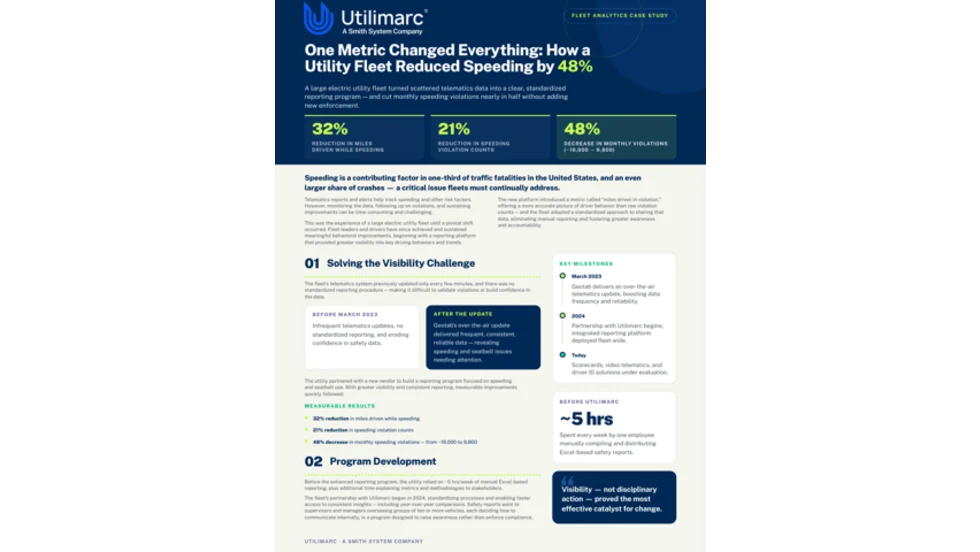
How Better Visibility Cut Speeding Violations by 48%
Fleet leaders don't need more data, they need clearer visibility into what the data is saying. This case study explores how one utility replaced speeding-event counts with a single metric — miles driven in violation — to strengthen safety and significantly reduce speeding violations.
Read More →