




How the Solar Eclipse Will Affect Fleets
The Aug. 21 solar eclipse will bring total or partial darkness to much of the continental U.S. – and with it, a potential traffic nightmare for drivers across the country.

Public Domain

Public Domain
The Aug. 21 solar eclipse will bring total or partial darkness to much of the continental U.S. – and with it, a potential traffic nightmare for drivers across the country.
While solar eclipses are a regular event, occurring, on average, once every 18 months, most of them happen across oceans or sparsely populated areas. This year's event is the first total solar eclipse in the United States in 38 years. The next may not come for another seven years. Vox.com has published a handy tool to find out how much of an eclipse will be visible from your zip code.
The entire U.S. will see at least a partial eclipse, but the sought-after total eclipse will follow a sweeping, narrow path from coast to coast. The potential for gridlock is even higher along the narrow band of total eclipse, which is expected to bring in floods of tourists to the 14 states along the eclipse path from Oregon to South Carolina.
In places like Kentucky, state and local agencies are preparing for the influx of visitors, asking people who must drive to plan ahead for any trips on the days surrounding the stellar event and to expect delays.
“We anticipate that a majority of the visitors will filter into the eight-county region over the two or three days before the eclipse,” said Wade Clements, Kentucky Transportation Cabinet district 2 chief engineer. “Once the eclipse is over, we are expecting traffic issues akin to what Louisville faces before and after the Kentucky Derby or Thunder Over Louisville. We urge motorists to plan ahead before traveling to or through the region the day of the eclipse.”
In Oregon, the state Department of Transportation is taking a proactive stance on the expected traffic. ODOT has already warned residents that the eclipse could trigger the largest traffic event in the state’s history.
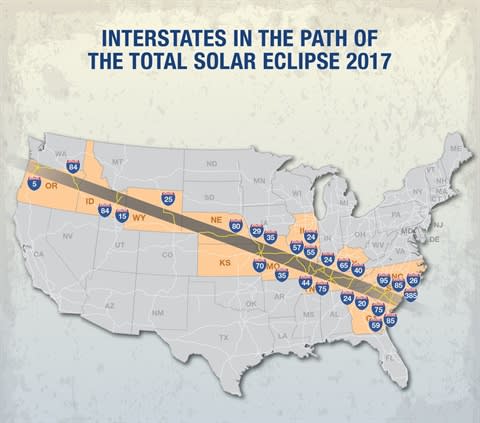
Map: FHWA/NASA
The Oregon Motor Carrier Transportation Division is taking steps to ease the congestion by banning certain kinds of traffic and roadside activity, including blocking over-width loads in the state from Aug. 18-22, stopping construction and non-emergency maintenance on state highways, and warning truckers of the lack of available parking and hotel rooms. In other states like Colorado, similar bans on oversized vehicles have also been issued to prepare for visitor traffic.
Some trucking companies have announced plans to reduce business in the most affected areas, with some companies cutting service entirely, while others are trying to plan around it, according to a KATU report from Portland, Oregon.
Each state will have restrictions in place to address the traffic, so make sure to check with the transportation agencies in each of the 14 states in the eclipse’s direct path to prepare for the traffic crunch. The Federal Highway Administration has set up apage dedicated to the August solar eclipse with links to state agency websites, general safety tips, as well as information on the event. It’s all a lot of preparation for an event that will only last a few minutes.
More Safety

What’s Next for Fleet? Safety, AI & Industry Recognition | AF News Recap
Could your company's culture be encouraging distracted driving? This week, we're exploring how workplace expectations affect driver safety, what AI, EVs, and autonomous vehicles could mean for the future of fleet management, and how fleet professionals can strengthen their award nominations.
Read More →
Does Your Fleet's Culture Encourage Distracted Driving?
What happens when the people responsible for enforcing safety rules are the ones setting the wrong example? The answer may reveal why some of the biggest risks to fleet drivers have little to do with what's written in the employee handbook.
Read More →
Fleet Manager’s Ultimate Playbook: Navigating the New Standard in OEM Connectivity
Rising operating costs, driver safety concerns, and unplanned downtime are putting unprecedented pressure on modern fleets. Discover how fleet managers use embedded OEM connectivity and real-time vehicle data to cut TCO, prevent downtime, and protect drivers without aftermarket telematics hardware.
Read More →
From Driver Well-Being to EV Charging | AF News Recap
Mental health belongs in the fleet safety conversation. This week, we’re looking at five ways fleets can support employee well-being before a crisis, plus Holman’s expansion in Mexico, new one-day Fleet Forward passes, and why EV charging demand is outpacing infrastructure growth.
Read More →
Nexar-Nauto Merger Aims to Give Fleets Better Safety Intelligence Through Larger Driving Dataset
Stefan Heck tells Automotive Fleet that combining more than 10 billion miles of driving history with Nexar's AI models will give fleets deeper insights into driver risk and roadway conditions than either company could provide independently.
Read More →
Don't Wait for a Crisis: 5 Ways to Build Mental Health Into Your Fleet Safety Program
For Suicide Prevention Month, fleet and safety leaders have an opportunity to put mental health where it belongs: at the center of workplace safety.
Read More →
How Camera Data Can Strengthen a Fleet’s Insurance Renewal
Insights from a commercial insurance carrier and a broker show how fleets can turn video telematic data, driver coaching, and improved claims results into a stronger case at insurance renewal.
Read More →
The Safest Fleets Aren’t the Ones with the Most Technology
You’ve made the telematics investment. Here’s how to capture the other half of its value and build the safest fleet on the road.
Read More →
Hidden in Plain Sight: Fleet Compliance Risks
Fleet compliance isn't just about having policies — it's about consistently enforcing them. This practical guide reveals six hidden compliance risks common in public sector and shared fleet operations and outlines proven strategies to improve visibility, accountability, and audit readiness
Read More →
NETS Sets 2026 Fleet Safety Benchmark Conference for Indianapolis
The Sept. 15–17 program will feature fleet benchmarking data, case studies, emerging technologies, and implementation strategies while running alongside the NSC Safety Congress & Expo.
Read More →