




How Stay on Top of Motor Vehicle Records
Regular monitoring of drivers' motor vehicle records help fleets further reduce accident risk. Here's how to do it.


Regular monitoring of drivers' motor vehicle records is a proven way for a fleet manager to reduce accident risk.
Screenshot via Driver's Alert/YouTube.
The two most significant predictors of crash involvement are prior total citation frequency followed by prior crash involvement frequency, according to research from the California Department of Motor Vehicles.
These two pieces of critical information are commonly found in a driver's motor vehicle record. It should come as no surprise then that careful monitoring of MVRs should be a top priority for fleet managers who want to mitigate risk, reduce accidents, and improve overall fleet safety.
Ron Kirsch, an occupational health and safety expert, recommends that fleet managers regularly review MVRs for all drivers. Annual reviews, says Kirsch, are not good enough.
Regular reviews allow fleet managers to stay on top of rapidly changing information, such as citations that have recently been added to an MVR, and to identify earlier any safety issues that need to be addressed.
To maximize fleet safety, Kirsch recommends fleet managers take the following steps concerning MVRs:
Monitor MVRs Monthly
Make a commitment to order MVRs for all drivers on a monthly basis, even if the practice is only required annually.
Maintain an Accurate Driver Roster
Fleet managers need to make sure the information in every MVR is correct. Take the time to validate the basics such as names, date of birth, and driver's license number. However, it's important to also validate whether or not a driver was ever licensed to drive in another state and if so, if that license has been surrendered. Obviously, you'll want to ensure the driver's current license is valid as well as see what certifications or endorsements he or she might have on record.
Look for At-Fault Accidents
These are the obvious accidents caused by reckless driving and DUIs, for example. With monthly MVR reviews you'll be in a position to spot high-risk drivers sooner, and take steps to correct the problem. Reckless drivers are 325% more likely to have an accident than the average driver, notes Kirsch.
Spot Red Flags
Violations like improper lane changes and failure to yield may seem minor, but if an MVR shows it's a consistent problem the driver may be a liability. Drivers with these kinds of violation are 91% to 105% more likely to have an at fault accident, according to the American Transportation Research Institute.
More Safety

Fleet Manager’s Ultimate Playbook: Navigating the New Standard in OEM Connectivity
Rising operating costs, driver safety concerns, and unplanned downtime are putting unprecedented pressure on modern fleets. Discover how fleet managers use embedded OEM connectivity and real-time vehicle data to cut TCO, prevent downtime, and protect drivers without aftermarket telematics hardware.
Read More →
From Driver Well-Being to EV Charging | AF News Recap
Mental health belongs in the fleet safety conversation. This week, we’re looking at five ways fleets can support employee well-being before a crisis, plus Holman’s expansion in Mexico, new one-day Fleet Forward passes, and why EV charging demand is outpacing infrastructure growth.
Read More →
Nexar-Nauto Merger Aims to Give Fleets Better Safety Intelligence Through Larger Driving Dataset
Stefan Heck tells Automotive Fleet that combining more than 10 billion miles of driving history with Nexar's AI models will give fleets deeper insights into driver risk and roadway conditions than either company could provide independently.
Read More →
Don't Wait for a Crisis: 5 Ways to Build Mental Health Into Your Fleet Safety Program
For Suicide Prevention Month, fleet and safety leaders have an opportunity to put mental health where it belongs: at the center of workplace safety.
Read More →
How Camera Data Can Strengthen a Fleet’s Insurance Renewal
Insights from a commercial insurance carrier and a broker show how fleets can turn video telematic data, driver coaching, and improved claims results into a stronger case at insurance renewal.
Read More →
The Safest Fleets Aren’t the Ones with the Most Technology
You’ve made the telematics investment. Here’s how to capture the other half of its value and build the safest fleet on the road.
Read More →
Hidden in Plain Sight: Fleet Compliance Risks
Fleet compliance isn't just about having policies — it's about consistently enforcing them. This practical guide reveals six hidden compliance risks common in public sector and shared fleet operations and outlines proven strategies to improve visibility, accountability, and audit readiness
Read More →
NETS Sets 2026 Fleet Safety Benchmark Conference for Indianapolis
The Sept. 15–17 program will feature fleet benchmarking data, case studies, emerging technologies, and implementation strategies while running alongside the NSC Safety Congress & Expo.
Read More →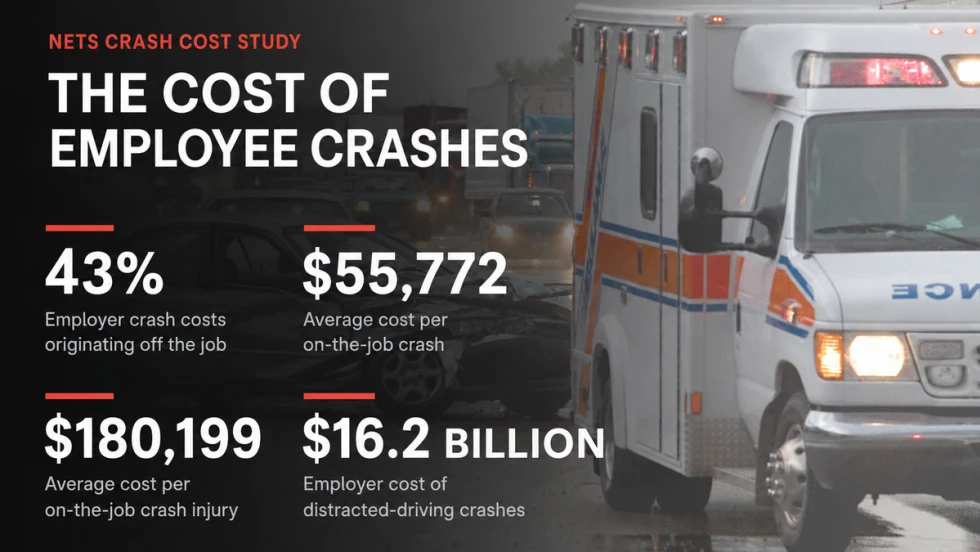
Off-the-Job Crashes Account for 43% of Employers’ $61.7 Billion Crash Burden
NETS quantifies costs dispersed across fleet, risk, HR, and other departments while providing new per-crash benchmarks for employers.
Read More →
Ram Recalls More Than 1.27 Million 1500 Pickups for Seat Belt Anchor Issue
The recall affects certain 2019-2026 Ram 1500 pickups that may have improperly attached second-row seat belt buckle anchors.
Read More →