




How Driverless Cars Will Signal Their Next Move
Ford teams with Virginia Tech on a research project investigating how driverless vehicles can best communicate with other road users, including pedestrians.

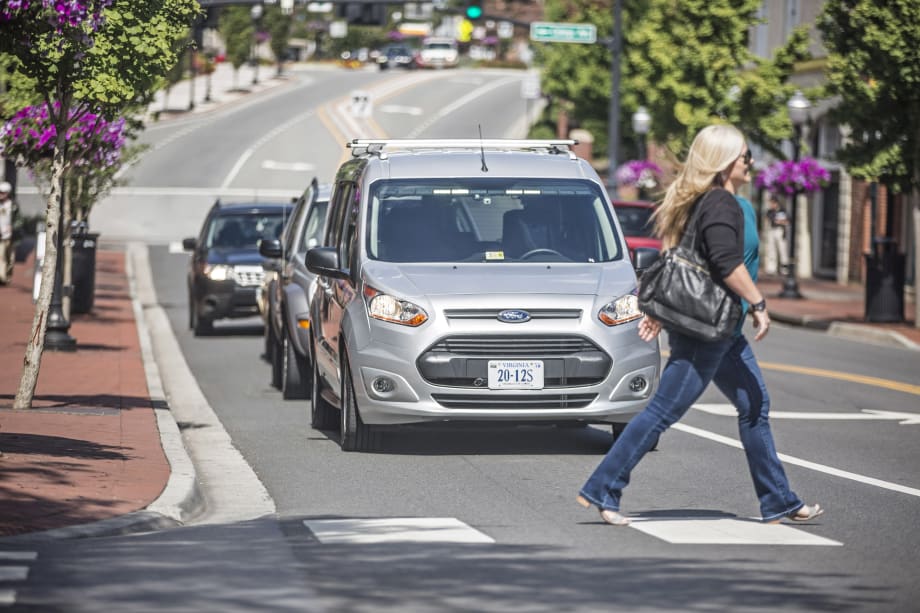
A pedestrian crosses the street in front of what appears to be a driverless van -- but isn't. Photo courtesy of Ford.
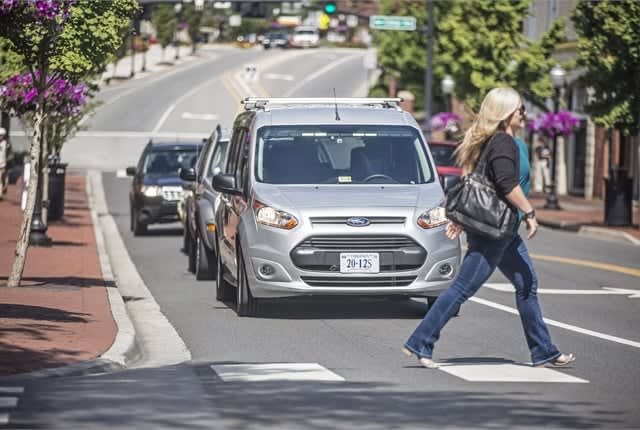
A pedestrian crosses the street in front of what appears to be a driverless van -- but isn't. Photo courtesy of Ford.
In everyday driving, a simple head nod or hand wave from a driver is usually enough to indicate it’s okay for a pedestrian to cross the street. But in the future, when autonomous vehicles travel the streets, how will a self-driving car with no human driver communicate with pedestrians, cyclists or humans operating other cars on the road?
Looking to prepare for this eventual reality, Ford Motor Co. partnered with Virginia Tech Transportation Institute to conduct a study that tested methods for communicating a self-driving vehicle’s intent. Researchers found creative ways to elicit real-world reactions to a self-driving car on public roads.
“Understanding how self-driving vehicles impact the world as we know it today is critical to ensuring we’re creating the right experience for tomorrow,” said John Shutko, Ford’s human factors technical specialist. “We need to solve for the challenges presented by not having a human driver, so designing a way to replace the head nod or hand wave is fundamental to ensuring safe and efficient operation of self-driving vehicles in our communities.”
The joint research project set out to investigate the most effective means for the vehicle to communicate. The team considered using displayed text, but that would require one universally understood language. The use of symbols was rejected because symbols historically have low recognition among consumers. In the end, the researchers decided lighting signals are the most effective means for creating a visual communications protocol for self-driving vehicles. Light signals for turning and braking are already standardized and widely understood.
Researchers found that lighting signals could communicate whether the vehicle was in autonomous drive mode, beginning to yield, or about to accelerate from a stop.
So Ford outfitted a Transit Connect van with a light bar placed on the windshield. To simulate a fully self-driving experience without using an actual autonomous vehicle, the Virginia Tech Transportation Institute team developed a way to conceal the driver with a “seat suit.”
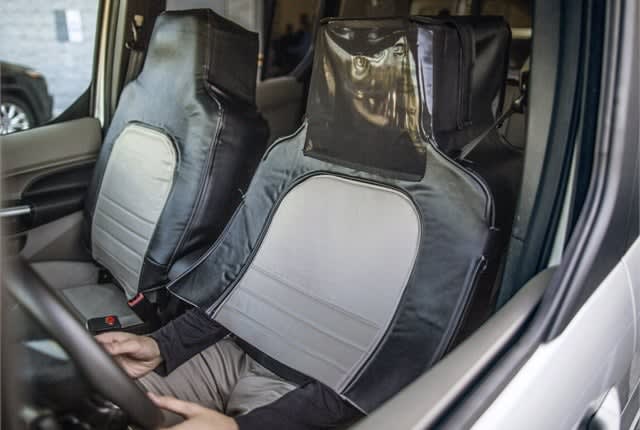
A driver wearing the seat suit developed by Virginia Tech Transportation Institute. Photo courtesy of Ford.
The suit created the illusion of a fully autonomous vehicle, which was necessary to test and evaluate real-world encounters and behaviors, Ford said. The researchers experimented with three light signals to test how the vehicle communicated its intent:
Yield — Two white lights that moved side to side, indicating the vehicle was about to yield to a full stop
Active autonomous driving mode — A solid white light to indicate the vehicle was driving autonomously
Start to go — A rapidly blinking white light to indicate the vehicle was beginning to accelerate from a stop.
The simulated autonomous Transit Connect was driven on public roads in northern Virginia — home to a density of traffic and pedestrians — throughout August, with researchers capturing video and logs of pedestrian reactions. More than 150 hours of data over approximately 1,800 miles of driving were collected in an urban environment, including encounters with pedestrians, bicyclists and other drivers. External signals were activated more than 1,650 times at various locations around Arlington, Va., including at intersections, parking lots, garages and airport roadways.
Numerous high-definition cameras mounted in the study vehicle provided a 360-degree view of surrounding areas and captured the behavior of other road users. This data will be valuable to understanding if other road users change their behaviors in response to self-driving vehicles and the signals they employ, according to Ford.
“This work is of value not only to vehicle users and manufacturers, but also to anyone who walks, rides or drives alongside autonomous vehicles in the future,” said Andy Schaudt, project director for the Center for Automated Vehicle Systems at the Virginia Tech Transportation Institute. “We are proud to support Ford in developing this important research.”
Ford is already working with several industry organizations to push toward creation of a standard, including the International Organization for Standardization and SAE International. A common visual communications interface most people can understand — across all self-driving vehicles in all locations — will help ensure safe integration into transportation systems, Ford said.
The automaker is also working on ways to communicate with those who are blind or visually impaired as part of a separate work stream.
“Preparing for a self-driving future is going to take all of us working together,” Shutko said. “That’s why we’re developing and advocating for a standard solution so it can be adopted by the industry and applied to all self-driving vehicles.”
More Safety

Nexar-Nauto Merger Aims to Give Fleets Better Safety Intelligence Through Larger Driving Dataset
Stefan Heck tells Automotive Fleet that combining more than 10 billion miles of driving history with Nexar's AI models will give fleets deeper insights into driver risk and roadway conditions than either company could provide independently.
Read More →
Don't Wait for a Crisis: 5 Ways to Build Mental Health Into Your Fleet Safety Program
For Suicide Prevention Month, fleet and safety leaders have an opportunity to put mental health where it belongs: at the center of workplace safety.
Read More →
How Camera Data Can Strengthen a Fleet’s Insurance Renewal
Insights from a commercial insurance carrier and a broker show how fleets can turn video telematic data, driver coaching, and improved claims results into a stronger case at insurance renewal.
Read More →
The Safest Fleets Aren’t the Ones with the Most Technology
You’ve made the telematics investment. Here’s how to capture the other half of its value and build the safest fleet on the road.
Read More →
Hidden in Plain Sight: Fleet Compliance Risks
Fleet compliance isn't just about having policies — it's about consistently enforcing them. This practical guide reveals six hidden compliance risks common in public sector and shared fleet operations and outlines proven strategies to improve visibility, accountability, and audit readiness
Read More →
NETS Sets 2026 Fleet Safety Benchmark Conference for Indianapolis
The Sept. 15–17 program will feature fleet benchmarking data, case studies, emerging technologies, and implementation strategies while running alongside the NSC Safety Congress & Expo.
Read More →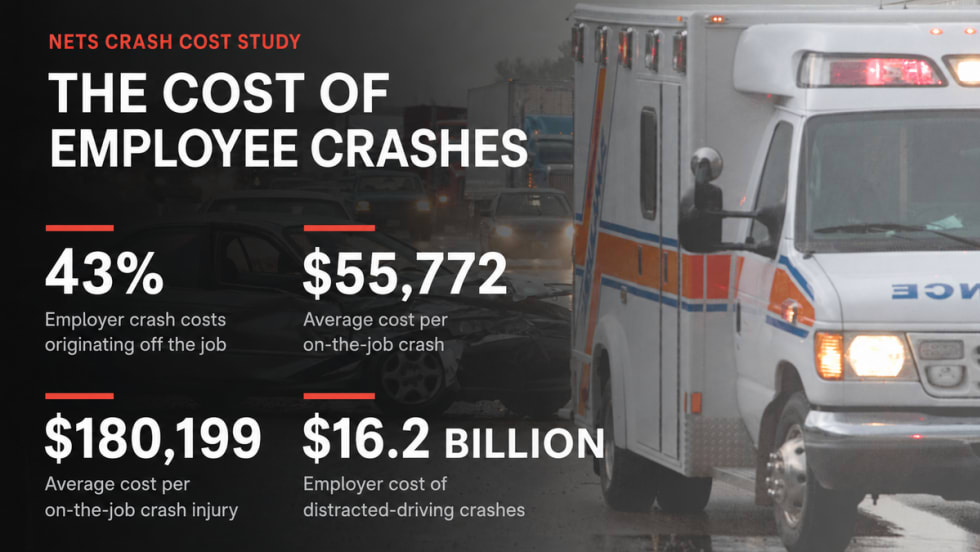
Off-the-Job Crashes Account for 43% of Employers’ $61.7 Billion Crash Burden
NETS quantifies costs dispersed across fleet, risk, HR, and other departments while providing new per-crash benchmarks for employers.
Read More →
Ram Recalls More Than 1.27 Million 1500 Pickups for Seat Belt Anchor Issue
The recall affects certain 2019-2026 Ram 1500 pickups that may have improperly attached second-row seat belt buckle anchors.
Read More →
How Better Visibility Cut Speeding Violations by 48%
Fleet leaders don't need more data, they need clearer visibility into what the data is saying. This case study explores how one utility replaced speeding-event counts with a single metric — miles driven in violation — to strengthen safety and significantly reduce speeding violations.
Read More →
Operation Safe Driver Week: Why the Industry's Oldest Safety Campaign Still Matters to Fleets
A look at how a 2007 enforcement initiative became one of the most consequential weeks on the fleet safety calendar, and what it means for your drivers in 2026.
Read More →