




House Approves Self-Driving Car Bill
The legislation seeks to accelerate deployment of highly automated passenger vehicles by consolidating and updating the safety regulations affecting them.
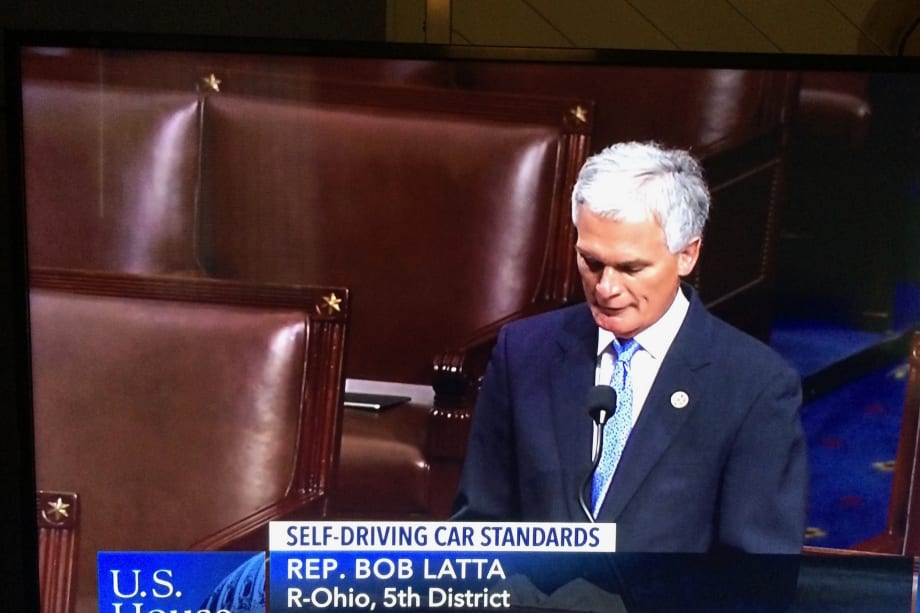
Representative Bob Latta (R-Ohio) urges passage of the Self-Drive Act before a voice vote on the floor. Photo courtesy of C-SPAN.
Representative Bob Latta (R-Ohio) urges passage of the Self-Drive Act before a voice vote on the floor. Photo courtesy of C-SPAN.
The U.S. House of Representatives on Wednesday, Sept. 6, passed a bill that provides a framework for future federal regulation of autonomous passenger vehicles and prohibits individual states from enacting laws regulating the design, construction or performance of such vehicles.
The Senate is expected to take up the issue of autonomous vehicle regulation later this month.
If enacted, the bill would allow an autonomous vehicle manufacturer to apply for an exemption from federal safety standards designed for conventional cars. During the first year of eligibility, the number of cars qualifying for such exemption per manufacturer would be capped at 25,000 vehicles. But that cap would rise to 100,000 over three years.
Passed on a voice vote in the House, the “Self Drive Act” seeks to accelerate deployment and testing of autonomous vehicles by eliminating the patchwork of state regulations involving such vehicles’ mechanical, hardware and software systems. The bill is also designed to ensure that existing safety regulations, written for traditional cars, don't hinder the advancement of autonomous vehicle technology.
"We have an opportunity today to support and promote the safe testing and deploying of this life-saving technology," said Bob Latta, chairman of the House Energy and Commerce subcommittee (Digital Commerce and Consumer Protection) that crafted the bill. "U.S. companies are investing in the research and development of this technology and should not be held up by regulatory barriers that were created when self-driving cars were just science fiction. We must act and we must act now."
The bill drew bipartisan support because of the technology's potential to lower traffic accidents and fatalities.
"Given the latest roadway fatality numbers, this technology is especially needed today," said Representative Greg Walden (R-Ore.), House Energy and Commerce Committee chair, before the vote. "Almost 40,000 people lost their lives on our roads last year."
Walden cited research indicating that 94% of traffic accidents result from human error.
The legislation requires that the U.S. Department of Transportation prepare a plan — within a year of the law’s enactment — to ensure the safety and security of highly automated vehicles. That plan would include new federal safety standards that take into account self-driving cars and light trucks.
The bill also directs the Department of Transportation to require the submission of safety assessment certifications from manufacturers of highly automated vehicles. The department would have two years to finalize rules for these certifications. In the meantime, manufacturers would need to submit safety assessment letters to the National Highway Traffic Safety Administration (NHTSA). Once final, the DOT would evaluate the rules every five years to ensure they’re up to date.
Under the bill, NHTSA must identify any elements that may require new federal standards. These guidelines might address such subjects as human-machine interface, sensors and cybersecurity.
Additionally, all manufacturers would need to submit written cybersecurity plans detailing company practices for detecting and responding to cyber attacks and unauthorized intrusions.
Within two years of the law's enactment, the Department of Transportation would issue a rule requiring that all self-driving vehicles weighing less than 10,000 pounds include a rear seat occupant alert system. Such systems warn drivers when a child or pet is left in the backseat. Also at the two-year mark, the department would need to complete research into the development of updated safety standards for motor vehicle headlights.
More Safety

Fleet Manager’s Ultimate Playbook: Navigating the New Standard in OEM Connectivity
Rising operating costs, driver safety concerns, and unplanned downtime are putting unprecedented pressure on modern fleets. Discover how fleet managers use embedded OEM connectivity and real-time vehicle data to cut TCO, prevent downtime, and protect drivers without aftermarket telematics hardware.
Read More →
From Driver Well-Being to EV Charging | AF News Recap
Mental health belongs in the fleet safety conversation. This week, we’re looking at five ways fleets can support employee well-being before a crisis, plus Holman’s expansion in Mexico, new one-day Fleet Forward passes, and why EV charging demand is outpacing infrastructure growth.
Read More →
Nexar-Nauto Merger Aims to Give Fleets Better Safety Intelligence Through Larger Driving Dataset
Stefan Heck tells Automotive Fleet that combining more than 10 billion miles of driving history with Nexar's AI models will give fleets deeper insights into driver risk and roadway conditions than either company could provide independently.
Read More →
Don't Wait for a Crisis: 5 Ways to Build Mental Health Into Your Fleet Safety Program
For Suicide Prevention Month, fleet and safety leaders have an opportunity to put mental health where it belongs: at the center of workplace safety.
Read More →
How Camera Data Can Strengthen a Fleet’s Insurance Renewal
Insights from a commercial insurance carrier and a broker show how fleets can turn video telematic data, driver coaching, and improved claims results into a stronger case at insurance renewal.
Read More →
The Safest Fleets Aren’t the Ones with the Most Technology
You’ve made the telematics investment. Here’s how to capture the other half of its value and build the safest fleet on the road.
Read More →
Hidden in Plain Sight: Fleet Compliance Risks
Fleet compliance isn't just about having policies — it's about consistently enforcing them. This practical guide reveals six hidden compliance risks common in public sector and shared fleet operations and outlines proven strategies to improve visibility, accountability, and audit readiness
Read More →
NETS Sets 2026 Fleet Safety Benchmark Conference for Indianapolis
The Sept. 15–17 program will feature fleet benchmarking data, case studies, emerging technologies, and implementation strategies while running alongside the NSC Safety Congress & Expo.
Read More →
Off-the-Job Crashes Account for 43% of Employers’ $61.7 Billion Crash Burden
NETS quantifies costs dispersed across fleet, risk, HR, and other departments while providing new per-crash benchmarks for employers.
Read More →
Ram Recalls More Than 1.27 Million 1500 Pickups for Seat Belt Anchor Issue
The recall affects certain 2019-2026 Ram 1500 pickups that may have improperly attached second-row seat belt buckle anchors.
Read More →