




Honda Updates High-Tech Accord for 2016
Honda presented the upgraded 2016 Accord in Silicon Valley. The new Accord comes equipped with advanced safety and driver-assistance tech, Honda Sensing, and dual infotainment systems, Apple Car Play and Android Auto.
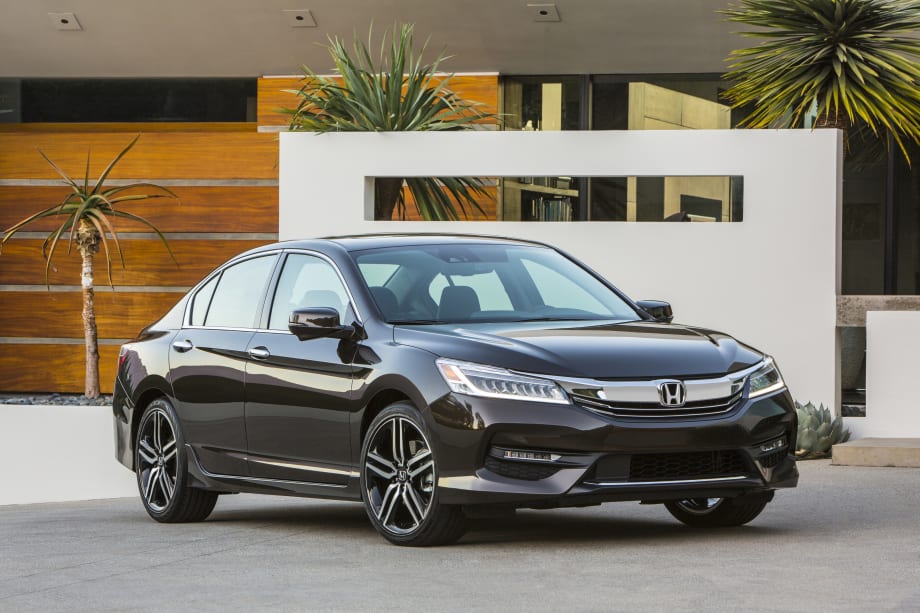
Photo courtesy of Honda.
Photo courtesy of Honda.
Honda has introduced its upgraded 2016 Accord in Silicon Valley because the vehicle comes equipped with advanced safety and driver-assistance tech, Honda Sensing, as well as Apple CarPlay and Android Auto functionality.
Honda Sensing, which is now available on all trim levels, is Honda's comprehensive suite of advanced safety and driver-assistive technologies. The package includes a collision mitigation braking system with forward collision warning, lane keeping assist, road departure mitigation with lane departure warning and adaptive cruise control. On the Touring trim, Honda Sensing is included as standard equipment.
The 2016 Accord will arrive in August as the first Honda model and among the first high-volume cars in the marketplace to feature both Apple CarPlay and Android Auto.
Honda has updated the Accord's audio and digital experience with a 7-inch display audio touchscreen interface featuring Apple CarPlay and Android Auto on EX and above trims, as well as available HondaLink Assist and HD Radio.
The 2016 Accord's new 7-inch touchscreen is paired with a 7.7-inch high-resolution display screen and steering wheel-mounted controls. The upper screen can display audio settings, turn-by-turn directions, time and trip information, LaneWatch and rearview camera displays, incoming calls, SMS text messages when stopped, and parking sensor alerts.
Also, all models feature a standard multiple-angle rearview camera and expanded view driver's mirror and, for the first time, new auto high-beam headlights (Touring trim) that enhance nighttime visibility and driving convenience by defaulting to the high-beam setting and automatically switching to low beams after detecting an oncoming vehicle.
In 2013, commercial fleets added 1,761 Accord mid-size sedans. The car ranked 11 out of 27 vehicles among fleets in the category of of Intermediate/Full-Size Cars, according to Automotive Fleet research.
More Operations
Here's When You Should Make an Exception to Fleet Policy
Fleet policies are designed to create consistency, but not every driver or situation fits neatly within standard rules.
Read More →
AI-Native or AI-Acquired: What Should Fleet Managers Look for in an AI Platform?
Six questions can help fleet managers look beyond AI marketing claims to evaluate integration, data access, and real-world operational performance.
Read More →
A buyer's guide to fleet management software in 2027
Buying fleet management software in 2027 means looking beyond features and price. As fleet operations, technology and expectations evolve, this guide explores what today’s fleet professionals should consider when choosing a system that can deliver value now and adapt to what comes next.
Read More →

What Will Shape the Next Era of Fleet Management?
EVs, AI, and autonomous vehicles are reshaping fleet management. Discover what’s ahead—and how fleet leaders can prepare for the next era.
Read More →
How Fleets Can Recruit and Train Veterans for Technician Roles
Here's how the technician shortage has affected uptime for fleets, and what to do about it.
Read More →
Avis Budget Group Deploys Neology Toll Management Technology Across Major Brands
Neology’s neoFleet platform will manage toll transactions and toll-authority operations for vehicles across Avis, Budget, Payless, Budget Truck and Zipcar.
Read More →
Fleet Personal-Use Charges Edge Higher in 2026
Nearly eight in 10 surveyed fleets allow personal use of company vehicles, while just over half of respondents report charging employees for the privilege.
Read More →
The Future of Fleet + What’s Changing Right Now | AF News Recap
Could developments overseas offer a preview of what’s coming for U.S. fleets? This week, we’re looking at the future of AI, autonomy, and electrification, plus Ford Pro’s new certified pre-owned program, smarter vehicle offboarding, and a new way for fleets to manage toll expenses.
Read More →
How to Handle Vehicle Offboarding
What do fleet managers need to do when a driver leaves?
Read More →
Fleet Manager’s Ultimate Playbook: Navigating the New Standard in OEM Connectivity
Rising operating costs, driver safety concerns, and unplanned downtime are putting unprecedented pressure on modern fleets. Discover how fleet managers use embedded OEM connectivity and real-time vehicle data to cut TCO, prevent downtime, and protect drivers without aftermarket telematics hardware.
Read More →