




Growth in Battery-Electric Trucks & Buses by 2030
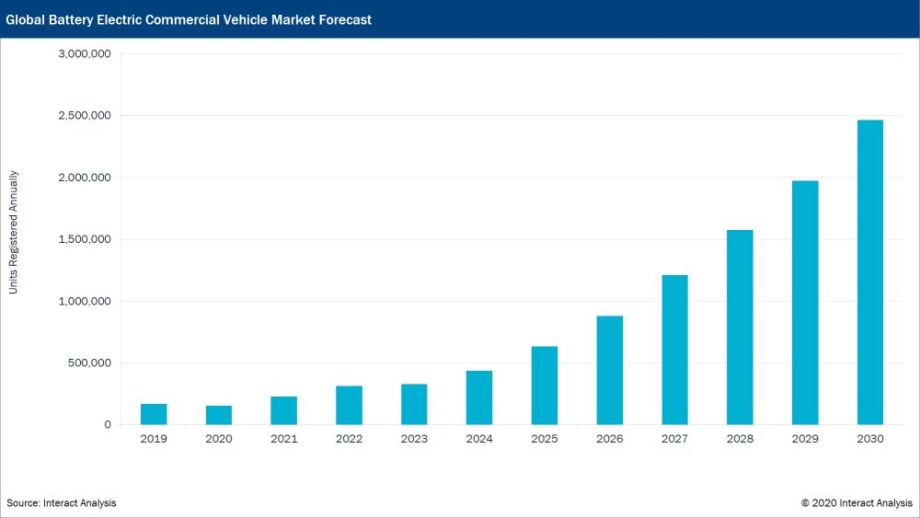
Though sales dipped from 168,000 in 2019 to around 156,000 in 2020, the projected global sales figure for 2021 stands at nearly 231,000 units - a 47% growth for the sector.

The total truck and bus market (battery-electric, fuel cell, hybrid, and diesel) will decline by 16% in 2020 but will see 15% growth in 2021.
Source: Interact Analysis
Interact Analysis completed its latest in-depth report on the commercial vehicle sector, with a particular focus on the battery-electric and hybrid market. After a severe COVID-induced setback in 2020, the industry is predicted to make a swift recovery in 2021, according to the research company, that noted hybridization is the favored solution for most long-distance vehicles; while full electric is preferred for city buses and last-mile delivery vehicles.
After a 7% decline in the market for battery-electric commercial vehicles in 2020, which was the continuation of a decline in 2019 and was largely due to Chinese subsidy policies, the sector is expected to bounce back in 2021. Interact Analysis said that though sales dipped from 168,000 in 2019 to around 156,000 in 2020, the projected global sales figure for 2021 stands at nearly 231,000 units - a 47% growth for the sector.
This expected driven by growth in Europe and North America, along with the extension of China’s EV subsidy program which was meant to come to an end in 2020. APAC will be streets ahead in 2021, surpassing the 2019 global figure with over 171,000 sales. Europe will be second in this league table, with a projected 44,000 new electric vehicle registrations in 2021. The total truck and bus market (battery-electric, fuel cell, hybrid, and diesel) will decline by 16% in 2020 but will see 15% growth in 2021.
Interact Analysis forecasts that electrified powertrains – hybrid, fuel cell, and battery-electric – will account for more than 2.5 million annual registrations of commercial vehicles by 2030, out of a total of more than 20 million. Battery electric powertrains are predicted to make serious inroads in the city bus and light-duty vehicle sectors, notably last-mile delivery vehicles, reflecting the anticipated lasting boom in online-shopping caused by the pandemic.
Inter-city bus fleets and long-haul trucks where pure battery electric is not always a viable option are predicted to see an increasing use of fuel cell technology, according to Interact Analysis.
The latest policy developments in China signalling a relaxation in green rules to stimulate production indicate that hybrid technologies will have a strong role in the region. Targets indicate that by 2030 New Energy Vehicles (battery electric or fuel-cell electric) should account for 30% of new sales in China while hybrids should account for 75% of ‘traditional energy’ vehicles. The impact on the medium and heavy-duty commercial vehicle market could be significant.
“We aren’t there yet with full electric powertrains for heavy-duty commercial vehicles, and we may not be for some time. Therefore, we predict that hybrid solutions will come to the fore in APAC (partly due to new regulations in China), whilst in Europe, OEM fleet CO2 emissions regulations (-15% by 2025 in the EU) will likely push mild hybridisation in heavy-duty applications. California, along with several other U.S. states, is mandating OEMs to sell a certain number of zero emission commercial vehicles. This will disincentivise OEMs to sell hybrids as these vehicles may cannibalise zero-emission vehicle sales," said Rueben Scriven, Senior Analyst at Interact Analysis.
Originally posted on Work Truck Online
More Global Fleet

GeoFencing Adds to Your Truck Security Arsenal
Geofencing is a familiar fleet tool today, but its early adoption marked a major shift in vehicle tracking, route monitoring, and the debate over employee privacy.
Read More →
Holman Takes Full Ownership of ARIZA in Mexico
Holman is bringing its Mexican fleet management operation fully under its own brand after more than 30 years as a joint venture. The change gives multinational fleet customers a single Holman operation across the U.S., Canada, and Mexico.
Read More →
5 Tire Maintenance Tips to Help Prevent Work Truck Downtime
Regular tire checks can do more than extend tread life. These five maintenance practices can help work truck fleets catch problems early, reduce costs, and prevent downtime.
Read More →

Proven Ways to Reduce Work Truck Downtime
The age-old problem of downtime will always be a reality, but with new strategies at hand, fleets have more ways to keep trucks on the road longer.
Read More →


Cameras, Safety and Insurance: From Reactive Claims to Real-Time Prevention (Part 2 of 2)
Part Two: Commercial auto remains one of the most challenging and costly lines of coverage for fleet operators and insurers alike. Continue learning more about how to effectively address these issues from Onur Aksan, Enterprise Business Development Executive, Geotab
Read More →
Cameras, Safety and Insurance: From Reactive Claims to Real-time Prevention
Commercial auto remains one of the most challenging and costly lines of coverage for fleet operators and insurers alike. Learn more about how to effectively address these issues from Onur Aksan, Enterprise Business Development Executive, Geotab.
Read More →
Fleet Costs Are Rising: Here’s How Leaders Are Responding
Fleet leaders are under pressure to reduce costs, adapt to economic uncertainty, and make smarter decisions. See how peers across North America are responding with real data, proven strategies, and forward-looking insights. Download the 2026 Market Pulse Report to benchmark your strategy and uncover where you can gain an edge.
Read More →
Enterprise Fleet Management Surpasses 900,000 Vehicles in U.S. & Canada
Enterprise Mobility connects with mobility solutions around the globe
Read More →