




GM’s Lutz Extols ‘Electric Evolution’ at LA Auto Show
LOS ANGELES - Bob Lutz filled in as keynote speaker on day one of the Los Angeles Auto Show press days, outlining GM's electric vehicle research and product development, including the Chevrolet Volt.
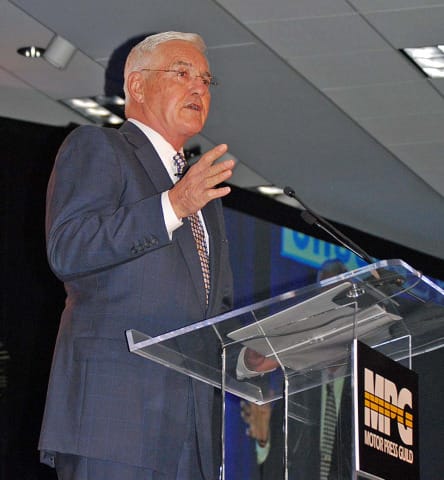
Bob Lutz, General Motors vice chair of marketing and communications, outlined the automaker's electric vehicle research and product development, including the Chevrolet Volt, an electric vehicle with extended-range.
LOS ANGELES - Announcing new partnerships to further develop electric vehicles, Bob Lutz, General Motors vice chair of marketing and communications, told members of the Motor Press Guild (MPG) in a keynote address Dec. 2 at the Los Angeles Auto Show , "Going forward, the auto industry can no longer rely on oil to supply 98 percent of world's automotive energy requirements."
Considering global energy and environmental issues and the automobile's future, that "one fact stands out above all others," said Lutz, who outlined GM's electric vehicle research and product development, including the Chevrolet Volt, an electric vehicle with extended-range.
Lutz was a last-minute substitution for planned speaker GM's CEO Fritz Henderson, who abruptly resigned his post the day before the MPG event. Praising Henderson as an "intelligent" and highly capable leader, Lutz declined to comment further on the GM management development.
Lutz' presentation focused on the "Electric Evolution," and he announced the 2011 Volt will be available first to the California market "by the end of next year," followed by launches in other "lead markets" to be made public in the coming weeks.
He also announced new partnerships with three California utilities - Pacific Gas & Electric, Southern California Edison, and the Sacramento Municipal Utility District - and the Electric Power Research Institute (EPRI), an independent non-profit research organization based in Palo Alto, Calif. With the help of a matching $30 million U.S. Department of Energy (DOE) grant, the partnerships "will advance the electrification of the automobile," Lutz explained.
As part of the program, GM will deliver more than 100 Chevrolet Volts to participants to use in their fleets for two years, starting in early 2011. Findings based on performance data collected though the Volt's OnStar system and driver feedback will be reported to the DOE. The "extended, real-world study will help us make electric vehicles as good as they can be for our EV [electric vehicle] customers," said Lutz.
Advanced lithium-ion battery technology is "key" to marketing and public acceptance of the Volt and other electrically driven vehicles, Lutz said. He described GM's research and development efforts this area, including a joint engineering development contract with LG Chem and Compact Power, and a partnership with the University of Michigan to create a new advanced battery lab and specialized battery engineering curriculum. In August, GM also opened a high-volume lithium-ion battery pack plant in Brownstown, Mich.
Lutz also cited GM's multipronged alternatively powered vehicle strategy, which includes internal combustion engine improvements, broad-scale application of hybrid technology, advanced biofuels, such as cellulosic and non-food-based ethanol development, and hydrogen fuel-cell vehicles, including the Chevrolet Equinox Fuel Cell now undergoing testing with selected GM customers.
In addition to noting the company's technology and research partnerships with business and agencies in China, India, and Brazil, the GM vice chairman pointed out the single "tough, but fair," national standard to control greenhouse gas emissions and fuel economy U.S. automakers endorsed last summer. "A single standard helps OEMs improve our planning and manufacturing efficiency, and develop future product plans with greater consistency and certainty," said Lutz.
More Operations

How Fleets Can Recruit and Train Veterans for Technician Roles
Here's how the technician shortage has affected uptime for fleets, and what to do about it.
Read More →
Avis Budget Group Deploys Neology Toll Management Technology Across Major Brands
Neology’s neoFleet platform will manage toll transactions and toll-authority operations for vehicles across Avis, Budget, Payless, Budget Truck and Zipcar.
Read More →
Fleet Personal-Use Charges Edge Higher in 2026
Nearly eight in 10 surveyed fleets allow personal use of company vehicles, while just over half of respondents report charging employees for the privilege.
Read More →
The Future of Fleet + What’s Changing Right Now | AF News Recap
Could developments overseas offer a preview of what’s coming for U.S. fleets? This week, we’re looking at the future of AI, autonomy, and electrification, plus Ford Pro’s new certified pre-owned program, smarter vehicle offboarding, and a new way for fleets to manage toll expenses.
Read More →
How to Handle Vehicle Offboarding
What do fleet managers need to do when a driver leaves?
Read More →
Fleet Manager’s Ultimate Playbook: Navigating the New Standard in OEM Connectivity
Rising operating costs, driver safety concerns, and unplanned downtime are putting unprecedented pressure on modern fleets. Discover how fleet managers use embedded OEM connectivity and real-time vehicle data to cut TCO, prevent downtime, and protect drivers without aftermarket telematics hardware.
Read More →
U.S. Bank Adds Verra Mobility Toll Management to Voyager Fleet Platform
The integration allows U.S. Bank Voyager fleet customers to manage toll payments and violations alongside fuel, EV charging and maintenance expenses.
Read More →
ADAS Prevents Crashes. But Repairs Cost More | AF News Recap
ADAS-equipped vehicles may crash less often, but they can cost more when they do. This week, we’re breaking down what that tradeoff means for fleets, plus Subaru’s first Forester Wilderness Hybrid, Nissan’s new e-POWER Rogue, and why Calstart has become Catalyst Mobility.
Read More →
Moventum Fleet Management Names Mark Iorillo Head of Sales
Iorillo brings nearly 20 years of fleet management and sales experience to the role, including previous positions at Element Fleet Management, CEI, Donlen and Ryder.
Read More →
Fleet Has a Talent Pipeline Problem. What Comes Next? | AF News Recap
Where will fleet’s next generation of leaders come from? This week, we’re looking at the industry’s talent pipeline, what certification can add to a fleet career, how to build an award-worthy track record, and the return of Automotive Fleet’s Personal Use Survey.
Read More →