




GM to Replace Lock Cylinder During Ignition Switch Recall
The automaker is adding this second repair to the 2.2 million vehicles already recalled in the U.S.
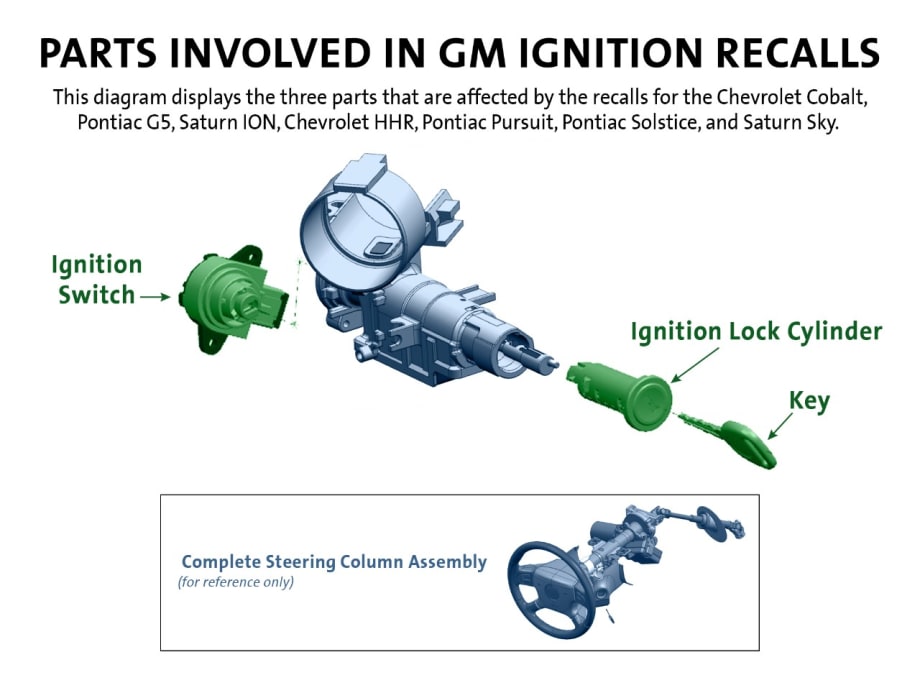
Diagram courtesy of General Motors.
Diagram courtesy of General Motors.
General Motors has informed the National Highway Traffic Safety Administration of plans to replace the ignition lock cylinders in the 2.2 million cars covered by the ignition switch recall in the U.S.
The cylinders can allow removal of the ignition key while the engine is running, leading to a possible rollaway and increasing the likelihood of a crash.
“As always, owners of manual transmission vehicles should be sure the ignition is in the “off” position and set to reverse gear with the parking brake set before removing the key,” the company advised. “Owners of vehicles with automatic transmission should be sure the vehicle is in “park” before removing the key.”
GM said it is aware of several hundred complaints of keys coming out of ignitions. Searches of GM and government databases found one rollaway in a parking lot that resulted in a crash and one injury claim. The same searches turned up no fatalities, the automaker said.
GM has decided to replace the ignition lock cylinders and cut and, if necessary, reprogram new keys.
The cars covered are model years:
2003-2007 Saturn Ion
2005-2010 Chevrolet Cobalt
2006-2010 Pontiac Solstice
2007-2010 Pontiac G5
2007-2010 Saturn Sky
2006-2011 Chevrolet HHR.
All of these cars were recalled in recent weeks for ignition switches that may fail to meet GM’s torque specification. The ignition switch may unintentionally move from the “run” position to the “accessory” or “off” position, with a corresponding reduction or loss of power. This risk may be increased if the key ring is carrying added weight, or if the vehicle goes off the road or experiences some other jarring event.
The timing of the key movement out of the “run” position, relative to activation of the sensing algorithm of a crash, may result in the airbags not deploying. This condition increases the potential for occupant injury in certain kinds of crashes, GM said.
Until recall repairs are made, GM is advising owners of the recalled vehicles to remove all items except the vehicle key from their key rings. If there is a key fob, it also should be removed from the key ring.
More Safety
IIHS Crash Avoidance Tests Reveal Safety Gaps in Cargo Vans and Work Trucks
New crash-avoidance ratings from the Insurance Institute for Highway Safety reveal inconsistent performance among commercial vehicles, with several popular cargo vans and heavy-duty pickups struggling to avoid collisions with other vehicles and pedestrians.
Read More →
What’s Next for Fleet? Safety, AI & Industry Recognition | AF News Recap
Could your company's culture be encouraging distracted driving? This week, we're exploring how workplace expectations affect driver safety, what AI, EVs, and autonomous vehicles could mean for the future of fleet management, and how fleet professionals can strengthen their award nominations.
Read More →
Does Your Fleet's Culture Encourage Distracted Driving?
What happens when the people responsible for enforcing safety rules are the ones setting the wrong example? The answer may reveal why some of the biggest risks to fleet drivers have little to do with what's written in the employee handbook.
Read More →
Fleet Manager’s Ultimate Playbook: Navigating the New Standard in OEM Connectivity
Rising operating costs, driver safety concerns, and unplanned downtime are putting unprecedented pressure on modern fleets. Discover how fleet managers use embedded OEM connectivity and real-time vehicle data to cut TCO, prevent downtime, and protect drivers without aftermarket telematics hardware.
Read More →
From Driver Well-Being to EV Charging | AF News Recap
Mental health belongs in the fleet safety conversation. This week, we’re looking at five ways fleets can support employee well-being before a crisis, plus Holman’s expansion in Mexico, new one-day Fleet Forward passes, and why EV charging demand is outpacing infrastructure growth.
Read More →
Nexar-Nauto Merger Aims to Give Fleets Better Safety Intelligence Through Larger Driving Dataset
Stefan Heck tells Automotive Fleet that combining more than 10 billion miles of driving history with Nexar's AI models will give fleets deeper insights into driver risk and roadway conditions than either company could provide independently.
Read More →
Don't Wait for a Crisis: 5 Ways to Build Mental Health Into Your Fleet Safety Program
For Suicide Prevention Month, fleet and safety leaders have an opportunity to put mental health where it belongs: at the center of workplace safety.
Read More →
How Camera Data Can Strengthen a Fleet’s Insurance Renewal
Insights from a commercial insurance carrier and a broker show how fleets can turn video telematic data, driver coaching, and improved claims results into a stronger case at insurance renewal.
Read More →
The Safest Fleets Aren’t the Ones with the Most Technology
You’ve made the telematics investment. Here’s how to capture the other half of its value and build the safest fleet on the road.
Read More →
Hidden in Plain Sight: Fleet Compliance Risks
Fleet compliance isn't just about having policies — it's about consistently enforcing them. This practical guide reveals six hidden compliance risks common in public sector and shared fleet operations and outlines proven strategies to improve visibility, accountability, and audit readiness
Read More →