




GM Says Self-Driving Vehicle Technology to be Available by Decade’s End
DETROIT - General Motors’ Vice President of Global Research and Development Alan Taub commented on autonomous vehicle development during the Intelligent Transport Systems World Congress in Orlando.
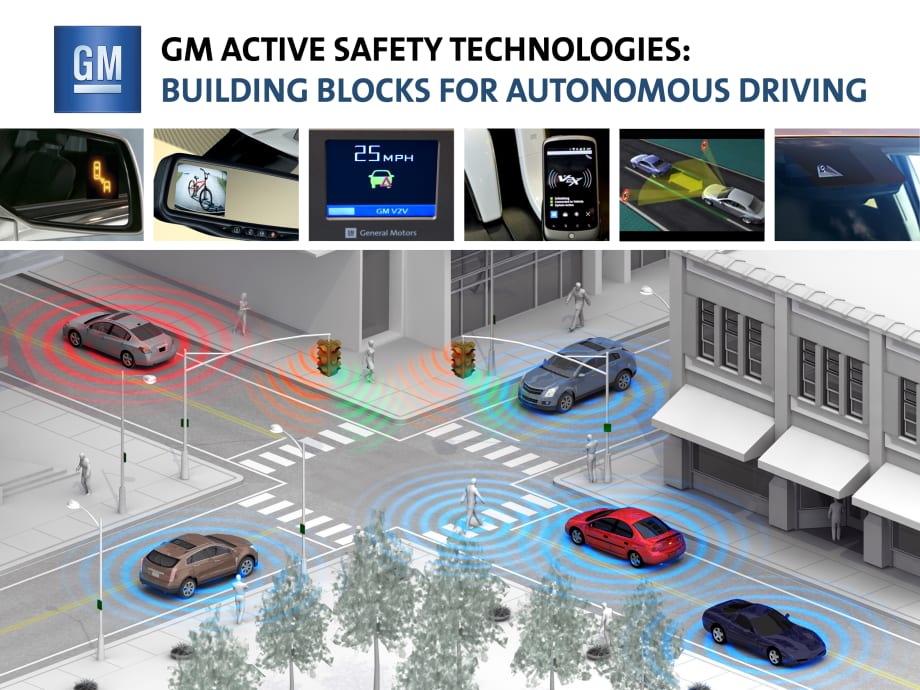
This diagram from GM shows how a range of technologies will work together to enable autonomous driving.
This diagram from GM shows how a range of technologies will work together to enable autonomous driving.
DETROIT – General Motors’ Vice President of Global Research and Development Alan Taub said technologies that enable vehicles to drive themselves will be available by the end of the decade. He added that vehicles that partially drive themselves will be available by the middle of the decade.
Taub made these comments to the Intelligent Transport Systems World Congress in Orlando on Sunday, Oct. 16. He said that these new technologies are being built on leading-edge active safety systems. Technologies such as sensors, radar, portable communication devices, GPS, and cameras provide information about the vehicle and its surroundings to a vehicle’s computer system and the driver.
“The technologies we’re developing will provide an added convenience by partially or even completely taking over the driving duties,” Taub said. “The primary goal, though, is safety. Future generation safety systems will eliminate the crash altogether by interceding on behalf of drivers before they’re even aware of a hazardous situation.”
GM said it’s already including a number of these safety systems in its vehicles. A lane departure warning system is available on the Chevrolet Equinox and GMC Terrain; the Cadillac Escalade, GMC Yukon, Chevrolet Tahoe, and Suburban all offer an available side blind-zone alert. A number of GM vehicles, including the Equinox and Terrain, offer back-up cameras.
The automaker said additional advanced safety systems in development that will provide the foundation for autonomous driving including the following:
Crash Avoidance: A crash avoidance system available on the 2012 GMC Terrain uses a camera to help drivers avoid front-end and lane departure crashes. The system uses a high-resolution digital camera mounted on the windshield ahead of the rearview mirror to look for shapes of vehicles and lane markings, alerting the driver to possible collisions and lane departures.
V2V and V2I Systems: Vehicle-to-vehicle and vehicle-to-infrastructure communication systems gather information from other vehicles, roadways, and traffic signals to warn drivers about possible hazards ahead. For example, slowed or stalled vehicles, hard-braking drivers, slippery roads, sharp curves, and upcoming stop signs and intersections. These systems, on display this week at the ITS World Congress, can be embedded in the vehicle or be added as applications to portable devices/smartphones that connect wirelessly to the vehicle.
The EN-V urban mobility concept combines GPS with vehicle-to-vehicle communications and distance-sensing technologies to enable autonomous driving. The EN-V’s capabilities, which GM said are being demonstrated at the ITS World Congress, includes pedestrian detection, collision avoidance, platooning, and automated parking and retrieval, where the EN-V drops off its driver, parks itself and then returns to pick up the driver via commands from a smartphone.
With regard to autonomous vehicle system development, GM worked with Carnegie Mellon University to develop the “The Boss” Chevrolet Tahoe that brought autonomous vehicle operation to life in 2007 and won the DARPA Urban Challenge.
The event required teams to build a driverless vehicle capable of driving in traffic and performing complex maneuvers such as merging, passing, parking, and negotiating intersections over a 60-mile course.
More Safety

Fleet Manager’s Ultimate Playbook: Navigating the New Standard in OEM Connectivity
Rising operating costs, driver safety concerns, and unplanned downtime are putting unprecedented pressure on modern fleets. Discover how fleet managers use embedded OEM connectivity and real-time vehicle data to cut TCO, prevent downtime, and protect drivers without aftermarket telematics hardware.
Read More →
From Driver Well-Being to EV Charging | AF News Recap
Mental health belongs in the fleet safety conversation. This week, we’re looking at five ways fleets can support employee well-being before a crisis, plus Holman’s expansion in Mexico, new one-day Fleet Forward passes, and why EV charging demand is outpacing infrastructure growth.
Read More →
Nexar-Nauto Merger Aims to Give Fleets Better Safety Intelligence Through Larger Driving Dataset
Stefan Heck tells Automotive Fleet that combining more than 10 billion miles of driving history with Nexar's AI models will give fleets deeper insights into driver risk and roadway conditions than either company could provide independently.
Read More →
Don't Wait for a Crisis: 5 Ways to Build Mental Health Into Your Fleet Safety Program
For Suicide Prevention Month, fleet and safety leaders have an opportunity to put mental health where it belongs: at the center of workplace safety.
Read More →
How Camera Data Can Strengthen a Fleet’s Insurance Renewal
Insights from a commercial insurance carrier and a broker show how fleets can turn video telematic data, driver coaching, and improved claims results into a stronger case at insurance renewal.
Read More →
The Safest Fleets Aren’t the Ones with the Most Technology
You’ve made the telematics investment. Here’s how to capture the other half of its value and build the safest fleet on the road.
Read More →
Hidden in Plain Sight: Fleet Compliance Risks
Fleet compliance isn't just about having policies — it's about consistently enforcing them. This practical guide reveals six hidden compliance risks common in public sector and shared fleet operations and outlines proven strategies to improve visibility, accountability, and audit readiness
Read More →
NETS Sets 2026 Fleet Safety Benchmark Conference for Indianapolis
The Sept. 15–17 program will feature fleet benchmarking data, case studies, emerging technologies, and implementation strategies while running alongside the NSC Safety Congress & Expo.
Read More →
Off-the-Job Crashes Account for 43% of Employers’ $61.7 Billion Crash Burden
NETS quantifies costs dispersed across fleet, risk, HR, and other departments while providing new per-crash benchmarks for employers.
Read More →
Ram Recalls More Than 1.27 Million 1500 Pickups for Seat Belt Anchor Issue
The recall affects certain 2019-2026 Ram 1500 pickups that may have improperly attached second-row seat belt buckle anchors.
Read More →