GM Leads Industry Evaluation of Rear Impact Crash Dummy
DETROIT – General Motors is leading a collaborative research effort exploring the potential use of a new crash test dummy designed to help automakers and safety experts better understand how crash victims are hurt in rear impacts.
by Staff
August 27, 2012
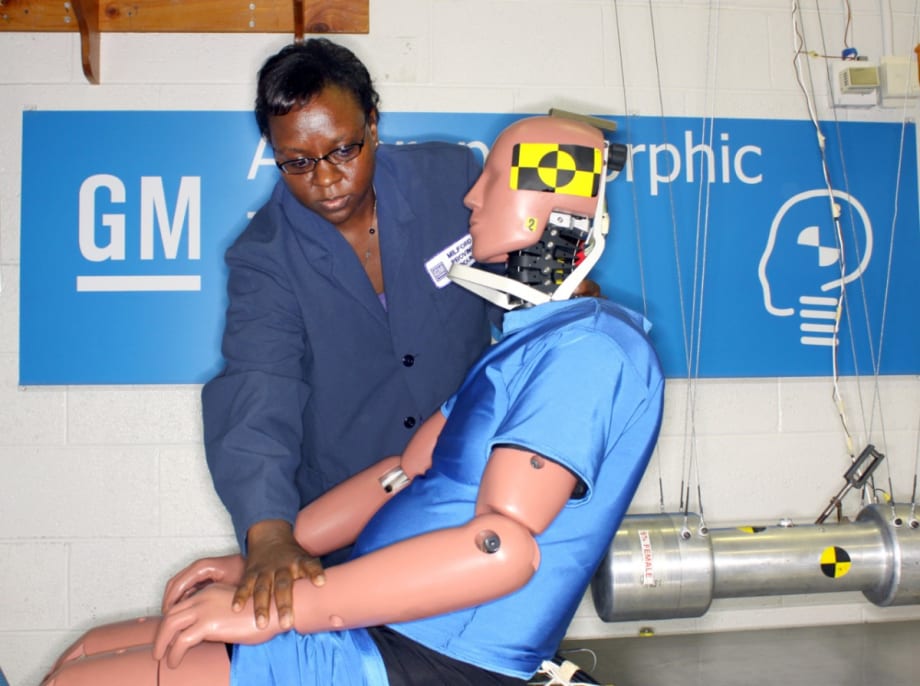
Engineer Barbara Bunn works with a BioRID crash test dummy in the GM Anthropomorphic Test Lab at the Milford Proving Ground in Milford, Mich. (Photo by Chris Guddeck for General Motors).
3 min to read
DETROIT – General Motors is leading a collaborative research effort exploring the potential use of a new crash test dummy designed to help automakers and safety experts better understand how crash victims are hurt in rear impacts.
The dummy, called BioRID, was designed by Chalmers University in Gothenburg, Sweden, for seat restraint assessment. It is distinguished by its sophisticated spinal column with 24 vertebra simulators that allow it to sit naturally. The dummy demonstrates humanlike neck movement in rear-end collisions.
Ad Loading...
To gain acceptance, BioRID needs to deliver repeatable, reproducible test results – a feat that’s considered integral to the design and evaluation of vehicle safety.
GM crash test engineer Barbara Bunn recently developed and conducted tests to evaluate the ability of different BioRIDs to produce consistent measurements when subjected to identical tests. The United States Council for Automotive Research in May recognized Bunn for her execution of the test matrix.
Bunn chairs the Occupant Safety Research Partnership’s Rear Impact Dummy Task Group.
“The test matrix Barb developed will be helpful to the industry for determining BioRID’s future, and demonstrates GM’s commitment to advancing crash test dummy technology and procedures for evaluating vehicle safety,” said Gay Kent, GM general director of vehicle safety and crashworthiness.
To create the test matrix, Bunn collaborated with engineers from Chrysler, Ford and Humanetics Innovative Systems, which manufactures the BioRID.
Ad Loading...
Bunn designed the construction of a crash simulator sled to simultaneously test four BioRIDs. She worked with safety engineers from Porsche, Volkswagen, Daimler, Chrysler and Ford to determine seating postures and other test criteria. The tests subjected the dummies to a low-speed rear impact simulation in nearly identical seats, and collected measurements of crash forces on areas such as the upper and lower neck.
Engineer Barbara Bunn works with a BioRID crash test dummy in the GM Anthropomorphic Test Lab at the Milford Proving Ground in Milford, Mich. (Photo by Chris Guddeck for General Motors).
The team compared its measurements to data from similar tests conducted by other automaker labs in Europe and provided its findings to regulators worldwide for consideration.
BioRID is one of many so-called anthropomorphic test devices (ATDs) -- the formal name for crash test dummies. GM routinely tests with a wide range of adult male-, female- and child-size ATDs that house sophisticated data collection sensors, capable of generating status reports 10,000 times per second.
GM engineers analyze data from physical crash tests and computer simulations to understand how a vehicle, its safety systems and occupants respond during a crash. These data help engineers look for ways to enhance vehicle safety.
“The execution of the BioRID test matrix couldn’t have been done without a strong spirit of collaboration,” Bunn said. “Ultimately, every automaker wants to improve the crash dummies that we use to design safety into our vehicles. That way, all of our customers will benefit in the long run.”
Ad Loading...
To view a video about the research effort, click here.
Distracted driving remains one of the most persistent risks in fleet operations. New approaches focus on removing mobile device use entirely while adding real-time safety support.
As distraction risks evolve, fleets are turning to smarter, more connected technologies to better understand what’s happening behind the wheel. Part 2 explores how these tools are helping identify risky behaviors and improve visibility across operations.
Distracted driving is often measured by what we can see—phones in hand, eyes off the road. But what about the distractions we can’t? A recent incident raises a bigger question about awareness, attention, and why subtle risks so often go unnoticed.
Fleets have more driver data than ever, so why isn't behavior changing? Training requires more than reports and coaching — it requires real-world practice.
A two-part conversation with Stefan Heck on how AI is transforming the fight against distracted driving. As fleets adopt smarter tools, the focus shifts from reacting to preventing risk. In Part 1, we look at where AI is making an impact for fleets today.
Fleet managers are under pressure to reduce accidents, control costs, and improve operational efficiency. See how advanced vehicle safety technologies are helping fleets operate smarter and safer.
An 11% drop in pedestrian fatalities in early 2025 signals progress in U.S. road safety, but elevated death rates and ongoing risks underscore the need for continued action from fleets and policymakers.