




GM Developing Wireless Pedestrian Detection Technology
DETROIT – General Motors researchers are developing a promising driver assistance feature designed to detect pedestrians and bicyclists on congested streets or in poor visibility conditions before the driver notices them.
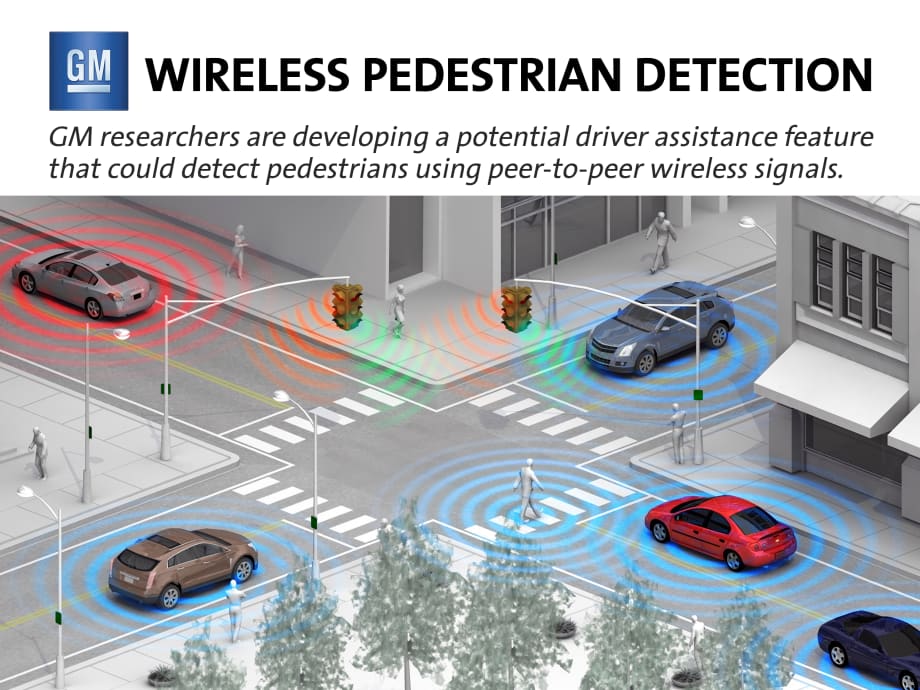
DETROIT – General Motors researchers are developing a promising driver assistance feature designed to detect pedestrians and bicyclists on congested streets or in poor visibility conditions before the driver notices them.
The feature relies on Wi-Fi Direct, the peer-to-peer wireless standard that allows devices including some smartphones to communicate directly with each other rather than through a shared access point such as a cell phone tower.
GM researchers have determined Wi-Fi Direct can be integrated with other sensor-based object detection and driver alert systems already available on production vehicles to help detect pedestrians and bicyclists carrying smartphones equipped with Wi-Fi Direct.
The automaker also is looking to develop a complementary app for Wi-Fi Direct-capable smartphones that can be downloaded by frequent road users, such as bike messengers or construction workers. The app would help Wi-Fi Direct-equipped vehicles identify such people when they’re not readily visible to the driver.
“This new wireless capability could warn drivers about pedestrians who might be stepping into the roadway from behind a parked vehicle, or bicyclists who are riding in the car’s blind spot,” said Nady Boules, GM Global R&D director of the Electrical and Control Systems Research Lab. “Wi-Fi Direct has the potential to become an integral part of the comprehensive driver assistance systems we offer on many of our Chevrolet, Cadillac, Buick and GMC vehicles.”
Wireless pedestrian detection is part of GM’s ongoing development of vehicle-to-infrastructure (V2I) and vehicle-to-vehicle (V2V) communication systems that could provide advance warning about hazards such as slowed or stalled vehicles, slippery roads or intersections and stop signs.
By eliminating the intermediate step required to reach a cell phone tower, Wi-Fi Direct allows devices to connect in approximately one second compared to conventional wireless systems that typically need seven or eight seconds to acquire location information and connect.
“Wi-Fi Direct’s fast connections offer a distinct advantage in vehicle applications,” said Donald Grimm, GM Global R&D senior researcher of perception and vehicle control systems. “The quicker a vehicle can detect other Wi-Fi Direct users, the greater the potential for collision avoidance.”
According to the National Highway Traffic Safety Administration, 4,280 pedestrians and 618 bicyclists lost their lives in collisions with motor vehicles in 2010. Both totals were down by as much as 25 percent since 1995, consistent with overall traffic fatalities. GM’s potential use of Wi-Fi Direct is one way the automaker is working to help further reduce the number of traffic fatalities.
The Wi-Fi Alliance, the global industry association in charge of certifying wireless standards, claims Wi-Fi Direct devices can reach each other at a maximum distance of 656 feet, or more than two football fields away. In addition to aiding pedestrian detection, this range could enable secure transfers of files such as MP3s or digital address book information between a home computer and the user’s Wi-Fi Direct-equipped vehicle infotainment or navigation system.
“As we move toward becoming a more connected society, having a self-aware connected car will be increasingly important,” said Thilo Koslowski, vice president of automotive industry analysis at Gartner Inc., a leading information technology research and advisory company. “Not only can Wi-Fi Direct help vehicles seamlessly communicate with other consumer devices, it can also augment vehicle-to-infrastructure communications as well, which could lead to better traffic management and fewer accidents.”
To view a video about the research effort, click here and click on the full-screen option icon.
More Safety

Nexar-Nauto Merger Aims to Give Fleets Better Safety Intelligence Through Larger Driving Dataset
Stefan Heck tells Automotive Fleet that combining more than 10 billion miles of driving history with Nexar's AI models will give fleets deeper insights into driver risk and roadway conditions than either company could provide independently.
Read More →
Don't Wait for a Crisis: 5 Ways to Build Mental Health Into Your Fleet Safety Program
For Suicide Prevention Month, fleet and safety leaders have an opportunity to put mental health where it belongs: at the center of workplace safety.
Read More →
How Camera Data Can Strengthen a Fleet’s Insurance Renewal
Insights from a commercial insurance carrier and a broker show how fleets can turn video telematic data, driver coaching, and improved claims results into a stronger case at insurance renewal.
Read More →
The Safest Fleets Aren’t the Ones with the Most Technology
You’ve made the telematics investment. Here’s how to capture the other half of its value and build the safest fleet on the road.
Read More →
Hidden in Plain Sight: Fleet Compliance Risks
Fleet compliance isn't just about having policies — it's about consistently enforcing them. This practical guide reveals six hidden compliance risks common in public sector and shared fleet operations and outlines proven strategies to improve visibility, accountability, and audit readiness
Read More →
NETS Sets 2026 Fleet Safety Benchmark Conference for Indianapolis
The Sept. 15–17 program will feature fleet benchmarking data, case studies, emerging technologies, and implementation strategies while running alongside the NSC Safety Congress & Expo.
Read More →
Off-the-Job Crashes Account for 43% of Employers’ $61.7 Billion Crash Burden
NETS quantifies costs dispersed across fleet, risk, HR, and other departments while providing new per-crash benchmarks for employers.
Read More →
Ram Recalls More Than 1.27 Million 1500 Pickups for Seat Belt Anchor Issue
The recall affects certain 2019-2026 Ram 1500 pickups that may have improperly attached second-row seat belt buckle anchors.
Read More →
How Better Visibility Cut Speeding Violations by 48%
Fleet leaders don't need more data, they need clearer visibility into what the data is saying. This case study explores how one utility replaced speeding-event counts with a single metric — miles driven in violation — to strengthen safety and significantly reduce speeding violations.
Read More →
Operation Safe Driver Week: Why the Industry's Oldest Safety Campaign Still Matters to Fleets
A look at how a 2007 enforcement initiative became one of the most consequential weeks on the fleet safety calendar, and what it means for your drivers in 2026.
Read More →