




GM Adds Fleet-Friendly Captiva Sport Crossover to Lineup
DETROIT – Chevrolet plans to launch its 2012 Captiva Sport to help satisfy demand for a crossover from fleet customers in the U.S.
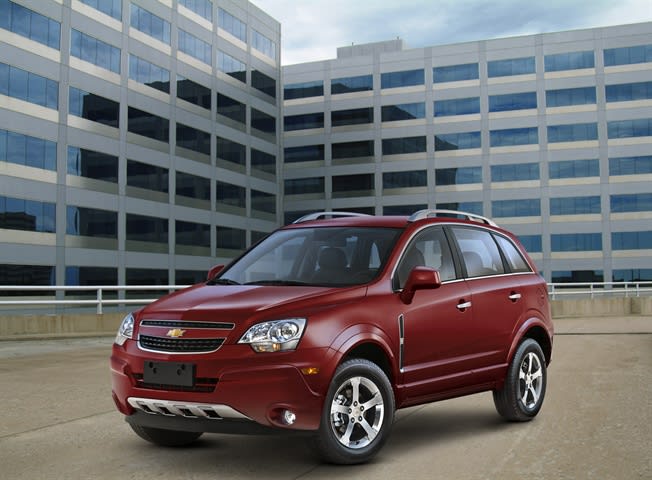
GM's new Chevrolet Captiva Sport is an MY-2012 vehicle slated to go on sale in the fourth quarter of 2011.

DETROIT – Chevrolet plans to launch its 2012 Captiva Sport, a new entry to the US market, in the fourth quarter of 2011 to help satisfy demand for a crossover from fleet customers, the company stated. The new Captiva Sport is based on the company’s Chevrolet Captiva compact crossover, which it said is sold in more than 50 markets globally.
“It says a lot about our ability to draw on international programs and proven, quality crossovers that we were able to identify and federalize a strong new entrant such as Captiva Sport for the U.S. market,” said Alan Batey, U.S. vice president, Chevrolet Sales and Service. “We turned to our global network for a solution to quickly meet the rising demand from local fleet customers and continue to meet strong retail demand for the Equinox.”
Under the hood, the Captiva Sport features GM’s Ecotec 2.4L direct-injected four-cylinder engine or its 3.0L direct-injected V-6 engine. Each engine comes with a six-speed automatic transmission. This vehicle will come in three models, LS, LT, and LTZ (LTZ is an all-wheel-drive model) with four different trim packages in total. The LT and LTZ models offer the V-6 engine with dual exhaust.
Chevrolet said all models will offer four-wheel disc brakes with antilock, traction control, StabiliTrak electronic stability control, air conditioning, power locks and windows (with driver’s express down), 17-inch aluminum wheels, XM Satellite Radio, six-speaker sound system, and remote keyless entry.
Other standard safety features include front-row safety belt pretensioners, a Pedal Release System that decouples the brake pedal in a crash to avoid injuries, active head restraints, a tire pressure monitoring system, automatic power door locks, and side turn signal lamps.
In addition to handling features such as StabiliTrak that help drivers avoid crashes, the Captiva Sport helps protect occupants with its high-strength steel structure and offers Dual-stage front-seat air bags, front-seat side thorax air bags, and rollover capable head curtain air bags covering front and rear rows are standard on all models.
Uplevel LT and LTZ models include OnStar and Bluetooth phone connectivity. A rear-view camera and leather trim package – including leather-trimmed and heated front seats – are standard on LTZ and available on other trims. The LTZ trim level also includes a 10-speaker sound system and a sunroof.
“The range of features offered by the Captiva Sport is as rich as any Chevrolet vehicle,” said Batey. “Our fleet customers will find it to be a versatile vehicle that gives them the cargo capacity they need, in a fuel efficient package that will help keep their ownership costs in check.”
Preliminary Specifications
Overview
Model: Captiva Sport (LS and LT)
Body style / driveline: 5-door, 5-passenger front engine transaxle, FWD, AWD compact sport-utility vehicle
Construction: steel body-frame integral
EPA vehicle class: sport utility vehicle
Manufacturing location: Ramos Arizpe, Mexico
Engines
Type: 2.4L DOHC I-4 DI, 3.0L DOHC V-6 DI
Displacement (cu. in. / cc): 145 / 2384, 183 / 2994
Bore & stroke (in. / mm): 3.46 x 3.85 / 88 x 98, 3.50 x 3.15 / 89 x 80.2
Block material: cast aluminum, sand-cast aluminum with cast-in bore liners
Cylinder head material: cast aluminum, cast aluminum
Valvetrain: DOHC, four valves per cylinder; variable valve timing, DOHC, four valves per cylinder; variable valve timing
Fuel delivery: direct sequential fuel injection with electronic throttle control, direct sequential fuel injection with electronic throttle control
Compression ratio: 11.4:1, 11.7:1
Horsepower (hp / kW @ rpm): 182 / 136 @ 6700, 264 / 197 @ 6950
Torque (lb.-ft. / Nm @ rpm): 172 / 233 @ 4900, 222 / 301 @ 5100
Recommended fuel: regular unleaded, regular unleaded
Emissions controls: close-coupled catalytic converters; Quick-Sync 24x ignition system; returnless fuel rail; fast-response O2 sensor, close-coupled catalytic converters; Quick-Sync 24x ignition system; returnless fuel rail; fast-response O2 sensor
Estimated fuel economy (city / hwy.): TBD, TBD
Transmissions
Type: Hydra-Matic 6T45 six-speed automatic electronically controlled with electronic range select, and the Hydra-Matic 6T50 six-speed automatic electronically controlled with electronic range select
Application: 2.4L, 3.0L
Gear ratios: (:1):
First: 4.58, 4.58
Second: 2.96, 2.96
Third: 1.91, 1.91
Fourth: 1.45, 1.45
Fifth: 1.00, 1.00
Sixth: 0.75, 0.75
Reverse: 2.94, 2.94
Final drive ratio: 3.23, 3.23
Chassis/Suspension
Front: independent, strut-type with specifically tuned coil springs, direct-acting stabilizer bar (27-mm with all engines)
Rear: independent, trailing arm with three lateral locating links and one trailing link, indirect-acting stabilizer bar, specifically tuned coil springs
Traction control: all-speed using engine torque reduction and brake intervention
Steering type: 2.4L: specifically calibrated hydraulic-power-assisted (HPS) rack-and-pinion
3.0L: specifically calibrated hydraulic-power-assisted (HPS) rack-and-pinion
Steering ratio: 2.4L: 17.2:1, 3.0L: 17.2:1
Steering wheel turns, lock-to-lock: 2.4L: 2.7, 3.0L: 2.7
Turning circle, curb-to-curb (ft. /m): 40 / 12.2
Brakes
Type: front and rear vented disc with power assist and ABS; traction control and stability control; dual piston caliper front/single piston caliper rear
Rotor diameter x thickness (in / mm): front: 11.7 x 1.14 / 296 x 29, rear: 11.9 x .78 / 303 x 20
Total swept area (sq. cm): front: 67, rear: 38
Wheels/Tires
Wheel size and type: 17 x 7-inch aluminum alloy
Tires: P235/60R17
Dimensions
Exterior
Wheelbase (in. / mm): 106.6 / 2707
Overall length (in. / mm): 180.1 / 4576
Overall width (in. / mm): 72.8 / 1850
Overall height (in. / mm): 67 / 1704
Track (in. / mm): front: 61.4 / 1562, rear: 61.8 / 1572
Minimum ground clearance (in. / mm): 7.8 / 200
Step-in height (in. / mm): front: 17.8 / 453, rear: 18.0 / 458
Approach angle (degrees): 18.2
Departure angle (degrees): 22.7
Curb weight (lb. / kg): 2.4L: TBD, 3.0L: TBD
Weight distribution (% front / rear): 58 / 42
Interior (Front, Rear)
Seating capacity: 2, 3
Headroom (in. / mm): 40.2 / 1023, 39.3 / 1000
Legroom (in. / mm): 40.7 / 1036, 36.9 / 939
Hip room 52.6 / 1338, 52.9 / 1344
Shoulder room (in. / mm): 56.0 / 1424, 55.9 / 1422
Capacities
EPA interior volume: (cu. ft. / L): 126.9 / 3596
Cargo volume (cu. ft. / L): 56.4 / 1598 (behind front seat)
29.2 / 827 (behind second-row seat at normal position
Passenger volume (cu. ft. / L): 97.7 / 2769 (est.)
Trailer towing maximum (lb. / kg): 2.4L: 1500 / 680, 3.0L: 3500 / 1588
Fuel tank (gal. / L): FWD: 19.2 / 73, AWD: 16.7 / 63
Engine oil (qt. / L): 2.4L: 5.0 / 4.7, 3.0L: 6.0 / 5.7
Cooling system (qt. / L): 2.4L: 9.0 / 8.5, 3.0L: 10 / 9.5
More Operations

Fleet Has a Talent Pipeline Problem. What Comes Next? | AF News Recap
Where will fleet’s next generation of leaders come from? This week, we’re looking at the industry’s talent pipeline, what certification can add to a fleet career, how to build an award-worthy track record, and the return of Automotive Fleet’s Personal Use Survey.
Read More →
Smith System Launches Driver Risk Management Program
Fleets have more driver data than ever, but identifying risky behavior doesn't necessarily correct it. Smith System's new Driver Risk Management program combines monitoring, training, and follow-up coaching to help fleets connect risk signals with driver intervention.
Read More →
Automotive Fleet Opens 2026 Personal Use Survey for Commercial Fleet Managers
Less than two weeks left! Commercial and corporate fleet managers are invited to share how their organizations handle company vehicle personal-use policies, charges, and driver eligibility.
Read More →
From AI Prompts to AI-Generated Safety Songs | AF News Recap
Can better prompts make AI more useful for fleet managers? This week, we’re breaking down smarter fleet analysis, an AI-assisted experiment that turned safety training into music, and what happened to fuel prices in August.
Read More →
How to Write Better AI Prompts for Fleet Analysis
Include these six elements in your fleet prompts to generate more relevant analysis and accurate answers.
Read More →
Fleet Meets: Eric Kilgore
This edition of the Fleet Meets series features one of the industry's best leaders driving multi-market and national operations.
Read More →
Why Reactive Fleet Management Is Becoming Too Expensive to Sustain
Research highlights a growing need for proactive management strategies to address rising costs in fleet operations effectively.
Read More →
What Your Fleet KPIs Aren’t Telling You
Tracking fleet metrics is only useful when the data leads to better decisions. This guide helps fleet leaders assess cost, utilization, and downtime more accurately, identify performance gaps, and prioritize the actions that can improve operational results.
Read More →
Hidden in Plain Sight: Fleet Compliance Risks
Fleet compliance isn't just about having policies — it's about consistently enforcing them. This practical guide reveals six hidden compliance risks common in public sector and shared fleet operations and outlines proven strategies to improve visibility, accountability, and audit readiness
Read More →
Turning Fleet Payment Data into Executive Insights
Does data alone drive results in operations?
Read More →