





Further Reading: Jolt to Debut Fast & Free EV Charging Network in New Zealand
GlobalData Forecasts Gradual Improvement in New Zealand Card Payment Market
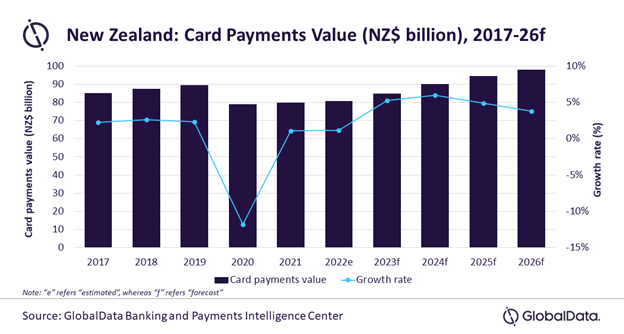
Rallying from a COVID-19 pandemic-triggered decline, the market should register a compound annual growth rate (CAGR) of 5% between 2022 and 2026 and reach NZ$98 billion ($67.1 billion) in 2026.
August 24, 2022
Persistent efforts from the country’s financial authorities and banks to increase the awareness of electronic payments and develop payment acceptance infrastructure have boosted consumer use of card payment methods for day-to-day transactions.
Photo: Global Data
2 min to read
A gradual recovery is expected over the next few years in the New Zealand payment card market, forecasts GlobalData, a global data and analytics company.
Rallying from a COVID-19 pandemic-triggered decline, the market should register a compound annual growth rate (CAGR) of 5% between 2022 and 2026 and reach NZ$98 billion ($67.1 billion) in 2026.
Issued by financial institutions, such as banks, payment cards allow the cardholder to access funds in a customer’s designated bank account or through a credit account, making payments by electronic transfer.
According to GlobalData’s Payment Cards Analytics, a database detailing payment card market size and market share data for 73 geographies, the value of card payments registered a decline of 11.8% in 2020 due to the COVID-19 pandemic. As businesses reopened, te card payments market registered a slow growth of 1.1% in 2021 to reach NZ$79.7 billion ($54.6 billion).
“The payment card market in New Zealand is mature, with each individual holding over three cards with high frequency of card payments at 91.4 in 2021,” comments Ravi Sharma, GlobalData lead banking and payments analyst.
Persistent efforts from the country’s financial authorities and banks to increase the awareness of electronic payments and develop payment acceptance infrastructure have boosted consumer use of card payment methods for day-to-day transactions.
“Besides cards, the rising preference for contactless payments have further resulted in the increased preference for cashless methods of payment. Although the COVID-19 pandemic affected the consumer spending, it also highlighted the importance of non-cash payment methods, thus further driving the use of electronic payments in the country,” says Shama.
Consumer payment habits have changed significantly post pandemic as large number of consumers are moving away from cash payments, opting instead for digital payment. The value of ATM cash withdrawals has dropped by 20.9% and 5.9% in 2020 and 2021, respectively, a trend that is expected to continue in 2022, according to GlobalData.
Payments NZ, a governance organization that manages the nation’s payment and clearing systems, confirms contactless payments are increasingly popular among consumers: contactless card transactions rose 62% between 2018 and 2020. The share of contactless payments in total card payments increased from 24% in 2018 to 39% in 2020.
“The gradual rise in consumer spending along with the rising preference for digital payments will help the country’s card market growth,” Sharma concludes. “However, growth could be slower in the near future due to the heightened global economic uncertainty and higher.”
More Global Fleet

GeoFencing Adds to Your Truck Security Arsenal
Geofencing is a familiar fleet tool today, but its early adoption marked a major shift in vehicle tracking, route monitoring, and the debate over employee privacy.
Read More →
Holman Takes Full Ownership of ARIZA in Mexico
Holman is bringing its Mexican fleet management operation fully under its own brand after more than 30 years as a joint venture. The change gives multinational fleet customers a single Holman operation across the U.S., Canada, and Mexico.
Read More →
5 Tire Maintenance Tips to Help Prevent Work Truck Downtime
Regular tire checks can do more than extend tread life. These five maintenance practices can help work truck fleets catch problems early, reduce costs, and prevent downtime.
Read More →

Proven Ways to Reduce Work Truck Downtime
The age-old problem of downtime will always be a reality, but with new strategies at hand, fleets have more ways to keep trucks on the road longer.
Read More →


Cameras, Safety and Insurance: From Reactive Claims to Real-Time Prevention (Part 2 of 2)
Part Two: Commercial auto remains one of the most challenging and costly lines of coverage for fleet operators and insurers alike. Continue learning more about how to effectively address these issues from Onur Aksan, Enterprise Business Development Executive, Geotab
Read More →
Cameras, Safety and Insurance: From Reactive Claims to Real-time Prevention
Commercial auto remains one of the most challenging and costly lines of coverage for fleet operators and insurers alike. Learn more about how to effectively address these issues from Onur Aksan, Enterprise Business Development Executive, Geotab.
Read More →
Fleet Costs Are Rising: Here’s How Leaders Are Responding
Fleet leaders are under pressure to reduce costs, adapt to economic uncertainty, and make smarter decisions. See how peers across North America are responding with real data, proven strategies, and forward-looking insights. Download the 2026 Market Pulse Report to benchmark your strategy and uncover where you can gain an edge.
Read More →
Enterprise Fleet Management Surpasses 900,000 Vehicles in U.S. & Canada
Enterprise Mobility connects with mobility solutions around the globe
Read More →