




GHSA Honors Achievement in Highway Safety
CINCINNATI -- The Governors Highway Safety Association (GHSA) on Sept. 27 honored its 2011 highway safety award winners. GHSA’s most prestigious award, the James J. Howard Highway Safety Trailblazer Award, was presented posthumously to Dr. Herb Simpson, president and CEO of the Traffic Injury Research Foundation (TIRF) from 1975 to 2006.
CINCINNATI -- The Governors Highway Safety Association (GHSA) on Sept. 27 honored its 2011 highway safety award winners. GHSA’s most prestigious award, the James J. Howard Highway Safety Trailblazer Award, was presented posthumously to Dr. Herb Simpson, president and CEO of the Traffic Injury Research Foundation (TIRF) from 1975 to 2006.
GHSA represents state and territorial highway safety offices that implement programs to address behavioral highway safety issues.
Simpson’s work was instrumental in identifying hard-core drunk drivers as a significant contributor to highway fatalities, and he helped pioneer the concept of graduated driver licensing (GDL).
GHSA gave the Kathryn J.R. Swanson Public Service Award to retired National Highway Traffic Safety Administration (NHTSA) Associate Administrator Marlene Klein Markison for her commitment to advancing highway safety programs across the country.
GHSA also presented five Peter K. O'Rourke Special Achievement Awards for outstanding achievements in highway safety during the prior calendar year. The 2011 winners are:
• AARP Driver Safety Program, which provides all drivers – especially those 50 years of age and older – with instruction to help improve their driving skills. In addition to making the roads safer in local communities, the program also helps prolong the independence of older drivers. In 2010, under new leadership, the program reached 464,307 participants in 27,141 classroom courses taught by more than 7,000 volunteers in all 50 states, Washington D.C., the U.S. Virgin Islands and Puerto Rico. An additional 61,840 participants took an online version of the course.
• Traffic Safety Coalition, a group of safety advocates promoting the use of traffic safety cameras to deter dangerous and illegal driving behavior. In 2010, traffic cameras in Illinois were in danger of being deemed illegal by the state legislature. The coalition successfully reframed the debate to focus on red-light running fatalities and speed-related fatalities on U.S. roadways every year, stressing how cameras help police enforce traffic safety laws and deter drivers from breaking the law. The bill to ban traffic safety cameras did not pass, and the Traffic Safety Coalition preserved Illinois communities’ ability to utilize safety cameras.
• Missouri Traffic and Highway Safety Division, which spearheaded a statewide safety coalition that helped the state realize its fifth consecutive year of decreases in traffic fatalities and disabling injuries in 2010. The Traffic and Highway Safety Division launched the Missouri Coalition for Roadway Safety, an association of safety advocates, law enforcement, engineers, EMS officials, educators, and community partners that worked to set goals and strategies to reduce fatalities and injuries. Under the Missouri Traffic and Highway Safety Division’s leadership, the coalition successfully combined engineering, enforcement and education to help the state achieve traffic fatality levels not seen since 1950.
• The No Refusal Program, which uses police, prosecutors, judges and medical professionals to obtain mandatory blood samples from suspected impaired drivers who refuse breath tests. The strategy was launched by Montgomery County, Texas, prosecutor Warren Diepraam. In his jurisdiction, No Refusal helped reduce DWI fatality charges by 70 percent and DWI cases by 30 percent. The test refusal rate fell to 25 percent from the state average of 45 percent. In 2010, as a NHTSA prosecutor fellow, Diepraam helped bring No Refusal into other states and trained thousands of prosecutors, judges and police on appropriate procedures. Joining together police, prosecutors, nurses and judges toward a common cause, No Refusal has helped prevent death and tragedy on Texas roadways as it continues expand across the nation.
• Teens in the Driver Seat (TDS), a Texas-based peer-to-peer safety program for young drivers that makes teens directly responsible for both the development and delivery of traffic safety messages to their peers. Since the program’s inception in 2002, Texas has seen a 40 percent decrease in the frequency of teen drivers involved in fatal crashes. Last year, and despite budget cutbacks, TDS grew by 20 percent, adding more than 100 schools to its active roster and expanded to Connecticut, Georgia and North Carolina.
More Safety

Ram Recalls More Than 1.27 Million 1500 Pickups for Seat Belt Anchor Issue
The recall affects certain 2019-2026 Ram 1500 pickups that may have improperly attached second-row seat belt buckle anchors.
Read More →
Top 50 Executive Fleets
It is that time of year again! Time for the 2026 list of the Top 50 Executive Fleets, presented by Automotive Fleet and Volvo as part of its annual Fleet 500. Download now to see this year's list of companies!
Read More →
How Better Visibility Cut Speeding Violations by 48%
Fleet leaders don't need more data, they need clearer visibility into what the data is saying. This case study explores how one utility replaced speeding-event counts with a single metric — miles driven in violation — to strengthen safety and significantly reduce speeding violations.
Read More →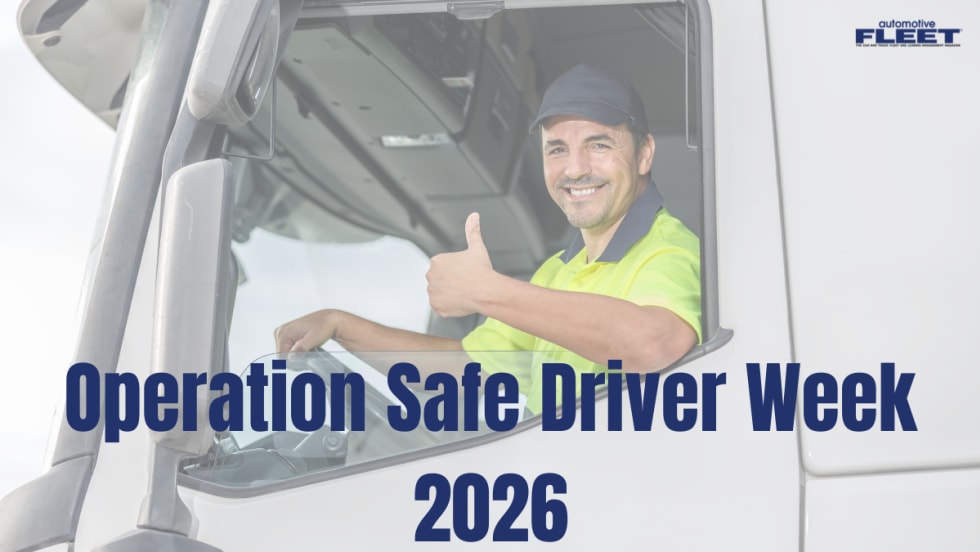
Operation Safe Driver Week: Why the Industry's Oldest Safety Campaign Still Matters to Fleets
A look at how a 2007 enforcement initiative became one of the most consequential weeks on the fleet safety calendar, and what it means for your drivers in 2026.
Read More →
Nexar-Nauto Merger Aims to Give Fleets Better Safety Intelligence Through Larger Driving Dataset
Stefan Heck tells Automotive Fleet that combining more than 10 billion miles of driving history with Nexar's AI models will give fleets deeper insights into driver risk and roadway conditions than either company could provide independently.
Read More →
From Silos to Solutions: Relationship Management for Safer Fleets
From telematics adoption and driver accountability to policy consistency and risk mitigation, this episode breaks down what it really takes to build a safer fleet culture without slowing business down.
Read More →
IIHS Launches First Commercial Vehicle Safety Evaluations
The Insurance Institute for Highway Safety has begun evaluating heavy-duty pickups and cargo vans for driver protection. Which models earned top marks?
Read More →
Reducing Risk by Eliminating Phone Use Behind the Wheel
Hosted with the cofounder of Lifesaver Mobile, this episode addresses phone use behind the wheel and how to design a driving environment that actually helps prevents accidents.
Read More →
Cameras, Safety and Insurance: From Reactive Claims to Real-Time Prevention (Part 2 of 2)
Part Two: Commercial auto remains one of the most challenging and costly lines of coverage for fleet operators and insurers alike. Continue learning more about how to effectively address these issues from Onur Aksan, Enterprise Business Development Executive, Geotab
Read More →
How 5-Second Telematics Data Is Changing Fleet Safety
This episode connects with Steve Santostasi of Ford Pro and covers how a few seconds of data can make a difference in fleet safety.
Read More →