




Fuel Costs, Financing Drive Car Ownership Costs Lower
The annual cost to own and operate a vehicle has fallen to $8,698, a nearly 2% drop from last year due to declines in gas prices and finance charges, according to AAA.
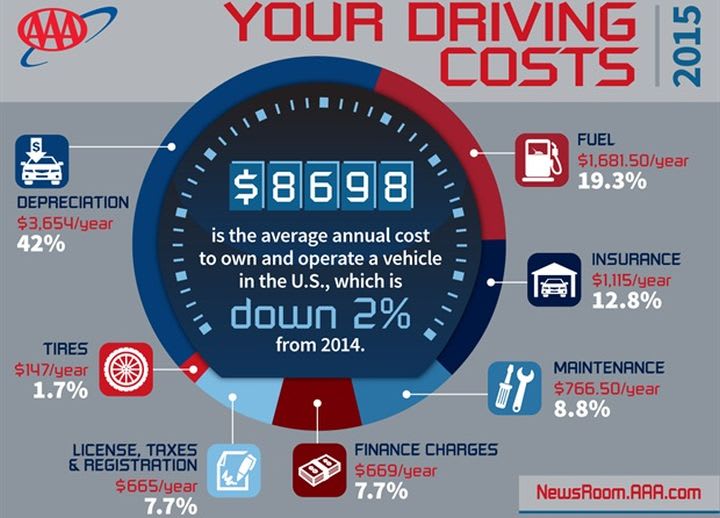
Illustration courtesy of AAA.
Illustration courtesy of AAA.
The annual cost to own and operate a vehicle has fallen to $8,698, a nearly 2% drop from last year due to declines in gasoline prices and finance charges, according to AAA’s 2015 Your Driving Costs study. AAA says tire costs are relatively flat, rising one penny per mile driven.
The research examines the cost of fuel, maintenance, tires, insurance, license and registration fees, taxes, depreciation and finance charges associated with driving a typical sedan 15,000 miles annually. In the U.S., a driver can expect to spend 58 cents for each mile driven, nearly $725 per month, to cover the fixed and variable costs associated with owning and operating a car in 2015.
“Fortunately, reduced gasoline and finance costs more than offset rising costs in other areas,” says John Nielsen, AAA’s managing director of automotive engineering and repair. “As a result, car owners can look forward to saving approximately $178 this year.”
Based on 15,000 miles | Small Sedan | Medium Sedan | Large Sedan | Sedan Average | Minivan | SUV (4WD) |
Annual Total Cost | $6,729 | $8,716 | $10,649 | $8,698 | $9,372 | $10,624 |
Annual Cost Per Mile | $0.449 | $0.581 | $0.710 | $0.580 | $0.625 | $0.708 |
Fuel: DOWN 13.77% to 11.2 cents per mile/$1,681.50 per year (-$268.50).
Compared to last year’s study, the average cost of regular unleaded fuel fell nearly 13 percent to $2.855 per gallon. This decline, coupled with improvements in vehicle fuel economy, resulted in an average 11.21 cents-per-mile fuel cost. Due in large part to this decrease, the cost of owning and operating a sport utility vehicle is slightly less than that of a large sedan this year.
Finance Charges: DOWN 21.02% to $669 per year (-$178).
With rising car sales and stiff competition among dealers, many manufacturers are offering low finance rates to attract buyers. In 2015, average vehicle finance rates dropped 21 percent, which equates to approximately $15 per month on a typical five-year loan. However, rates vary widely with borrower credit scores.
Depreciation: UP 4.10% to $3,654 per year (+144).
The single largest ownership expense, depreciation, rose for 2015 due to increasing new car sales that are causing an influx of used and off-lease vehicles entering the marketplace. This increased supply has resulted in lower values and selling prices for used vehicles, thus driving up depreciation costs.
Insurance: UP 8.99% to $1,115 per year (+$92).
Insurance rates vary widely by driver, driving habits, insurance company and geographical area. AAA’s calculations are based on low-risk drivers with excellent driving records. While premium calculations are confidential, this modest increase of $7.67 per month may be due in part to high-cost modern vehicle features such as infotainment systems, advanced safety features and lightweight materials that can be more expensive to repair and, therefore, insure.
Maintenance: UP 9.9% to 5.11 cents per mile/$766.50 per year (+$7.50).
Annual maintenance, including labor time and repair part costs associated with factory-recommended maintenance, was factored into the 2015 survey along with average costs of an extended warranty. Maintenance costs varied widely by vehicle type but, on average, were up slightly from 5.06 cents to 5.11 cents per mile. A recent survey of AAA-approved auto repair shops found that the majority of drivers are behind schedule in routine maintenance, including oil changes, tire maintenance and battery inspection/testing.
License/Registration/Taxes: UP 3.74% to $665 per year (+$24).
Vehicle prices rose modestly in 2014, contributing to an overall increase in state and local tax costs. Additionally, some states increased fees related to vehicle purchasing, titling, registration and licensing.
Tires: UP 1.03% to .98 cents per mile/$147 per year (+$1.50).
Due to the competitive and dynamic nature of the tire market, tire costs in 2015 remain relatively unchanged, rising by just .01 cents per mile.
In addition to calculating the driving costs for sedans, AAA determined annual costs associated with both minivans and sport utility vehicles. Owners of these vehicles will benefit from annual driving costs nearly four percent lower this year, at $9,372 and $10,624 respectively, due to lower gas prices and finance rates.
“When shopping for a vehicle, smaller isn’t always cheaper,” says Nielsen. “A minivan, for example, can carry up to 7 passengers, yet costs $100 less to own and operate each month compared to a large sedan.”
AAA has published Your Driving Costs since 1950. That year, driving a car 10,000 miles per year cost 9 cents per mile, and gasoline sold for 27 cents per gallon.
The Your Driving Costs study employs a proprietary AAA methodology to analyze the cost to own and operate a vehicle in the United States. Variable operating costs considered in the study include fuel, maintenance and repair, and tires. Fixed ownership costs factored into the results include insurance, license and registration fees, taxes, depreciation and finance charges. Ownership costs are calculated based on the purchase of a new vehicle that is driven over five years and 75,000 miles.
For more information, visit AAA.com.
More Operations

Here's When You Should Make an Exception to Fleet Policy
Fleet policies are designed to create consistency, but not every driver or situation fits neatly within standard rules.
Read More →
AI-Native or AI-Acquired: What Should Fleet Managers Look for in an AI Platform?
Six questions can help fleet managers look beyond AI marketing claims to evaluate integration, data access, and real-world operational performance.
Read More →
A buyer's guide to fleet management software in 2027
Buying fleet management software in 2027 means looking beyond features and price. As fleet operations, technology and expectations evolve, this guide explores what today’s fleet professionals should consider when choosing a system that can deliver value now and adapt to what comes next.
Read More →

What Will Shape the Next Era of Fleet Management?
EVs, AI, and autonomous vehicles are reshaping fleet management. Discover what’s ahead—and how fleet leaders can prepare for the next era.
Read More →
How Fleets Can Recruit and Train Veterans for Technician Roles
Here's how the technician shortage has affected uptime for fleets, and what to do about it.
Read More →
Avis Budget Group Deploys Neology Toll Management Technology Across Major Brands
Neology’s neoFleet platform will manage toll transactions and toll-authority operations for vehicles across Avis, Budget, Payless, Budget Truck and Zipcar.
Read More →
Fleet Personal-Use Charges Edge Higher in 2026
Nearly eight in 10 surveyed fleets allow personal use of company vehicles, while just over half of respondents report charging employees for the privilege.
Read More →
The Future of Fleet + What’s Changing Right Now | AF News Recap
Could developments overseas offer a preview of what’s coming for U.S. fleets? This week, we’re looking at the future of AI, autonomy, and electrification, plus Ford Pro’s new certified pre-owned program, smarter vehicle offboarding, and a new way for fleets to manage toll expenses.
Read More →
How to Handle Vehicle Offboarding
What do fleet managers need to do when a driver leaves?
Read More →
Fleet Manager’s Ultimate Playbook: Navigating the New Standard in OEM Connectivity
Rising operating costs, driver safety concerns, and unplanned downtime are putting unprecedented pressure on modern fleets. Discover how fleet managers use embedded OEM connectivity and real-time vehicle data to cut TCO, prevent downtime, and protect drivers without aftermarket telematics hardware.
Read More →