




Ford Uses Virtual Reality to Show Pre-Collision Assist
Attendees of the 2018 Work Truck Show can experience Ford Motor Co.’s new Pre-Collision Assist with pedestrian detection, which is now standard on 2019 Transit Connect compact vans.
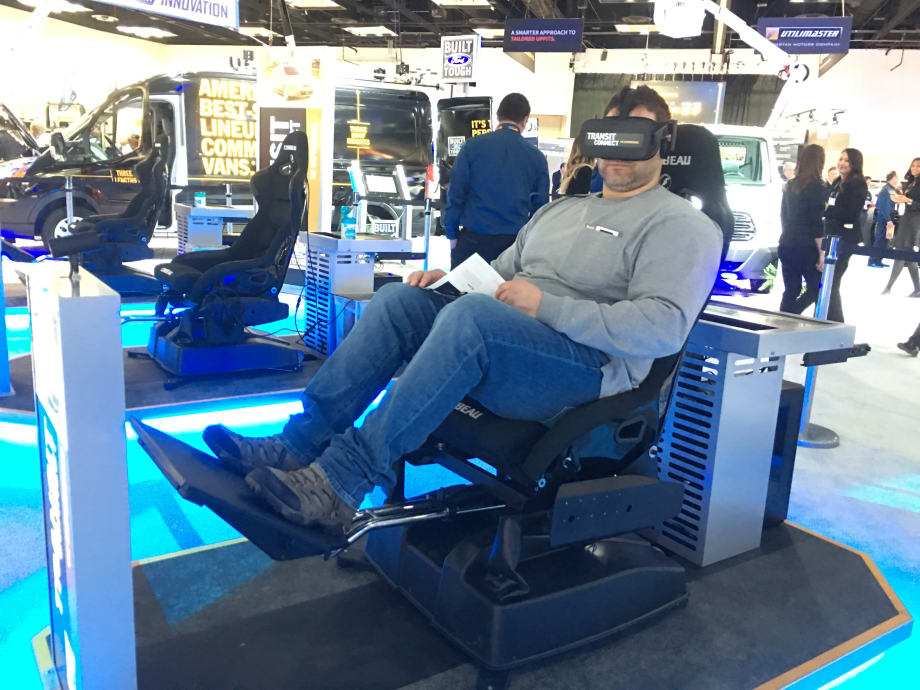
Photo by Roselynne Reyes.
Photo by Roselynne Reyes.
Attendees of the 2018 Work Truck Show can experience Ford Motor Co.’s new Pre-Collision Assist with pedestrian detection, which is now standard on 2019 Transit Connect compact vans.
Via a one and a half minute virtual reality (VR), show attendees have the opportunity to not only see the dangers of distracted driving, but get a feel of how the vehicle will feel when Pre-Collision Assist is activated.
“It’s hard to get that full experience as a driver at a trade show,” said Julie Ellenberger, a Ford brand manager. “We wanted to create this new virtual reality experience to really help people understand how the feature works and how it could help them in their everyday lives.”
If the system detects an impending collision, a warning light will appear on the instrument cluster and an audible alert will sound. If the driver does not respond to the alerts by stepping on the brakes, the brakes will precharge and automatically apply themselves if needed.
The feature has already been programmed on to select vehicles, such as Ford passenger wagons revealed at the Chicago Auto Show in February. Ellenberger says that response to the feature has been very positive.
“We’re really excited because this is one of the biggest asks from our fleet customers,” she said. “We knew that this was a feature that not only our fleet customers wanted but all of our customers would benefit from and that’s why we really pushed to make it a standard feature.”
For attendees at the Work Truck Show, Ford’s booth features three cargo vans with different configurations and upfits. The VR experience allows consumers to get a feel for the interior of the vehicle from the driver seat. Sights and sounds of driving through a city environment eventually lead to a distraction, causing the driver to not see on obstacle on the road ahead. At this point, the Pre-Collision Assist kicks in, stopping the vehicle.
To actually experience the vehicle stopping on its own, helps to give people that peace of mind,” Ellenberger said. “The more and more vehicles that have this feature, the better off we’re all going to be.”
Ford’s VR experience can be found at Booth #3239 at the Work Truck Show 2018 in Indianapolis.
More Safety

What’s Next for Fleet? Safety, AI & Industry Recognition | AF News Recap
Could your company's culture be encouraging distracted driving? This week, we're exploring how workplace expectations affect driver safety, what AI, EVs, and autonomous vehicles could mean for the future of fleet management, and how fleet professionals can strengthen their award nominations.
Read More →
Does Your Fleet's Culture Encourage Distracted Driving?
What happens when the people responsible for enforcing safety rules are the ones setting the wrong example? The answer may reveal why some of the biggest risks to fleet drivers have little to do with what's written in the employee handbook.
Read More →
Fleet Manager’s Ultimate Playbook: Navigating the New Standard in OEM Connectivity
Rising operating costs, driver safety concerns, and unplanned downtime are putting unprecedented pressure on modern fleets. Discover how fleet managers use embedded OEM connectivity and real-time vehicle data to cut TCO, prevent downtime, and protect drivers without aftermarket telematics hardware.
Read More →
From Driver Well-Being to EV Charging | AF News Recap
Mental health belongs in the fleet safety conversation. This week, we’re looking at five ways fleets can support employee well-being before a crisis, plus Holman’s expansion in Mexico, new one-day Fleet Forward passes, and why EV charging demand is outpacing infrastructure growth.
Read More →
Nexar-Nauto Merger Aims to Give Fleets Better Safety Intelligence Through Larger Driving Dataset
Stefan Heck tells Automotive Fleet that combining more than 10 billion miles of driving history with Nexar's AI models will give fleets deeper insights into driver risk and roadway conditions than either company could provide independently.
Read More →
Don't Wait for a Crisis: 5 Ways to Build Mental Health Into Your Fleet Safety Program
For Suicide Prevention Month, fleet and safety leaders have an opportunity to put mental health where it belongs: at the center of workplace safety.
Read More →
How Camera Data Can Strengthen a Fleet’s Insurance Renewal
Insights from a commercial insurance carrier and a broker show how fleets can turn video telematic data, driver coaching, and improved claims results into a stronger case at insurance renewal.
Read More →
The Safest Fleets Aren’t the Ones with the Most Technology
You’ve made the telematics investment. Here’s how to capture the other half of its value and build the safest fleet on the road.
Read More →
Hidden in Plain Sight: Fleet Compliance Risks
Fleet compliance isn't just about having policies — it's about consistently enforcing them. This practical guide reveals six hidden compliance risks common in public sector and shared fleet operations and outlines proven strategies to improve visibility, accountability, and audit readiness
Read More →
NETS Sets 2026 Fleet Safety Benchmark Conference for Indianapolis
The Sept. 15–17 program will feature fleet benchmarking data, case studies, emerging technologies, and implementation strategies while running alongside the NSC Safety Congress & Expo.
Read More →