




Ford Refining Computer Crash Testing
DEARBORN, MI - Ford is beginning research into one of the world's first digital human child body models. Such a model could someday serve as a digital dummy for computer crash testing aimed at improving research of future safety technologies, the automaker said.
DEARBORN, MI - Ford is beginning research into one of the world's first digital human child body models. Such a model could someday serve as a digital dummy for computer crash testing aimed at improving research of future safety technologies, the automaker said.
"We study injury trends in the field, and we know that traffic crashes are the leading cause of death for people from age one to 34," said Dr. Steve Rouhana, senior technical leader for safety, Ford research and advanced engineering. "We want to better understand how injuries to younger occupants may be different."
The work is the next step in Ford's decade-long research to build a sophisticated and detailed computer adult human model, with body parts and organs painstakingly replicated so scientists could better understand what happens to the adult body in a crash.
"Our restraint systems are developed to help reduce serious injuries and fatalities in the field, and they have proven to be very effective," Rouhana said. "But crash injuries still occur. The more you know about the human body, the more we can consider how to make our restraint systems even better.
"A child's body is very different from an adult's. Building a digital human model of a child will help us design future systems that offer better protection for our young passengers."
Building a digital model is no simple task. The work on Ford's adult human body model that started back in 1993 was not completed until 2004 -- and only then after extensive validations. Digital models are used in research, not in vehicle development. They don't take the place of crash dummies, which measure the effect of forces on the body. Instead, they are used as a way to understand how to further improve restraint system effectiveness through better understanding of injury mechanisms.
The digital model is constructed component by component -- brain, skull, neck, ribcage, upper and lower extremities, etc. -- with extensive research included on each part.
"Building the model of a person is just like building a model of a car," said Rouhana. "You start with your surface geometry for each component and any subcomponent it contains -- in this case the geometry of the human body and its internal organs."
After gathering such data through medical scans as well as anatomical texts, the researchers build a model section by section, creating regions of the body. The brain in Ford's adult human digital model was constructed as a separate component, detailed down to the stem, the gray matter and the fluid between the layers, said Dr. Jesse Ruan, a researcher in biomechanics at Ford.
The components are then joined into a virtual human body, which is extensively validated. Then, using mathematical and analytical tools combined with available body data, researchers are able to determine the effects of a crash -- and the pressure of a restraint system -- on the body.
Child data, however, are not as extensively available. Ford researchers, leveraging their global contacts, contracted into a one-year agreement with Tianjin University of Science and Technology, which is working with Tianjin Children's Hospital, to obtain child geometry and basic body information from sources like MRIs and CAT scans provided by volunteers. Tianjin is one of the largest cities in China, close to the capital of Beijing. All other information for the project will be obtained from public domain literature.
"This is just the beginning," said Ruan. "We're taking the first step toward building a future child digital human body model."
More Safety

Nexar-Nauto Merger Aims to Give Fleets Better Safety Intelligence Through Larger Driving Dataset
Stefan Heck tells Automotive Fleet that combining more than 10 billion miles of driving history with Nexar's AI models will give fleets deeper insights into driver risk and roadway conditions than either company could provide independently.
Read More →
Don't Wait for a Crisis: 5 Ways to Build Mental Health Into Your Fleet Safety Program
For Suicide Prevention Month, fleet and safety leaders have an opportunity to put mental health where it belongs: at the center of workplace safety.
Read More →
How Camera Data Can Strengthen a Fleet’s Insurance Renewal
Insights from a commercial insurance carrier and a broker show how fleets can turn video telematic data, driver coaching, and improved claims results into a stronger case at insurance renewal.
Read More →
The Safest Fleets Aren’t the Ones with the Most Technology
You’ve made the telematics investment. Here’s how to capture the other half of its value and build the safest fleet on the road.
Read More →
Hidden in Plain Sight: Fleet Compliance Risks
Fleet compliance isn't just about having policies — it's about consistently enforcing them. This practical guide reveals six hidden compliance risks common in public sector and shared fleet operations and outlines proven strategies to improve visibility, accountability, and audit readiness
Read More →
NETS Sets 2026 Fleet Safety Benchmark Conference for Indianapolis
The Sept. 15–17 program will feature fleet benchmarking data, case studies, emerging technologies, and implementation strategies while running alongside the NSC Safety Congress & Expo.
Read More →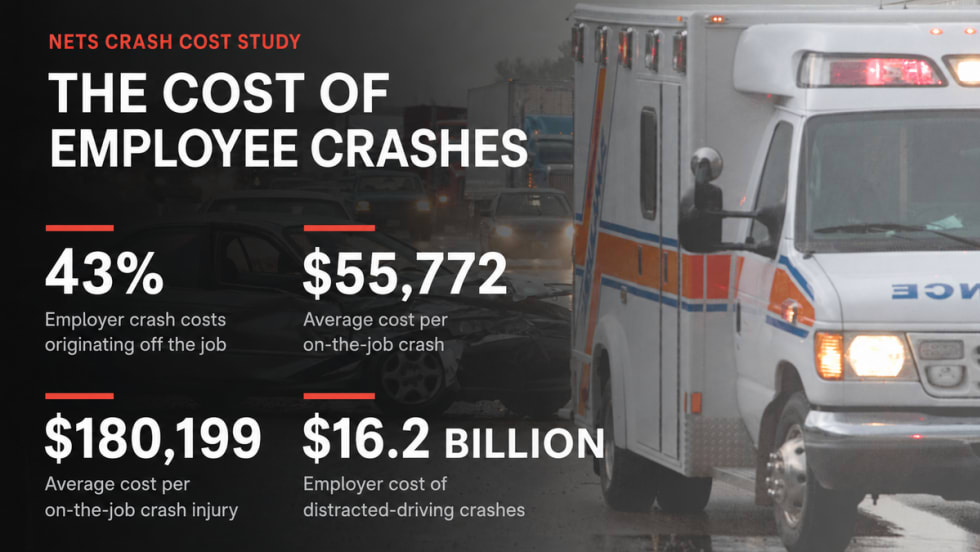
Off-the-Job Crashes Account for 43% of Employers’ $61.7 Billion Crash Burden
NETS quantifies costs dispersed across fleet, risk, HR, and other departments while providing new per-crash benchmarks for employers.
Read More →
Ram Recalls More Than 1.27 Million 1500 Pickups for Seat Belt Anchor Issue
The recall affects certain 2019-2026 Ram 1500 pickups that may have improperly attached second-row seat belt buckle anchors.
Read More →
How Better Visibility Cut Speeding Violations by 48%
Fleet leaders don't need more data, they need clearer visibility into what the data is saying. This case study explores how one utility replaced speeding-event counts with a single metric — miles driven in violation — to strengthen safety and significantly reduce speeding violations.
Read More →
Operation Safe Driver Week: Why the Industry's Oldest Safety Campaign Still Matters to Fleets
A look at how a 2007 enforcement initiative became one of the most consequential weeks on the fleet safety calendar, and what it means for your drivers in 2026.
Read More →