




Ford Lowers Noise Levels in F-650/F-750 Trucks
Ford's redesigned 2016 F-650 and F-750 trucks will offer a lower noise level than outgoing models mostly due to the redesigned turbo diesel engine, Ford announced on the eve of NTEA's Work Truck Show.

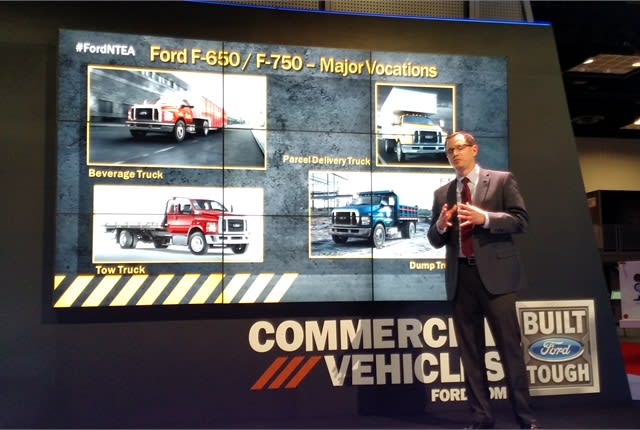
Ford's John Davis says upcoming F-650/750 will suit many applications, and powertrains were tested for heavy service.
Photo: Tom Berg
Ford's redesigned 2016 F-650 and F-750 trucks will offer a lower noise level than outgoing models mostly due to the redesigned turbo diesel engine, Ford announced on the eve of NTEA's Work Truck Show.
The 2016-MY medium-duty trucks are powered by a Ford 6.7L Power Stroke V-8 that's 25% quieter in the cabin, according to Ford. When idling, the engine is as much as 45% quieter in the cabin and 35% quieter in front of the grille.
"While the truck is able to work harder, we also made life inside the cab easier," said John Ruppert, general manager of Ford Commercial Vehicle Sales and Marketing. "Lowering in-cab and exterior noise levels improves driver comfort and minimizes disturbances while idling at work sites."
The 2016-MY medium-duty trucks are powered by a Ford 6.7L Power Stroke V-8 that's 25% quieter in the cabin.
Photo: Ford
When traveling at 60 mph, the level of engine noise in the cabin drops to 68 decibels from 74 decibels compared to the prior model, according to Ford. Idling levels have fallen to 48 decibels from 63 decibels.
(Decibels measure the intensity and power of sound. Each 10-unit increase represents a 10-fold increase in sound power perceived by the human ear, so a 10 decibel sound is 10 times more powerful than a zero decibel sound, and 20 decibels is 100 times stronger than zero decibels.)
Ford achieved the quieter cabin through engine engineering.
The PowerStroke V-8 is the only diesel to be used in the new Ford Class 6 and 7 models. The 6.8-liter gasoline V-10, which is convertible to propane and natural gas, will also be available in the F-650. They will be mated to a 6-speed TorqShift automatic that has been beefed up to take the engines’ output in comparatively heavy service.
Enhancements to the Power Stroke combustion system, structural integrity of the compacted graphite iron block and a single turbocharger mounted to the engine block account for many of the noise, vibration and harshness improvements over the previously offered diesel.
Fuel injectors were upgraded to optimize the combustion process, which features a two-stage combustion event instead of a single-injection event, further avoiding harsh, sudden and loud combustion, said John Davis, chief engineer.
A pilot fuel injection into cylinders begins the compression process before the main injection. The result is smoother fuel burning with less diesel clatter and a reduction of intrusive engine sound both inside and outside the truck.
At idle, two pilot injection events are used to make the firing process even smoother and to aid in quietness. The “ticking” of the high-speed injectors is masked by specially designed covers on the engine.
Mounting the engine’s turbocharger inside the engine block valley also brings improvements in overall noise, vibration and harshness.
“We used smart engineering and our unique Power Stroke engine architecture to create a powerful yet quiet diesel for our commercial customers,” Davis said. The powertrains have been tested to more than 50,000 pounds gross combination weight.
The trucks will be available this summer.
More Operations

Fleet Has a Talent Pipeline Problem. What Comes Next? | AF News Recap
Where will fleet’s next generation of leaders come from? This week, we’re looking at the industry’s talent pipeline, what certification can add to a fleet career, how to build an award-worthy track record, and the return of Automotive Fleet’s Personal Use Survey.
Read More →
Smith System Launches Driver Risk Management Program
Fleets have more driver data than ever, but identifying risky behavior doesn't necessarily correct it. Smith System's new Driver Risk Management program combines monitoring, training, and follow-up coaching to help fleets connect risk signals with driver intervention.
Read More →
Automotive Fleet Opens 2026 Personal Use Survey for Commercial Fleet Managers
Less than two weeks left! Commercial and corporate fleet managers are invited to share how their organizations handle company vehicle personal-use policies, charges, and driver eligibility.
Read More →
From AI Prompts to AI-Generated Safety Songs | AF News Recap
Can better prompts make AI more useful for fleet managers? This week, we’re breaking down smarter fleet analysis, an AI-assisted experiment that turned safety training into music, and what happened to fuel prices in August.
Read More →
How to Write Better AI Prompts for Fleet Analysis
Include these six elements in your fleet prompts to generate more relevant analysis and accurate answers.
Read More →
Fleet Meets: Eric Kilgore
This edition of the Fleet Meets series features one of the industry's best leaders driving multi-market and national operations.
Read More →
Why Reactive Fleet Management Is Becoming Too Expensive to Sustain
Research highlights a growing need for proactive management strategies to address rising costs in fleet operations effectively.
Read More →
What Your Fleet KPIs Aren’t Telling You
Tracking fleet metrics is only useful when the data leads to better decisions. This guide helps fleet leaders assess cost, utilization, and downtime more accurately, identify performance gaps, and prioritize the actions that can improve operational results.
Read More →
Hidden in Plain Sight: Fleet Compliance Risks
Fleet compliance isn't just about having policies — it's about consistently enforcing them. This practical guide reveals six hidden compliance risks common in public sector and shared fleet operations and outlines proven strategies to improve visibility, accountability, and audit readiness
Read More →
Turning Fleet Payment Data into Executive Insights
Does data alone drive results in operations?
Read More →