




Ford Demonstrates Obstacle Avoidance Technology
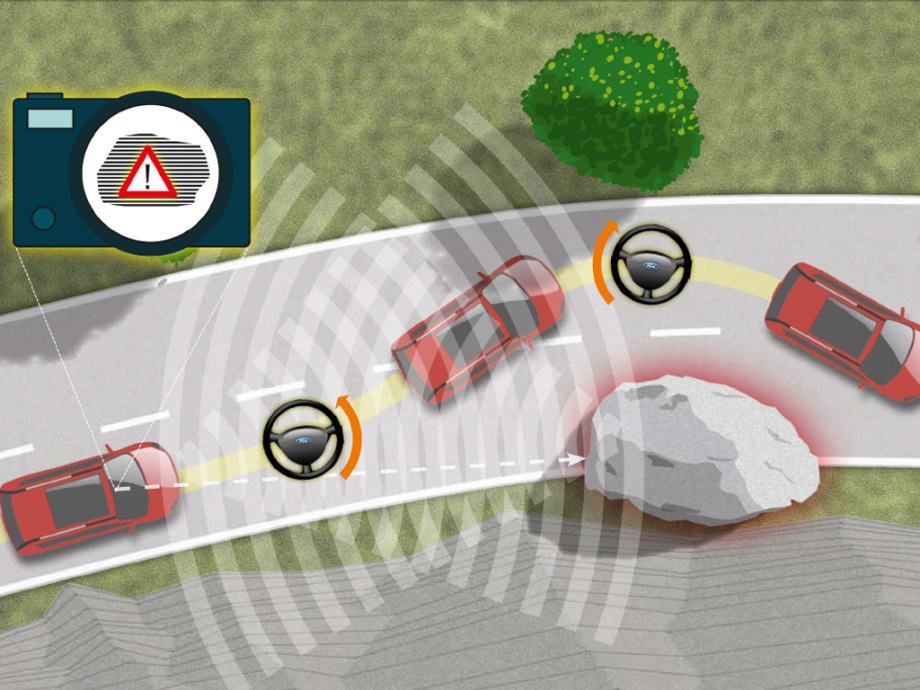
The technology uses automatic steering and braking to avoid collisions with vehicles that are stopped or slowing in the same lane ahead.
Graphic: Ford Motor Co.
Graphic: Ford Motor Co.
Ford Motor Co. last week demonstrated a test car equipped with the company’s obstacle avoidance technology, which automatically steers and brakes to direct the vehicle away from traffic if the driver fails to steer or brake following system warnings.
This prototype technology, Ford said, represents another milestone in the company’s Blueprint for Mobility, which envisions a future of automated functionality and advanced technologies to help improve safety, reduce congestion and improve the environment.
Ford conducted the obstacle avoidance demonstration for the first time in North America at the Dearborn Development Center test track in Michigan. Developed at Ford’s research facility in Aachen, Germany, obstacle avoidance is demonstrated on a Ford Focus.
The sensor-based technologies found in driver-assist and semi-automated features, including obstacle avoidance and fully assisted parking aid, form the building blocks for the future of automated driving, the automaker said.
Featured on the Ford Edge Concept that debuted last month at the Los Angeles Auto Show, Ford’s obstacle avoidance uses automatic steering and braking to avoid collisions with vehicles that are stopped or slowing in the same lane ahead. The system issues warnings first if it detects slow-moving objects or stationary obstacles ahead. If the driver fails to steer or brake following those warnings, the system will then automatically steer and brake to avoid a collision. Obstacle avoidance builds on the foundation of several driver-assist technologies now being offered in many Ford products around the world.
“The obstacle avoidance research project is a prime example of technologies we are developing to benefit drivers whose Ford vehicles are equipped with the technology and others who share the road with them,” said Paul Mascarenas, chief technical officer and vice president of Ford research and innovation. “We are optimistic that through our research and findings, we will be able to reduce these types of rear-end collisions.”
The test car is the product of a four-year research project called interactIVe (Accident Avoidance by Active Intervention of Intelligent Vehicles), a Ford-led consortium consisting of 29 partners.
Obstacle avoidance uses three radars, ultrasonic sensors and a camera to scan the road as far as 656 feet ahead. If the system detects a slow-moving or stationary object, it first displays a warning, then sounds a chime. If the driver does not steer or brake, the obstacle avoidance technology applies the brakes, scans for gaps on either side of the hazard, and takes control of the electronic power steering to avoid a collision. The technology has been tested at speeds greater than 38 mph.
Using similar sensor and automated vehicle control technology, Ford also recently unveiled fully assisted parking aid. This prototype technology lets customers park their vehicles at the touch of a button, or even by remote control. The concept builds on Ford’s current active park assist feature, which automatically steers the car into a parallel parking space while the driver controls the shifting, accelerator and brake.
Fully assisted parking aid can find a perpendicular parking space using ultrasonic sensors. From inside, the driver pushes a button to activate the system. From outside the vehicle, fully assisted parking aid can be remotely activated, allowing people to wait until the vehicle has pulled out of a tight parking spot before entering.
“Through development of obstacle avoidance and fully assisted parking aid technologies, we are building the foundation for a future of automated driving and personal mobility,” said Mascarenas.
More Safety

Nexar-Nauto Merger Aims to Give Fleets Better Safety Intelligence Through Larger Driving Dataset
Stefan Heck tells Automotive Fleet that combining more than 10 billion miles of driving history with Nexar's AI models will give fleets deeper insights into driver risk and roadway conditions than either company could provide independently.
Read More →
Don't Wait for a Crisis: 5 Ways to Build Mental Health Into Your Fleet Safety Program
For Suicide Prevention Month, fleet and safety leaders have an opportunity to put mental health where it belongs: at the center of workplace safety.
Read More →
How Camera Data Can Strengthen a Fleet’s Insurance Renewal
Insights from a commercial insurance carrier and a broker show how fleets can turn video telematic data, driver coaching, and improved claims results into a stronger case at insurance renewal.
Read More →
The Safest Fleets Aren’t the Ones with the Most Technology
You’ve made the telematics investment. Here’s how to capture the other half of its value and build the safest fleet on the road.
Read More →
Hidden in Plain Sight: Fleet Compliance Risks
Fleet compliance isn't just about having policies — it's about consistently enforcing them. This practical guide reveals six hidden compliance risks common in public sector and shared fleet operations and outlines proven strategies to improve visibility, accountability, and audit readiness
Read More →
NETS Sets 2026 Fleet Safety Benchmark Conference for Indianapolis
The Sept. 15–17 program will feature fleet benchmarking data, case studies, emerging technologies, and implementation strategies while running alongside the NSC Safety Congress & Expo.
Read More →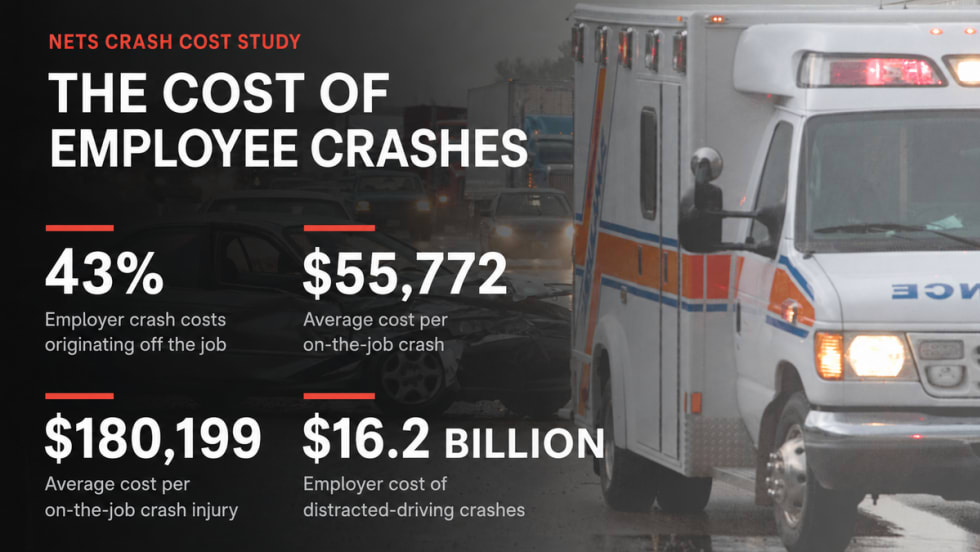
Off-the-Job Crashes Account for 43% of Employers’ $61.7 Billion Crash Burden
NETS quantifies costs dispersed across fleet, risk, HR, and other departments while providing new per-crash benchmarks for employers.
Read More →
Ram Recalls More Than 1.27 Million 1500 Pickups for Seat Belt Anchor Issue
The recall affects certain 2019-2026 Ram 1500 pickups that may have improperly attached second-row seat belt buckle anchors.
Read More →
How Better Visibility Cut Speeding Violations by 48%
Fleet leaders don't need more data, they need clearer visibility into what the data is saying. This case study explores how one utility replaced speeding-event counts with a single metric — miles driven in violation — to strengthen safety and significantly reduce speeding violations.
Read More →
Operation Safe Driver Week: Why the Industry's Oldest Safety Campaign Still Matters to Fleets
A look at how a 2007 enforcement initiative became one of the most consequential weeks on the fleet safety calendar, and what it means for your drivers in 2026.
Read More →