





Related: Ford Providing Support to Those Affected by COVID-19
Ford, 3M, and GE Healthcare Team Up for Urgent Medical Equipment
The three pieces of medical equipment that Ford will produce alongside these companies are powered-air purifying respirators, ventilators, and face shields.
March 24, 2020
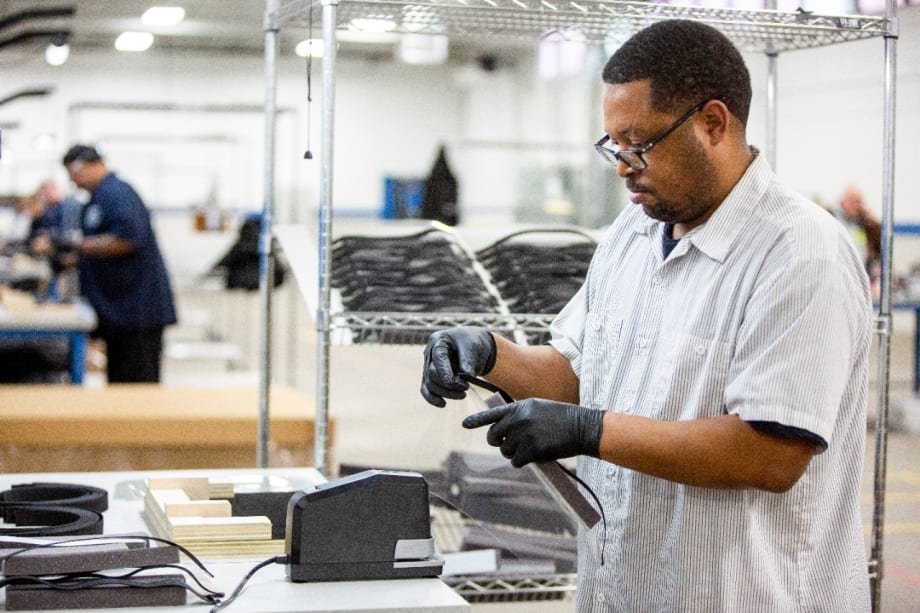
If Ford can produce respirators at one of its Michigan manufacturing facilities, it could help boost 3M’s production up to tenfold, Ford noted.
Photo courtesy of Ford.
2 min to read
Ford Motor Co. has started working with 3M and GE Healthcare to produce urgently needed medical equipment and supplies for healthcare workers, first responders, and patients fighting coronavirus.
The three pieces of medical equipment that Ford will produce alongside these companies are powered-air purifying respirators, ventilators, and face shields.
Ford and 3M will team up to increase 3M’s manufacturing capacity of its powered air-purifying respirators. The two companies will also be jointly developing a new respirator design that will leverage parts from both companies to meet the huge demand that COVID-19 has produced.
This new respirator could be produced in a Ford facility by UAW workers, the company noted.
Ford and 3M have been using off-the-shelf parts to expedite the production process. En example of this process is using fans from the Ford F-150's cooled seats, 3M HEPA air filters to filter airborne contaminant, and portable tool battery packs to power the respirators for up to eight hours.
If Ford can produce these respirators at one of its Michigan manufacturing facilities, it could help boost 3M’s production up to tenfold, Ford noted.
Ford and GE Healthcare will work together to expand production of a simplified version of GE Healthcare’s existing ventilator design. The ventilators could be produced at Ford’s manufacturing site in addition to a GE location.
Work on this initiative ties to a request for help from U.S. government officials, the company stated.
Ford’s U.S. design team is also creating and beginning to test transparent full-face shields for medical workers and first responders. The shield fully blocks a person’s face and eyes from accidental contact with liquids. When paired with N95 respirators, these face shields can more effectively limit potential exposure to COVID-19 than N95 respirators alone, the company stated.
Ford will test the first 1,000 face shields this week at Detroit Mercy, Henry Ford Health Systems, and Detroit Medical Center Sinai-Grace Hospitals.
Ford expects to finish about 75,000 of these shields this week, and the production schedule from then on is expected to be more than 100,000 face shields per week. Ford subsidiary Troy Design and Manufacturing’s facilities in Plymouth, Mich. Will produce these shields.
Ford has also committed to send Henry Ford health Systems 40,000 surgical masks while it locates additional supplies.
More Operations
Company Vehicle or Reimbursement? How Fleets Are Rethinking Assignments
As fleet costs and insurance pressures rise, fleet managers are taking a closer look at which employees need company-provided vehicles and when a reimbursement program may make more sense.
Read More →
Fleetio, ASE Launch Scholarship Program for Automotive Technicians
The second annual program will award 15 scholarships totaling $35,000 to support ASE certification, testing fees, and equipment costs.
Read More →
Reading the Global Signals: What AI and the Energy Transition Mean for Fleets Now
In this opening keynote of the 2026 Fleet Forward Conference, John Rossant, founder of CoMotion, How can fleet managers navigate a never-ending, changing industry landscape?
Read More →
90% Use Telematics. Are Fleets Getting Safer? | AF News Recap
This week, we're breaking down which industries have the highest rates, how Jamie McKay manages 2,400 vehicles, what's happening with the 2027 fleet awards, and why software-defined vehicles could introduce new costs.
Read More →
What's Best Handled by an FMC, and What's Better Done Directly?
Fleet managers continue to rely on FMCs for essential services but are taking a closer look at where working directly with suppliers can improve efficiency and responsiveness.
Read More →
Fleet Meets: Erin Gilchrist
Meet Erin Gilchrist, the inaugural Mike Antich Spirit of Fleet Award winner, as she shares insights on leadership, mentorship, the power of industry connections, and why people remain at the heart of fleet's future.
Read More →
How 2026 Fleet Visionary Jamie McKay Manages 2,400 Vehicles Across 37 States
How do you keep 2,400 vehicles running across 37 states? Fleet Visionary Award winner Jamie McKay shares how collaboration, flexibility, and a few simple strategies help her tackle fleet management challenges at Aptive Pest Control.
Read More →
Managing Fleet Costs in an Era of Permanent Volatility
Fleet operating costs have risen more than 20% since 2020, raising a key question: When does extending a vehicle's service life stop making financial sense?
Read More →
The Next Evolution of Fleet Management: Autonomous Operations
This opening keynote session at the Fleet Forward Conference highlights the future of autonomous driving for fleets.
Read More →
How to Reduce the Total Cost of Risk From Catalytic Converter Theft
A stolen catalytic converter can cost fleets far more in downtime and lost productivity than in repairs. A total-cost-of-risk approach can help fleet managers quantify their exposure and prioritize theft prevention.
Read More →