




Fleet Safety Video Tip: Winter Driving
Here's advice from the Wisconsin DOT along with an instructional video from the U.S. Army.
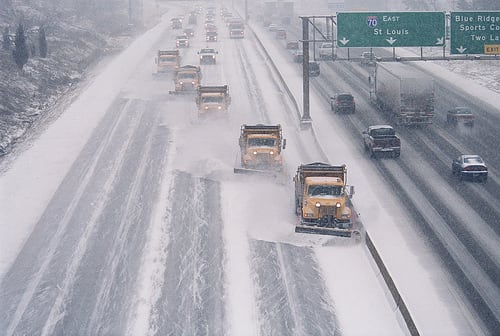
Photo: Missouri Department of Transportation
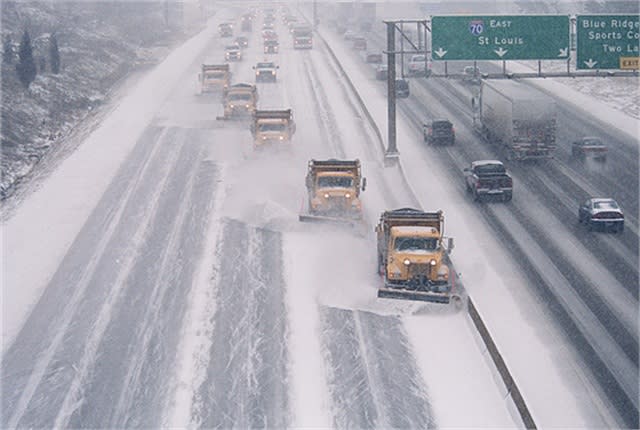
Photo: Missouri Department of Transportation
A number of cities – including Boston, New York and Philadelphia – this week saw their first snow of the season. It’s time again to remind your drivers of how dangerous roads can become in wintry conditions.
Here are some tips from the Wisconsin Department of Transportation that you can pass along:
Clear snow and ice from all windows and lights -- even the hood and roof -- before driving.
Pay attention. Don't try to out-drive the conditions. Remember the posted speed limits are for dry pavement.
Leave plenty of room for stopping.
Leave room for maintenance vehicles and plows. The law requires you to slow down or move over when approaching emergency or maintenance vehicles, including snowplows, parked on the side of the road when they have their flashing lights turned on. If you approach a parked emergency or maintenance vehicle during a winter storm and decide to change lanes, be extra careful. The passing lane may be in worse shape than the driving lane. There may also be a snow ridge between the two lanes. Avoid making an abrupt lane change. If approaching a snowplow, you need to stay back at least 200 feet and not pass on the right.
Know the current road conditions.
Use brakes carefully. Brake early and brake correctly. It takes more time and distance to stop in adverse conditions.
Watch for slippery bridge decks, even when the rest of the pavement is in good condition. Bridge decks will ice up sooner than the adjacent pavement.
Don't use your cruise control in wintry conditions. Even roads that appear clear can have sudden slippery spots and the short touch of your brakes to deactivate the cruise control feature can cause you to lose control of your vehicle.
Don't get overconfident in your 4x4 vehicle. Remember that your four-wheel drive vehicle may help you get going quicker than other vehicles but it won't help you stop any faster. Many 4x4 vehicles are heavier than passenger vehicles and actually may take longer to stop. Don't get overconfident in your 4x4 vehicle's traction. Your 4x4 can lose traction as quickly as a two-wheel drive vehicle.
Do not pump anti-lock brakes. If your car is equipped with anti-lock brakes, do not pump brakes in attempting to stop. The right way is to "stomp and steer!"
Look farther ahead in traffic than you normally do. Actions by cars and trucks will alert you quicker to problems and give you a split-second extra time to react safely.
Remember that trucks are heavier than cars. Trucks take longer to safely respond and come to a complete stop, so avoid cutting quickly in front of them.
Go slow!
And here's a U.S. Army video that offers valuable tips on how drivers can prevent, as well as counteract, loss of traction arising from slippery roads.
More Safety
Managing Road Risk at Scale: Why Fleet Safety Needs a Data-Driven Framework
Insights from the FIA Road and Driver Safety Indexes reveal how to manage road risk on a larger scale.
Read More →
Stellantis Recalls 1.3 Million Jeep Vehicles Worldwide Over Fire Risk
Stellantis is recalling more than 1.3 million Jeep Wrangler and Gladiator models worldwide over a fire risk linked to power steering pump wiring.
Read More →
Coaching Is Not Training, Even When AI Is Doing It
AI-powered safety platforms can detect risky behaviors and deliver immediate feedback. But effective driver development still requires a foundation of training followed by coaching that reinforces those skills.
Read More →
How Emotions Behind the Wheel Can Affect Fleet Safety
During National Safety Month, fleets are encouraged to look beyond distracted driving and recognize how stress, fatigue, and emotional well-being influence driver performance and crash risk.
Read More →
Nominations Open for 2026 Fleet Safety Award
Nominations have officially opened for the 2026 Fleet Safety Award Winner.
Read More →
Turning Connected Vehicle Data Into Decisions That Matter
Fleet leaders have more data than ever, but turning that data into clear, actionable decisions remains a challenge. This white paper shows how leading organizations are using connected vehicle data to improve safety, reduce costs, and optimize fleet performance. Learn how to turn insight into action across your fleet.
Read More →
Cameras, Safety and Insurance: From Reactive Claims to Real-time Prevention
Commercial auto remains one of the most challenging and costly lines of coverage for fleet operators and insurers alike. Learn more about how to effectively address these issues from Onur Aksan, Enterprise Business Development Executive, Geotab.
Read More →
NAFA Fleet Safety Symposium to Collocate With 2026 Fleet Forward Conference
The daylong certificate program will precede the Fleet Forward Conference at the Gaylord National Harbor in Maryland.
Read More →
The Distractions You Can’t Turn Off: What Drivers Face Outside the Vehicle
Fleet drivers face constant visual, cognitive, and environmental interruptions the moment they hit the road. From roadside chaos to mental fatigue and digital overload, today’s biggest driving risks often come from outside the vehicle itself.
Read More →
FLASH Weather AI Launches First Deep-Learning Hail Prediction Model With High-Resolution Forecasting
FLASH Weather AI has launched a first-of-its-kind hail prediction model capable of forecasting hail size and arrival time at 1-kilometer resolution up to 55 minutes ahead, giving fleets and insurers critical time to prepare for severe storms.
Read More →