




Fleet Operations, Finance Departments Not Seeing Eye to Eye
Corporate finance departments and fleet managers bring different perspectives to priorities such as vehicle acquisition, cost reduction measures, and maintenance and repair that can create obstacles such as "a significant lack of communication," according to a new survey from Fleet Advantage.

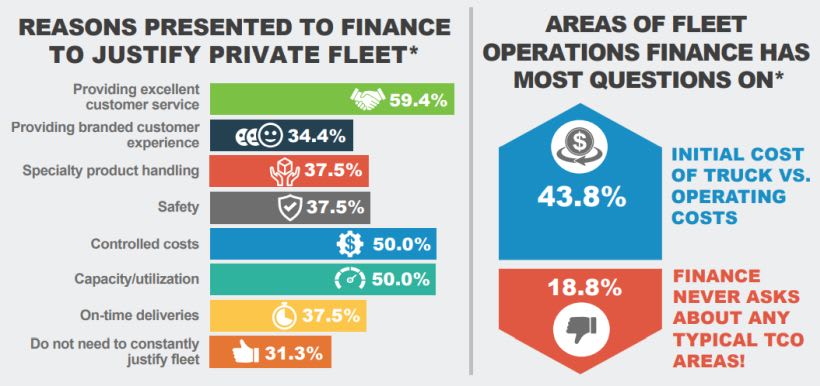
Fleet executives and their finance departments often bring different perspectives to fleet acquisition and cost control initiatives.
Graphic courtesy of Fleet Advantage.
Corporate finance departments and fleet managers bring different perspectives to priorities such as vehicle acquisition, cost reduction measures, and maintenance and repair that can create obstacles such as "a significant lack of communication," according to a new survey from Fleet Advantage.
About a third of fleet executives (37.5%) said their finance departments don't clearly communicate the company's financial metrics and goals to fleet operations personnel. Another third (34.4%) said finance doesn't understand the benefits of investing in new equipment. And 31.3% said finance doesn't understand the various operating costs associated with the fleet.
"It is evident that both the operations and finance departments are focused on different priorities in terms of fleet management and costs, and this poses a challenge to collectively achieve a singular organizational goal," said Brian Holland, Fleet Advantage's president and chief financial officer. "Hopefully, this survey will shed light on these communications challenges so that both departments can work closer on a fleet that operates more smoothly, with lower costs."
Fleet Advantage provides fleet services such as truck fleet analytics, equipment financing, and lifecycle cost management. The company's survey also delved into cost control perspectives and driver turnover.
The fleet executives said the finance department is concerned primarily about cost reduction (53.1%) followed by improving cash flow (40.6%). A quarter of fleet executives also said finance officers are unclear about how proper fleet acquisition strategies and lease-versus-purchase decisions affect the company's bottom line.
A majority of fleet executives (62.5%) said they focus on maintenance and repair costs when calculating a fleet's return on investment and three-fourths said they present this data to finance to gain access to capital expenditure for new equipment. A "stronger focus on TCO metrics" by finance would improve cost reduction initiatives and significantly improve cash flow in truck fleets. ABout 18.8% of finance professionals don't inquire about these metrics, according to Fleet Advantage.
The survey also looked more closely at driver turnover. About a fifth (18.8%) of the fleet executives said finance doesn't understand how newer trucks can reduce driver turnover and improve retention. Among heavy-duty truck fleets, this can be a critical issue due to a shortage of qualified drivers. The annual turnover rate at large truckload carriers with more than $30 million in annual revenue increased six points to 94%, according to the ATA's Trucking Activity Report. The turnover rate for smaller carriers fell to 73%, which was still seven points higher than the prior year.
Fleet Advantage has created an infographic to show the survey's results.
Related: Traditional Procurement Incentive Plans Are Counter-Productive to Good Fleet Management
More Operations

Fleet Has a Talent Pipeline Problem. What Comes Next? | AF News Recap
Where will fleet’s next generation of leaders come from? This week, we’re looking at the industry’s talent pipeline, what certification can add to a fleet career, how to build an award-worthy track record, and the return of Automotive Fleet’s Personal Use Survey.
Read More →
Smith System Launches Driver Risk Management Program
Fleets have more driver data than ever, but identifying risky behavior doesn't necessarily correct it. Smith System's new Driver Risk Management program combines monitoring, training, and follow-up coaching to help fleets connect risk signals with driver intervention.
Read More →
Automotive Fleet Opens 2026 Personal Use Survey for Commercial Fleet Managers
Less than two weeks left! Commercial and corporate fleet managers are invited to share how their organizations handle company vehicle personal-use policies, charges, and driver eligibility.
Read More →
From AI Prompts to AI-Generated Safety Songs | AF News Recap
Can better prompts make AI more useful for fleet managers? This week, we’re breaking down smarter fleet analysis, an AI-assisted experiment that turned safety training into music, and what happened to fuel prices in August.
Read More →
How to Write Better AI Prompts for Fleet Analysis
Include these six elements in your fleet prompts to generate more relevant analysis and accurate answers.
Read More →
Fleet Meets: Eric Kilgore
This edition of the Fleet Meets series features one of the industry's best leaders driving multi-market and national operations.
Read More →
Why Reactive Fleet Management Is Becoming Too Expensive to Sustain
Research highlights a growing need for proactive management strategies to address rising costs in fleet operations effectively.
Read More →
What Your Fleet KPIs Aren’t Telling You
Tracking fleet metrics is only useful when the data leads to better decisions. This guide helps fleet leaders assess cost, utilization, and downtime more accurately, identify performance gaps, and prioritize the actions that can improve operational results.
Read More →
Hidden in Plain Sight: Fleet Compliance Risks
Fleet compliance isn't just about having policies — it's about consistently enforcing them. This practical guide reveals six hidden compliance risks common in public sector and shared fleet operations and outlines proven strategies to improve visibility, accountability, and audit readiness
Read More →
Turning Fleet Payment Data into Executive Insights
Does data alone drive results in operations?
Read More →