




Feds Provide $232.5M for Emergency Road Repairs
The funds from the Federal Highway Administration reimburse states for the repair of roads and bridges damaged by storms and other unexpected disasters.
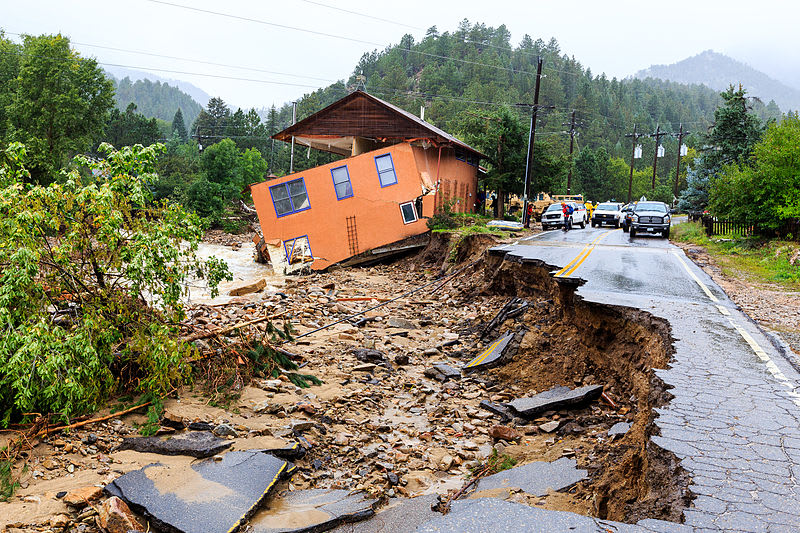
Road damage in Jamestown, Colo., caused by Boulder County flooding in September 2013. Photo by Steve Zumwalt/FEMA via Wikimedia Commons.
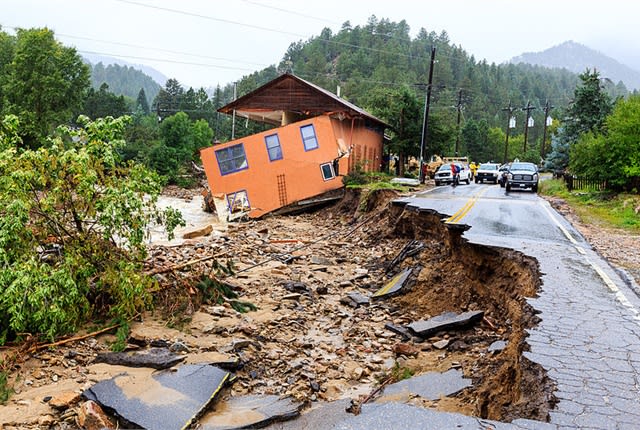
Road damage in Jamestown, Colo., caused by Boulder County flooding in September 2013. Photo by Steve Zumwalt/FEMA via Wikimedia Commons.
The U.S. Department of Transportation announced the allocation of $232.5 million in emergency relief funds to 26 states and Puerto Rico for the repair of roads and bridges damaged by storms, floods and other disasters.
The Federal Highway Administration (FHWA) released the funds. Transportation Secretary Anthony Fox announced the allocation totals on Feb. 18.
“We are committed to getting transportation facilities restored as quickly as possible following natural disasters and other emergencies,” Foxx said.
FHWA’s emergency relief program reimburses states for eligible expenses associated with damage from natural disasters or other emergency situations, based on state requests. The funds help to pay for the reconstruction or replacement of damaged highways and bridges, along with equipment set up for detours and the replacement of such items as guardrails.
The FHWA estimates that approximately $77 billion in annual investment is needed to meet the needs of the U.S. federal-aid highway system, according to a DOT report issued earlier this month.
Of special concern are 60,000 miles of coastal roads exposed to flooding from heavy rain and storm surges. Low-lying road infrastructure is particularly vulnerable to storm surges. Bridges, which often cross or stand near bodies of water, are also vulnerable.
At $55 million, Colorado topped the list among states reimbursed through the emergency relief program. The funding need was tied to flooding that caused widespread damage throughout the state. The hardest hit area in the state was Boulder.
Arizona received $36 million for a slope failure on US 89 in Coconino County, while Ohio drew $34 million for rock-fall damage on SR 7 in Jefferson County.
Both Alabama (Baldwin and Mobile counties) and Tennessee (south of Nashville) were repaid for repairs on two bridges on I-65 damaged by truck fires.
Delaware received funding to fix damaged piers on the I-495 bridge spanning the Christina River, near the Port of Wilmington.
Twenty other states received funding for extensive flooding, rainfall and other eligible events as well.
Emergency Relief Program Allocation
State
Event Title
Allocation
Alabama
Feb. 9, 2012 -- I-20 Sinkhole
$320,000
Alabama
Feb. 1-26, 2013 -- Severe Flooding
$1,200,000
Alabama
April 28, 2014 -- Storms and Flooding
$1,500,000
Alabama
May 22, 2014 -- Truck Crash and Fire on I-65 Bridge
$4,607,000
Alabama
July 31, 2014 -- Truck Crash/Fire on I-10 EB Bridge at Exit 30
$850,000
Arizona
Jan. 2010 -- Winter Storm
$1,000,000
Arizona
Feb. 20, 2013 -- US 89 Slope Failure
$36,000,000
Arizona
Sept. 2014 -- Rainfall and Flooding
$12,500,000
California
Feb. 2014 -- Storms
$2,765,597
California
Aug. 24, 2014 -- Napa Valley Earthquake
$4,800,000
Colorado
Sept. 11, 2013 -- Flooding
$55,000,000
Colorado
Aug. 9, 2013 -- US 24 Flood Damage
$576,159
Colorado
Jan. 2014 -- US 550 Rockfall
$850,000
Delaware
June 2014 -- I-495 Bridge Pier Damage
$4,000,000
Florida
Aug. 25, 2012 -- Tropical Storm Isaac
$900,000
Florida
April 29-30, 2014 -- Spring Flooding
$13,400,000
Idaho
July 31-Aug. 7, 2014 -- Heavy Rainfall and Flooding
$320,000
Indiana
April 2011 -- Severe Storms and Flooding
$369,603
Kentucky
June 2011 -- Storms and Flooding
$212,611
Kentucky
March 2012 -- Tornadoes and Storms
$53,342
Kentucky
April 2013 -- Storms and Flooding
$100,437
Michigan
Sept. 26, 2014 -- Pedestrian Bridge Collapse
$200,000
Montana
March 2014 -- Severe Flooding
$1,639,860
Nebraska
May 2011 -- Platte and Missouri River Flooding
$2,015,609
Nevada
Sept. 2014 -- Rainfall and Flooding
$9,144,000
New Mexico
Sept. 9, 2013 -- Flooding
$3,000,000
New Mexico
September 18, 2014 -- Severe Storms and Flooding
$530,500
New York
May 2014 -- Flooding
$1,000,000
North Dakota
May 19, 2014 -- Southern Mouse River Basin Flooding
$3,954,540
North Dakota
May 19, 2014 -- West James River Basin Flooding
$1,736,539
North Dakota
May 19, 2014 -- Divide County Basin 1 Flooding
$4,923,337
North Dakota
May 19, 2014 -- Divide County Basin 2 Flooding
$1,283,498
Ohio
Mid‐March 2011 -- Heavy Rain fall
$1,500,000
Ohio
Jan. 2012 -- ER Event in Jefferson County
$34,375,000
Oklahoma
May 24 - June 10, 2007 -- Flooding Event
$1,044,000
Oregon
Feb. 6, 2014 -- I-84 Rockslide
$750,000
Puerto Rico
May 10, 2014 -- Rio Grande Rainfall
$1,000,000
South Carolina
Aug. 6, 2013 -- Jones Mill Rd Bridge Failure
$483,412
South Dakota
June 2014 -- Heavy Rainfall and Flooding
$4,608,812
Tennessee
April 28-30, 2014 -- Storms, Landslide, and Rockslide
$825,600
Tennessee
Aug. 15, 2014 -- Tanker Truck Crash and Fire on I-65
$2,060,497
Utah
Sept. 2014 -- Rainfall and Flooding - Utah detours
$200,000
Vermont
April 23 - May 30, 2011 -- Severe Storms and Flooding
$166,000
Vermont
Aug. 27, 2011 -- Tropical Storm Irene
$4,440,000
Washington
Sept. 2013 -- Rain US 12 Slide
$230,027
Washington
March 2014 -- Abnormal Rainfall
$5,093,898
Washington
Aug. 21, 2014 -- Heavy Rainfall and Flooding
$3,527,285
Wisconsin
June 2012 -- NW Wisconsin Flooding Event
$1,200,000
Wisconsin
Sept. 25, 2013 -- I-43 Leo Frigo Bridge Pier Failure
$200,000
Total
$232,457,163
Source: U.S. Department of Transportation.
More Safety

IIHS Crash Avoidance Tests Reveal Safety Gaps in Cargo Vans and Work Trucks
New crash-avoidance ratings from the Insurance Institute for Highway Safety reveal inconsistent performance among commercial vehicles, with several popular cargo vans and heavy-duty pickups struggling to avoid collisions with other vehicles and pedestrians.
Read More →
What’s Next for Fleet? Safety, AI & Industry Recognition | AF News Recap
Could your company's culture be encouraging distracted driving? This week, we're exploring how workplace expectations affect driver safety, what AI, EVs, and autonomous vehicles could mean for the future of fleet management, and how fleet professionals can strengthen their award nominations.
Read More →
Does Your Fleet's Culture Encourage Distracted Driving?
What happens when the people responsible for enforcing safety rules are the ones setting the wrong example? The answer may reveal why some of the biggest risks to fleet drivers have little to do with what's written in the employee handbook.
Read More →
Fleet Manager’s Ultimate Playbook: Navigating the New Standard in OEM Connectivity
Rising operating costs, driver safety concerns, and unplanned downtime are putting unprecedented pressure on modern fleets. Discover how fleet managers use embedded OEM connectivity and real-time vehicle data to cut TCO, prevent downtime, and protect drivers without aftermarket telematics hardware.
Read More →
From Driver Well-Being to EV Charging | AF News Recap
Mental health belongs in the fleet safety conversation. This week, we’re looking at five ways fleets can support employee well-being before a crisis, plus Holman’s expansion in Mexico, new one-day Fleet Forward passes, and why EV charging demand is outpacing infrastructure growth.
Read More →
Nexar-Nauto Merger Aims to Give Fleets Better Safety Intelligence Through Larger Driving Dataset
Stefan Heck tells Automotive Fleet that combining more than 10 billion miles of driving history with Nexar's AI models will give fleets deeper insights into driver risk and roadway conditions than either company could provide independently.
Read More →
Don't Wait for a Crisis: 5 Ways to Build Mental Health Into Your Fleet Safety Program
For Suicide Prevention Month, fleet and safety leaders have an opportunity to put mental health where it belongs: at the center of workplace safety.
Read More →
How Camera Data Can Strengthen a Fleet’s Insurance Renewal
Insights from a commercial insurance carrier and a broker show how fleets can turn video telematic data, driver coaching, and improved claims results into a stronger case at insurance renewal.
Read More →
The Safest Fleets Aren’t the Ones with the Most Technology
You’ve made the telematics investment. Here’s how to capture the other half of its value and build the safest fleet on the road.
Read More →
Hidden in Plain Sight: Fleet Compliance Risks
Fleet compliance isn't just about having policies — it's about consistently enforcing them. This practical guide reveals six hidden compliance risks common in public sector and shared fleet operations and outlines proven strategies to improve visibility, accountability, and audit readiness
Read More →