




Related: Faraday Future to Build Production Plant in Las Vegas
Faraday Future Shows Concept EV Batmobile
Faraday Future revealed its FFZERO1 concept that uses a modular engineering system optimized for electric vehicles at an event prior to the opening of the International Consumer Electronics Show (CES).
by Staff
January 6, 20162 min to read
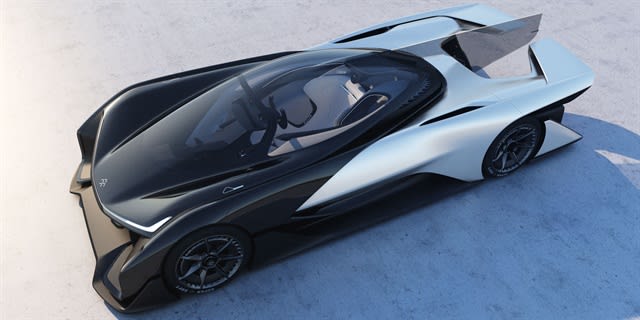
Photo courtesy of Faraday Future.
Faraday Future revealed its FFZERO1 concept that uses a modular engineering system optimized for electric vehicles at an event prior to the opening of the International Consumer Electronics Show (CES).
The vehicle's Variable Platform Architecture (VPA) was designed and engineered specifically for electric vehicles and will be used as the foundation for future products from the start-up company. The skateboard-style chassis can be adjusted by changing the lengths of the rails and other relative structures to accommodate the number of battery strings per each configuration. There are structural benefits to the design as well, such as larger crumple zones that improve safety by centralizing and protecting the battery pack.
Unlike battery systems in other EVs, the VPA features strings of batteries, which can be more easily replaced or changed than a single battery. On this platform, adding or subtracting strings will enable the creation of vehicles of varying sizes with more power or greater range.
The VPA also incorporates various motor configurations. Ranging from a one-motor to three-motor configurations, it is possible to modify vehicle characteristics, including rear-, front-, or all-wheel drive systems, extended range options, and various power outputs, all utilizing the same chassis architecture.
While technically a racecar, the FFZERO1 is the vehicle that will pave the way for other Faraday Future cars. “The FFZERO1 Concept is an amplified version of the design and engineering philosophies informing FF’s forthcoming production vehicles,” said Richard Kim, head of design. “This project liberated our designers and inspired new approaches for vehicle forms, proportions and packaging that we can apply to our upcoming production models.”
Other unique features include a steering column that allows smartphone integration; a single-seat configuration that is inspired by NASA designs; and aero tunnels that run through the interior length of the vehicle, allowing air to flow through the car rather than around it, reducing drag and improving battery cooling.
For more information, see the company’s press release.
More Green Fleet

Merchants Fleet Reports 290M EV Miles as Fleets Navigate Changing Electrification Market
From millions in operating savings to hundreds of millions of EV miles, Merchants Fleet’s latest report reveals what’s working and what’s changing in fleet electrification.
Read More →
The EV Breakdown Nobody's Talking About: Why Most Electric Vehicle Roadside Calls Aren't Mechanical Failures
Here's why EV breakdowns are widely misunderstood.
Read More →
ChargePoint Now Available in Energy Pass
ChargePoint and additional planned charging network integrations were added to GM's Energy Pass.
Read More →

First Look: Slate Auto's Electric Fleet Pickup
Could an affordable, modular EV pickup make electrification more practical for fleets?
Read More →
Slate Debuts Colorful, Unique EV Models
A recent media and client event, studded with electric vehicles dressed up on platforms, planted a new position for the manufacturer in the wider EV market. Fleets will find cost-saving advantages.
Read More →
Slate Electric SUV, Pickup Switchable Model Aims For Light-Duty Fleets
Everything about this EV is counterintuitive and understated, making it stand out from the crowd.
Read More →
Inspiration Mobility Acquires Key Electrada Assets
Inspiration Mobility Group has acquired select assets of Electrada, adding the fleet electrification provider's team, technology, and charging infrastructure development capabilities to its energy management business.
Read More →
Sponsored•June 1, 2026
Turning Connected Vehicle Data Into Decisions That Matter
Fleet leaders have more data than ever, but turning that data into clear, actionable decisions remains a challenge. This white paper shows how leading organizations are using connected vehicle data to improve safety, reduce costs, and optimize fleet performance. Learn how to turn insight into action across your fleet.
Read More →
Sponsored•May 29, 2026
Are You Tracking Your Fleet's True Total Cost of Ownership?
Bobit Business Media surveyed 190 fleet professionals and found that while most fleets are tracking costs, fragmented systems and data gaps are keeping true TCO visibility out of reach. With rising pressure to control spend in an increasingly volatile environment, the gap between what fleets think they know and what the data actually shows is wider than you might expect. See how your peers are managing costs today and where the industry still has room to improve.
Read More →