




Encana Reduces Accident Rate by 49% in 15 Months With Driver Safety Initiative
DENVER – Natural gas industry company Encana has developed a comprehensive driver safety program that has yielded significant results in terms of reducing the number of motor vehicle incidents its drivers are involved in.
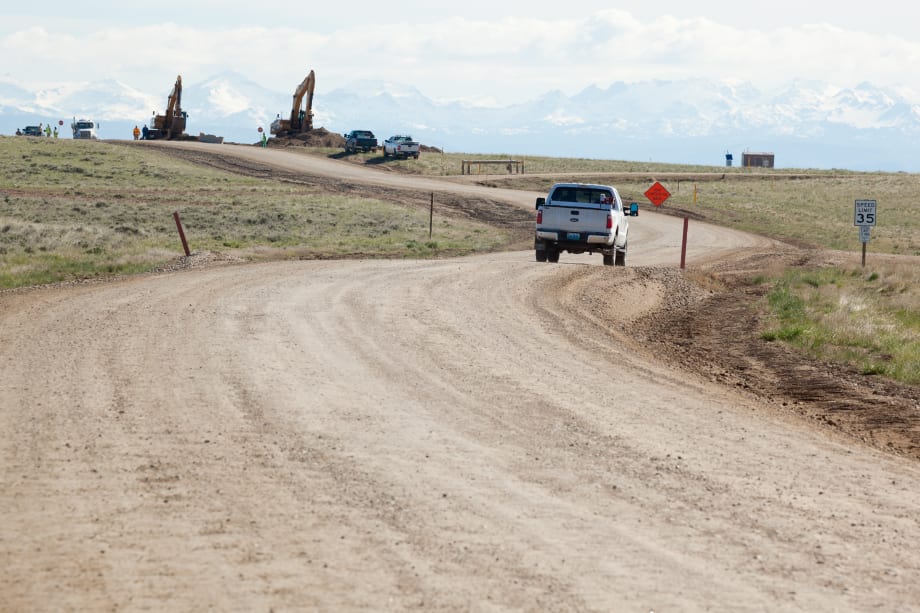
Photos courtesy Encana.
Photos courtesy Encana.
DENVER – Natural gas industry company Encana has developed a comprehensive driver safety program that has yielded significant results in terms of reducing the number of motor vehicle incidents its drivers are involved in.
The company’s fleet drivers often travel in off-road areas, making a focus on safety necessary to keep employees safe. Automotive Fleet interviewed Encana’s VP of Environment, Health, Safety and Security (EHS&S), Byron Gale, about what’s involved in the company’s program and how it achieved such significant results.
“Encana drivers deal with many of the same challenges as the general public: road and weather conditions, actions of other drivers and vehicles, fatigue, nighttime driving, narrow and winding roads, etc,” Gale said. “Other challenges our drivers face on a daily basis include: topography, windy gravel lease roads, hauling heavy equipment and/or trailers, and maneuvering vehicles on tightly-spaced well or drilling locations.”
These conditions called for a dedicated approach to safety, and Encana formally began its program in February of 2008. Since then, the company has continually improved its approach to driver safety. The program itself involves using technology from a company called Cartasite to monitor vehicles and driver performance, allowing drivers to see their driving performance on an ongoing basis, and a dedicated safety team that develops training materials administers the program.
Encana’s program and approach to improving safety is working well, as the company was able to achieve a number of significant safety-related gains, according to Gale.
“When we compare our motor vehicle incident (MVI) rates during the 15 months prior to the ROVR (Realtime Onboard Vehicle Reporting) program to the 15-month period following the program rollout, we have achieved a 49-percent reduction in this type of motor vehicle incident,” he said.
Other significant achievements, comparing statistics at the start of the 15-month period to those at the end, include a 50-percent reduction in excessive speed events; a nearly 60-percent reduction in rapid starts; and close to a 30-percent reduction in hard braking.
Elements of Encana’s Safety Initiative
The company’s safety program has five key components. These are its Driver Distraction Practice policy; using Cartasite’s GPS-based ROVR technology; forming a Driver Safety Team; hiring a Driver Safety Advisor; a standard Driver Safety Training program available to all its drivers in the U.S.; and having its fleet manager ensure that all vehicles are equipped with the appropriate safety equipment.
“Encana operates using an integrated Environment, Health, Safety & Security management system. Within the safety standards of this system is a program directed at driving safety,” Gale said. ”Despite the work we do drilling wells and producing natural gas, Encana recognizes that driving is perhaps the most dangerous and risky task we perform each day. Our EHS&S management system, our safety standards and programs, and our focus on driving safety began when Encana formed. But we have enhanced our USA Division driving safety program through the addition of several key components.”

The company’s Driver Distraction Practice policy prohibits the use of communication devices, hand-held and hands-free, while driving a company vehicle or a personal/rental vehicle on company business.
To better manage its fleet operations, in early 2009 Encana began using technology across its entire fleet from a company called Cartasite, specifically its (ROVR) system.
“Encana was comfortable with both Cartasite and the ROVR technology after using the technology in a pilot study, ‘Driving Change’ conducted in cooperation with the City and County of Denver in 2008,” Gale said. “The pilot study gave Encana the opportunity to fund the technology that later evolved into Cartasite’s ROVR device. The Driving Change program results indicated safer streets, better fuel economy, and reduced emissions.”
The company formed its USA Division Driving Safety Team in 2009, originally to develop and implement the ROVR program. In addition to its safety team, the company hired a Driving Safety Advisor, Colonel Mark Trostel, in the fall of 2009. He worked with the team to develop and implement the new ROVR program across the USA division.
“Once the ROVR program was rolled out, the team went back to its driving safety work - developing resources such as informational Web pages and working with our corporate office in Calgary on a Drive Safe DVD, training programs, tools, and guidance,” Gale said. Encana finished rolling out the program in April 2010.
Although the ROVR program has made a major impact, ongoing driver training is essential to reducing incident rates.
“Encana’s remaining MVIs tend to track roughly into one of four categories: winter driving, wildlife, backing, and turning events,” Gale said. “The ROVR program doesn’t necessarily provide support for these four categories of MVIs. Rather the program keeps us safe against the type of more significant MVIs that have the potential to generate more severe injuries, as the data and results have shown. For the four categories that may result in less significant MVIs and less severe injuries, we put together practices, we raise awareness, and we train our drivers.
Making the Program Work
Encana’s Gale said making the program work requires ongoing monitoring and administration. An essential part of this ongoing effort involves making safety training available to a wide number of employees.
“Driving Safety Training became a standard option in two Encana training packages called EH&S Essentials for Office Staff and EH&S Essentials for Field Staff,” Gale said. “Colonel Trostel has provided valuable guidance on training types and training sources such as CTS, Smith System, Attitudinal Dynamics of Driving, etc. in an effort to customize these programs to Encana’s needs and trends.”
He said the company gives drivers a weekly scorecard to show them their driving performance.
“The weekly scorecard indicates their driving performance relative to metrics such as excessive or hard braking, rapid starts or acceleration, excessive speed events, nighttime driving, idling, and fuel mileage,” Gale said. “They also receive an overall numerical score for the time period to reflect their overall driving performance and improvement.”
The company intends the program to be positive for drivers and help them improve their driving performance via self-correction. It only administers disciplinary actions in extreme cases.
“There is not necessarily a disciplinary approach with the ROVR program. Rather, based on scorecard results, scores, and trends, intervention, and/or additional training are provided to the drivers who need it,” Gale said. “However, our Distracted Driving Practice can be enforced up to and including termination – and terminations have occasionally occurred. The scorecards and results are also monitored at the USA Division level for trends and anomalous results. Based on the results, intervention and/or training may be necessary; or on the other hand, reward and recognition.”
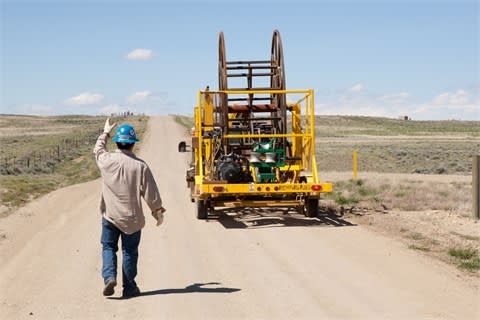
The scorecard system’s results track with the overall safety results the company has seen so far. Encana saw month-after-month increases in the number of drivers scoring above 90 in the program and a decrease in the number of drivers scoring below 80 (a score of 100 is perfect). Training is ongoing, and utilizes Cartasite’s Worldview software to let drivers know how they’re doing in addition to introductory training in using the software and a regular, mandatory driver safety course.
“The only training required for the ROVR program is an initial orientation-type training to familiarize drivers with the program,” Gale said. “They are shown how to access Cartasites’ WorldView pages to ‘see’ their driving, and they are trained on the scorecards which they receive. They are also trained on the ROVR device, the operating protocols of the program, and how it affects them. Beyond that, all drivers are required to take a driving safety course at regular intervals.”
Using a dedicated, ongoing approach to driver safety, combined with the use of Cartasite’s GPS-based vehicle monitoring technology and software, Encana has been able to reduce its motor vehicle incident rate significantly, reduce the costs associated with those incidents, and most importantly keep its employees safe.
By Greg Basich
More Safety
Operation Safe Driver Week: Why the Industry's Oldest Safety Campaign Still Matters to Fleets
A look at how a 2007 enforcement initiative became one of the most consequential weeks on the fleet safety calendar, and what it means for your drivers in 2026.
Read More →
Nexar-Nauto Merger Aims to Give Fleets Better Safety Intelligence Through Larger Driving Dataset
Stefan Heck tells Automotive Fleet that combining more than 10 billion miles of driving history with Nexar's AI models will give fleets deeper insights into driver risk and roadway conditions than either company could provide independently.
Read More →
From Silos to Solutions: Relationship Management for Safer Fleets
From telematics adoption and driver accountability to policy consistency and risk mitigation, this episode breaks down what it really takes to build a safer fleet culture without slowing business down.
Read More →
IIHS Launches First Commercial Vehicle Safety Evaluations
The Insurance Institute for Highway Safety has begun evaluating heavy-duty pickups and cargo vans for driver protection. Which models earned top marks?
Read More →
Reducing Risk by Eliminating Phone Use Behind the Wheel
Hosted with the cofounder of Lifesaver Mobile, this episode addresses phone use behind the wheel and how to design a driving environment that actually helps prevents accidents.
Read More →
Cameras, Safety and Insurance: From Reactive Claims to Real-Time Prevention (Part 2 of 2)
Part Two: Commercial auto remains one of the most challenging and costly lines of coverage for fleet operators and insurers alike. Continue learning more about how to effectively address these issues from Onur Aksan, Enterprise Business Development Executive, Geotab
Read More →
How 5-Second Telematics Data Is Changing Fleet Safety
This episode connects with Steve Santostasi of Ford Pro and covers how a few seconds of data can make a difference in fleet safety.
Read More →
Managing Road Risk at Scale: Why Fleet Safety Needs a Data-Driven Framework
Insights from the FIA Road and Driver Safety Indexes reveal how to manage road risk on a larger scale.
Read More →
Stellantis Recalls 1.3 Million Jeep Vehicles Worldwide Over Fire Risk
Stellantis is recalling more than 1.3 million Jeep Wrangler and Gladiator models worldwide over a fire risk linked to power steering pump wiring.
Read More →
Coaching Is Not Training, Even When AI Is Doing It
AI-powered safety platforms can detect risky behaviors and deliver immediate feedback. But effective driver development still requires a foundation of training followed by coaching that reinforces those skills.
Read More →