




Electric Canter E-Cell Truck Being Trialed in Portugal
The all-electric Canter E-Cell truck is currently being tested for the European market. A total of eight vehicles are part of the test, which is being conducted in Portugal.

Photo: Daimler
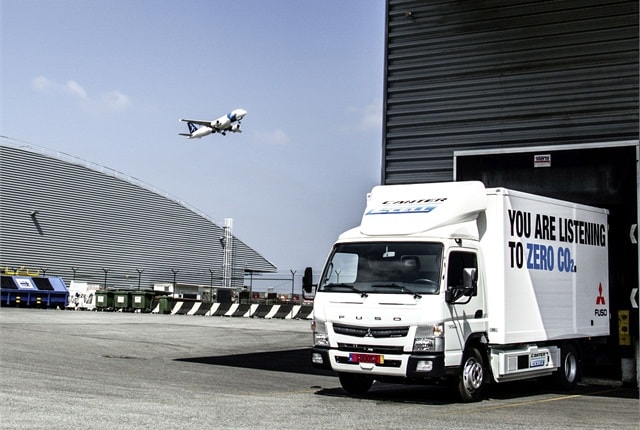
Photo: Daimler
The all-electric Canter E-Cell truck is currently being tested for the European market. A total of eight vehicles are part of the test, which is being conducted in Portugal.
These customer trials with the Canter E-Cell under real-life conditions are set to run for one year, according to the company. The eight Canter E-Cell trucks are based on the Canter with a wheelbase of 3,400 mm and feature a single cab in the wide, comfort specification. Each is fitted with either a 4.3 m-long platform body or a 4.4 m-long box body.
The capabilities of these electrically-powered trucks will be put to the test under a wide range of conditions. The city of Lisbon will be using the Canter E-Cell for horticultural and waste disposal purposes, the city of Porto as a means of transport between its various municipal buildings and the city of Abrantes similarly in the field of horticulture. The company Transporta will use the Canter E-Cell for house-to-house deliveries as part of its short-radius distribution service, the energy supplier REN for transport purposes within the port area of the town of Sines, to the south of Lisbon. And lastly, the Canter E-Cell will be helping the Portuguese national postal service CTT with transport runs between its distribution centres in Lisbon.
Compared with the original prototype model, the Fuso Canter E-Cell has now seen considerable further development. The design of the electrically-powered light-duty truck is based on the chassis of the conventional Canter and allows a permissible gross vehicle weight of 6.0 t, according to the company. The resulting payload of the chassis is around 3.0 t.
The electric motor in the new Canter E-Cell gives it a top performance of 150 hp and high maximum torque of 650 Nm. Power transmission to the rear axle is via a single-speed transmission. Both the cardan shaft and the rear axle are components that have been adopted from the Canter with combustion engine. Good performance is a given, as it is a feature of the design of an electric motor that its maximum torque is available immediately upon start-up. The top speed of the Canter E-Cell, as with all vehicles in this weight class, is limited to 90 km/h.
Located on each side of the frame are a total of four battery packs, accommodated in two fully encapsulated boxes. These are lithium-ion batteries with a nominal capacity of 48.4 kWh. This gives the Fuso Canter E-Cell a range of over 100 km,according to the company. Charging the batteries at 230 volts takes around seven hours, while use of a rapid-charging system can reduce this to just one hour.
More Global Fleet

Holman Takes Full Ownership of ARIZA in Mexico
Holman is bringing its Mexican fleet management operation fully under its own brand after more than 30 years as a joint venture. The change gives multinational fleet customers a single Holman operation across the U.S., Canada, and Mexico.
Read More →
Proven Ways to Reduce Work Truck Downtime
The age-old problem of downtime will always be a reality, but with new strategies at hand, fleets have more ways to keep trucks on the road longer.
Read More →
The Top 300 Commercial Fleets
The Top 300 Commercial Fleets: See the List
Read More →

Cameras, Safety and Insurance: From Reactive Claims to Real-Time Prevention (Part 2 of 2)
Part Two: Commercial auto remains one of the most challenging and costly lines of coverage for fleet operators and insurers alike. Continue learning more about how to effectively address these issues from Onur Aksan, Enterprise Business Development Executive, Geotab
Read More →
Cameras, Safety and Insurance: From Reactive Claims to Real-time Prevention
Commercial auto remains one of the most challenging and costly lines of coverage for fleet operators and insurers alike. Learn more about how to effectively address these issues from Onur Aksan, Enterprise Business Development Executive, Geotab.
Read More →
Fleet Costs Are Rising: Here’s How Leaders Are Responding
Fleet leaders are under pressure to reduce costs, adapt to economic uncertainty, and make smarter decisions. See how peers across North America are responding with real data, proven strategies, and forward-looking insights. Download the 2026 Market Pulse Report to benchmark your strategy and uncover where you can gain an edge.
Read More →
Enterprise Fleet Management Surpasses 900,000 Vehicles in U.S. & Canada
Enterprise Mobility connects with mobility solutions around the globe
Read More →
Automotive Fleet's Guide to Fleet Electrification
Unlock the secrets to a successful transition to electric fleets with Automotive Fleet's comprehensive Fleet Electrification Guide!
Read More →
Sumitomo Rubber Industries to Acquire Viaduct
Viaduct will join Sumitomo as an independent subsidiary. Partnership strengthens global reach and accelerates AI-driven innovation for fleets and manufacturing.
Read More →