




Related: 'Cognitive Distraction' Means Hands-Free Cell Phones Aren't Any Safer
Driver Visual Awareness Slows During Conversations
Research from the University of Iowa finds that even a simple conversation creates an "attention disengagement" lag that affects a driver’s reaction time.
by Staff
June 7, 2017
Photo by Ed Brown/Wikimedia Commons.
2 min to read
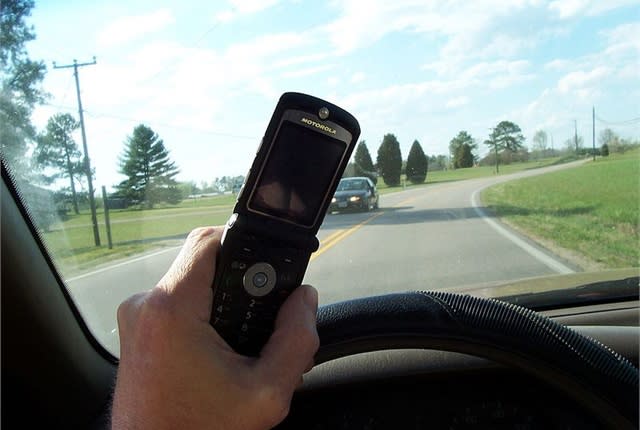
Photo by Ed Brown/Wikimedia Commons.
A new study from the University of Iowa concludes that drivers engaged in a conversation — either over the phone or with a passenger — are slower to recognize and respond to a new object in their field of view.
A conversation creates an “attention disengagement” lag, researchers found, which affects the driver’s ability to focus on the road ahead. The study was published online in the academic journal Psychonomic Bulletin and Review.
Researchers relied on computerized experiments that tracked the eye movements of test subjects while they were asked to answer true or false questions. Participants in the test took about twice as long to direct their eyes to a new object on the screen while answering the questions, compared to participants who weren’t asked any questions.
The experiments were designed to mimic a situation where a driver is having a conversation, either with someone on the phone or with a passenger, said Shaun Vecera, a professor in the University of Iowa Department of Psychological and Brain Sciences. Vecera was the research paper’s corresponding author.
The attention disengagement delay is about 40 milliseconds, or four-hundredths of a second. Though that doesn’t seem very long, the delay compounds. Each time the brain is distracted, the amount of time to disengage from one action and start another action gets longer, according to the study.
“It’s a snowball effect,” Vecera explained to Iowa Now, a website that focuses on University of Iowa news. “And that’s what contributes to the problem because eventually you’re oblivious to a lot that’s around you.”
When a driver is conversing with someone, his or her brain is taking in information, overlaying it with what’s already known, and then preparing to offer a thoughtful reply.
“Active listening delays the disengagement of attention, which must occur before attention can be moved to a new object or event,” Vecera said.
The study’s first author is Benjamin Lester, a University of Iowa graduate who majored in psychology. He is also a former post-doctoral research scholar at the university. The U.S. National Science Foundation and the Toyota Collaborative Safety Research Center funded the research.
In 2015, 3,477 people in the U.S. were killed and 391,000 were injured in motor vehicle crashes involving distracted drivers, according to the National Highway Traffic Safety Administration.
More Safety
Tips for Driving Safely on Halloween Night
This video features a reminder from the Connecticut Department of Transportation (DOT) and the Connecticut Police Chiefs Association, urging drivers to prioritize safety this Halloween.
Read More →
IIHS Crash Avoidance Tests Reveal Safety Gaps in Cargo Vans and Work Trucks
New crash-avoidance ratings from the Insurance Institute for Highway Safety reveal inconsistent performance among commercial vehicles, with several popular cargo vans and heavy-duty pickups struggling to avoid collisions with other vehicles and pedestrians.
Read More →
What’s Next for Fleet? Safety, AI & Industry Recognition | AF News Recap
Could your company's culture be encouraging distracted driving? This week, we're exploring how workplace expectations affect driver safety, what AI, EVs, and autonomous vehicles could mean for the future of fleet management, and how fleet professionals can strengthen their award nominations.
Read More →
Does Your Fleet's Culture Encourage Distracted Driving?
What happens when the people responsible for enforcing safety rules are the ones setting the wrong example? The answer may reveal why some of the biggest risks to fleet drivers have little to do with what's written in the employee handbook.
Read More →
Sponsored•October 1, 2026
Fleet Manager’s Ultimate Playbook: Navigating the New Standard in OEM Connectivity
Rising operating costs, driver safety concerns, and unplanned downtime are putting unprecedented pressure on modern fleets. Discover how fleet managers use embedded OEM connectivity and real-time vehicle data to cut TCO, prevent downtime, and protect drivers without aftermarket telematics hardware.
Read More →
From Driver Well-Being to EV Charging | AF News Recap
Mental health belongs in the fleet safety conversation. This week, we’re looking at five ways fleets can support employee well-being before a crisis, plus Holman’s expansion in Mexico, new one-day Fleet Forward passes, and why EV charging demand is outpacing infrastructure growth.
Read More →
Nexar-Nauto Merger Aims to Give Fleets Better Safety Intelligence Through Larger Driving Dataset
Stefan Heck tells Automotive Fleet that combining more than 10 billion miles of driving history with Nexar's AI models will give fleets deeper insights into driver risk and roadway conditions than either company could provide independently.
Read More →
Don't Wait for a Crisis: 5 Ways to Build Mental Health Into Your Fleet Safety Program
For Suicide Prevention Month, fleet and safety leaders have an opportunity to put mental health where it belongs: at the center of workplace safety.
Read More →
How Camera Data Can Strengthen a Fleet’s Insurance Renewal
Insights from a commercial insurance carrier and a broker show how fleets can turn video telematic data, driver coaching, and improved claims results into a stronger case at insurance renewal.
Read More →
The Safest Fleets Aren’t the Ones with the Most Technology
You’ve made the telematics investment. Here’s how to capture the other half of its value and build the safest fleet on the road.
Read More →