




Driver Distractions Extend 27 Seconds Beyond Act
New research from the AAA Foundation for Traffic Safety concludes that drivers’ mental distractions can persist long after completing a task.

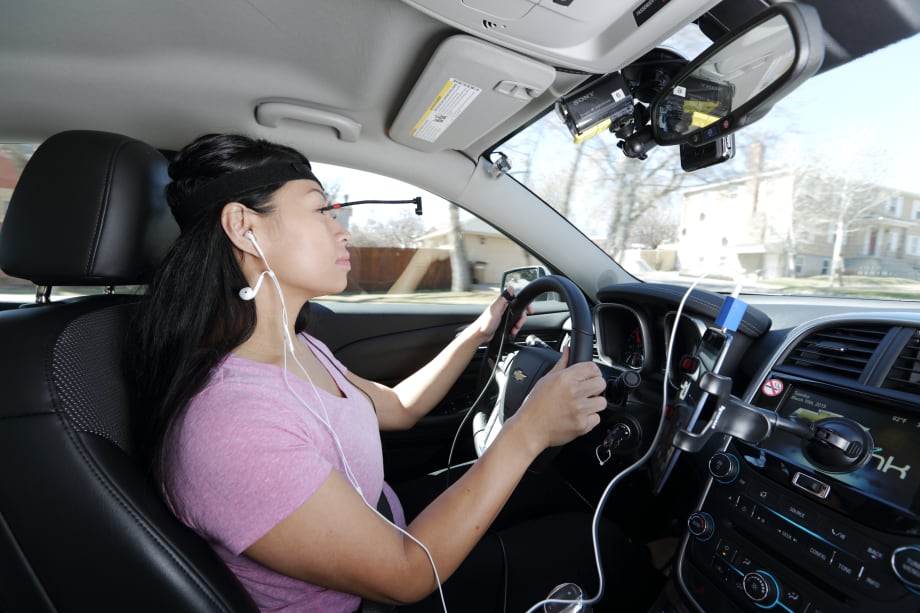
Drivers participated in a test aimed at gauging mental distractions presented by new hands-free technologies.
Photo courtesy of AAA.
Drivers participated in a test aimed at gauging mental distractions presented by new hands-free technologies. Photo courtesy of AAA.
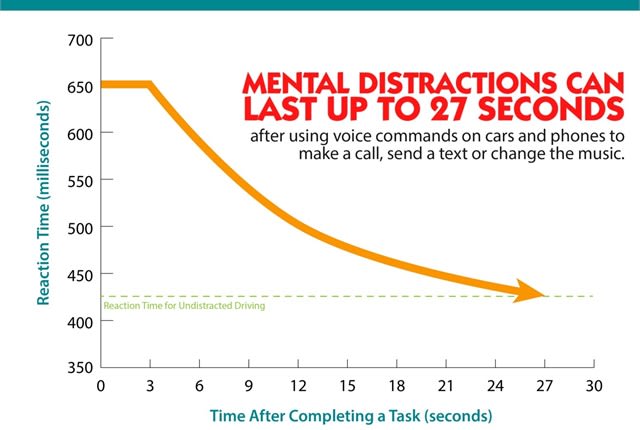
Potentially unsafe mental distractions can persist for as long as 27 seconds after a driver dials, changes music or sends a text using voice commands, according to new research by the AAA Foundation for Traffic Safety.
The study results raise new and unexpected concerns regarding the use of phones and vehicle information systems while driving, the foundation said. This research represents the third phase of the foundation’s investigation into cognitive distraction. Results show that new hands-free technologies can mentally distract drivers even if their eyes are on the road and their hands are on the wheel.
“The lasting effects of mental distraction pose a hidden and pervasive danger that would likely come as a surprise to most drivers,” said Peter Kissinger, president and CEO of the AAA Foundation for Traffic Safety. “The results indicate that motorists could miss stop signs, pedestrians and other vehicles while the mind is readjusting to the task of driving.”
Researchers found that potentially unsafe levels of mental distraction can last for as long as 27 seconds after completing a distracting task in the worst-performing systems studied. At the 25 mph speed limit in the study, drivers traveled the length of nearly three football fields during this time. When using the least distracting systems, drivers remained impaired for more than 15 seconds after completing a task.
“Drivers should use caution while using voice-activated systems, even at seemingly safe moments when there is a lull in traffic or the car is stopped at an intersection,” said Marshall Doney, AAA’s president and CEO. “The reality is that mental distractions persist and can affect driver attention even after the light turns green.”
The researchers discovered the residual effects of mental distraction while comparing new hands-free technologies in 10 2015 model-year vehicles and three types of smart phones. The analysis found that all systems studied increased mental distraction to potentially unsafe levels. The systems that performed best generally had fewer errors, required less time on task and were relatively easy to use.
Source: AAA Foundation for Traffic Safety
The researchers rated mental distraction on a five-point scale. Category one represents a mild level of distraction and category five represents the maximum. AAA considers a mental distraction rating of two and higher to be potentially dangerous while driving.
The best performing system was the Chevy Equinox with a cognitive distraction rating of 2.4, while the worst performing system was the Mazda 6 with a cognitive distraction rating of 4.6, researchers found. Among phone systems, Google Now performed best with a distraction rating of 3.0, while Apple Siri and Microsoft Cortana drew ratings of 3.4 and 3.8.
Using the phones to send texts significantly increased the level of mental distraction. While sending voice-activated texts, Google Now rated as a category 3.3 distraction, while Apple Siri and Microsoft Cortana rated as category 3.7 and category 4.1 distractions, respectively.
“The massive increase in voice-activated technologies in cars and phones represents a growing safety problem for drivers,” Doney said. “We are concerned that these new systems may invite driver distraction, even as overwhelming scientific evidence concludes that hands-free is not risk free.”
Previous AAA Foundation research established that a category 1 mental distraction is about the same as listening to the radio or an audio book. A category 2 distraction is about the same as talking on the phone, while category 3 is equivalent to sending voice-activated texts on a perfect, error-free system. Category 4 is similar to updating social media while driving, while category 5 corresponds to a highly challenging scientific test designed to overload a driver’s attention.
“Developers should aim to reduce mental distractions by designing systems that are no more demanding than listening to the radio or an audiobook,” Doney said. “Given that the impairing effects of distraction may last much longer than people realize, AAA advises consumers to use caution when interacting with these technologies while behind the wheel.”
Dr. David Strayer and Dr. Joel Cooper of the University of Utah conducted the research. A total of 257 drivers ages 21-70 participated in the study of 2015 model-year vehicles, while 65 additional drivers ages 21-68 tested the three phone systems.
More Safety

Fleet Manager’s Ultimate Playbook: Navigating the New Standard in OEM Connectivity
Rising operating costs, driver safety concerns, and unplanned downtime are putting unprecedented pressure on modern fleets. Discover how fleet managers use embedded OEM connectivity and real-time vehicle data to cut TCO, prevent downtime, and protect drivers without aftermarket telematics hardware.
Read More →
From Driver Well-Being to EV Charging | AF News Recap
Mental health belongs in the fleet safety conversation. This week, we’re looking at five ways fleets can support employee well-being before a crisis, plus Holman’s expansion in Mexico, new one-day Fleet Forward passes, and why EV charging demand is outpacing infrastructure growth.
Read More →
Nexar-Nauto Merger Aims to Give Fleets Better Safety Intelligence Through Larger Driving Dataset
Stefan Heck tells Automotive Fleet that combining more than 10 billion miles of driving history with Nexar's AI models will give fleets deeper insights into driver risk and roadway conditions than either company could provide independently.
Read More →
Don't Wait for a Crisis: 5 Ways to Build Mental Health Into Your Fleet Safety Program
For Suicide Prevention Month, fleet and safety leaders have an opportunity to put mental health where it belongs: at the center of workplace safety.
Read More →
How Camera Data Can Strengthen a Fleet’s Insurance Renewal
Insights from a commercial insurance carrier and a broker show how fleets can turn video telematic data, driver coaching, and improved claims results into a stronger case at insurance renewal.
Read More →
The Safest Fleets Aren’t the Ones with the Most Technology
You’ve made the telematics investment. Here’s how to capture the other half of its value and build the safest fleet on the road.
Read More →
Hidden in Plain Sight: Fleet Compliance Risks
Fleet compliance isn't just about having policies — it's about consistently enforcing them. This practical guide reveals six hidden compliance risks common in public sector and shared fleet operations and outlines proven strategies to improve visibility, accountability, and audit readiness
Read More →
NETS Sets 2026 Fleet Safety Benchmark Conference for Indianapolis
The Sept. 15–17 program will feature fleet benchmarking data, case studies, emerging technologies, and implementation strategies while running alongside the NSC Safety Congress & Expo.
Read More →
Off-the-Job Crashes Account for 43% of Employers’ $61.7 Billion Crash Burden
NETS quantifies costs dispersed across fleet, risk, HR, and other departments while providing new per-crash benchmarks for employers.
Read More →
Ram Recalls More Than 1.27 Million 1500 Pickups for Seat Belt Anchor Issue
The recall affects certain 2019-2026 Ram 1500 pickups that may have improperly attached second-row seat belt buckle anchors.
Read More →