




Domino’s Testing Self-Driving Fusion Hybrid for Pizza Delivery
Researchers from Ford and Domino's will study how Ann Arbor, Mich., customers interact with the autonomous vehicle delivering their pizza order.
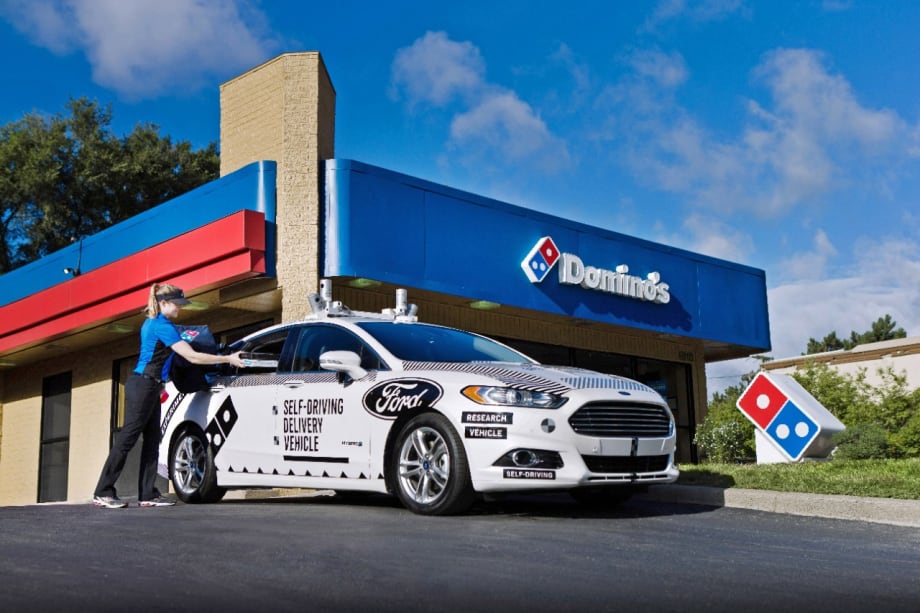
Randomly selected Domino's customers in Ann Arbor, Mich., will have the opportunity to receive their pizza order from a Ford Fusion Hybrid autonomous research vehicle. Photo courtesy of Ford.
Randomly selected Domino's customers in Ann Arbor, Mich., will have the opportunity to receive their pizza order from a Ford Fusion Hybrid autonomous research vehicle. Photo courtesy of Ford.
Domino’s Pizza is teaming with Ford Motor Co. on a research project aimed at understanding the role that self-driving vehicles can play in future pizza delivery, according to Ford.
Over the next several weeks, randomly selected Domino’s customers in Ann Arbor, Mich., will have the chance to receive their pizza order from a Ford Fusion Hybrid autonomous research vehicle. A Ford safety engineer, however, will be behind the wheel and other researchers will be on hand. Researchers from both companies will monitor customer reactions to interacting with a self-driving car as part of their delivery experience, Ford said in a released statement.
“As delivery experts, we’ve been watching the development of self-driving vehicles with great interest as we believe transportation is undergoing fundamental, dramatic change,” said Patrick Doyle, Domino’s president and CEO. “We pride ourselves on being technology leaders and are excited to help lead research into how self-driving vehicles may play a role in the future of pizza delivery. This is the first step in an ongoing process of testing that we plan to undertake with Ford.”
Research with companies like Domino’s will be crucial to ensuring that the technology is applied in ways that enhance the customer experience, Ford said. With a plan to begin production of self-driving vehicles in 2021, Ford is taking steps to design a business that meet the needs of both partner companies and their customers.
“As we increase our understanding of the business opportunity for self-driving vehicles to support the movement of people and goods, we’re pleased to have Domino’s join us in this important part of the development process,” said Sherif Marakby, Ford vice president of autonomous and electric vehicles.
Domino’s customers who agree to participate in the project will be able to track the delivery vehicle through GPS using an upgraded version of Domino’s Tracker. They will also receive text messages as the self-driving vehicle approaches, guiding them on how to retrieve their pizza using a unique code to unlock the Domino’s Heatwave Compartment inside the vehicle.
“We’re interested to learn what people think about this type of delivery,” said Russell Weiner, president of Domino’s USA. “The majority of our questions are about the last 50 feet of the delivery experience. For instance, how will customers react to coming outside to get their food? We need to make sure the interface is clear and simple. We need to understand if a customer’s experience is different if the car is parked in the driveway versus next to the curb. All of our testing research is focused on our goal to someday make deliveries with self-driving vehicles as seamless and customer-friendly as possible.”
Roush Enterprises fabricated the prototype vehicle’s pizza container, based on its experience working with Domino’s on the DXP delivery vehicle in 2015. Ford and Domino’s completed preliminary testing of the delivery process using the vehicle in self-driving mode at Mcity, the simulated urban environment on the University of Michigan’s campus.
More Safety

Nexar-Nauto Merger Aims to Give Fleets Better Safety Intelligence Through Larger Driving Dataset
Stefan Heck tells Automotive Fleet that combining more than 10 billion miles of driving history with Nexar's AI models will give fleets deeper insights into driver risk and roadway conditions than either company could provide independently.
Read More →
Don't Wait for a Crisis: 5 Ways to Build Mental Health Into Your Fleet Safety Program
For Suicide Prevention Month, fleet and safety leaders have an opportunity to put mental health where it belongs: at the center of workplace safety.
Read More →
How Camera Data Can Strengthen a Fleet’s Insurance Renewal
Insights from a commercial insurance carrier and a broker show how fleets can turn video telematic data, driver coaching, and improved claims results into a stronger case at insurance renewal.
Read More →
The Safest Fleets Aren’t the Ones with the Most Technology
You’ve made the telematics investment. Here’s how to capture the other half of its value and build the safest fleet on the road.
Read More →
Hidden in Plain Sight: Fleet Compliance Risks
Fleet compliance isn't just about having policies — it's about consistently enforcing them. This practical guide reveals six hidden compliance risks common in public sector and shared fleet operations and outlines proven strategies to improve visibility, accountability, and audit readiness
Read More →
NETS Sets 2026 Fleet Safety Benchmark Conference for Indianapolis
The Sept. 15–17 program will feature fleet benchmarking data, case studies, emerging technologies, and implementation strategies while running alongside the NSC Safety Congress & Expo.
Read More →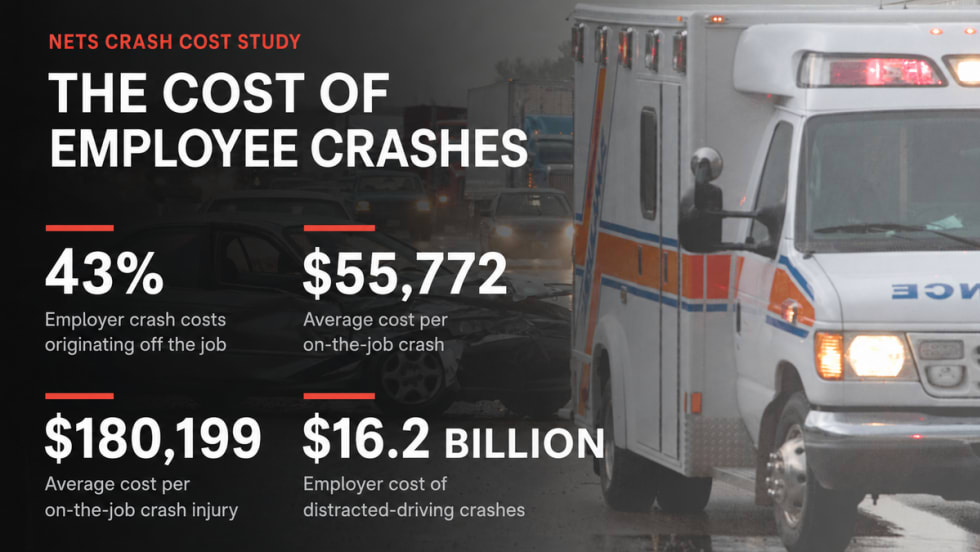
Off-the-Job Crashes Account for 43% of Employers’ $61.7 Billion Crash Burden
NETS quantifies costs dispersed across fleet, risk, HR, and other departments while providing new per-crash benchmarks for employers.
Read More →
Ram Recalls More Than 1.27 Million 1500 Pickups for Seat Belt Anchor Issue
The recall affects certain 2019-2026 Ram 1500 pickups that may have improperly attached second-row seat belt buckle anchors.
Read More →
How Better Visibility Cut Speeding Violations by 48%
Fleet leaders don't need more data, they need clearer visibility into what the data is saying. This case study explores how one utility replaced speeding-event counts with a single metric — miles driven in violation — to strengthen safety and significantly reduce speeding violations.
Read More →
Operation Safe Driver Week: Why the Industry's Oldest Safety Campaign Still Matters to Fleets
A look at how a 2007 enforcement initiative became one of the most consequential weeks on the fleet safety calendar, and what it means for your drivers in 2026.
Read More →