





Further Reading: Volkswagen Places Europcar at Center of New Mobility Strategy
Dataforce Study Indicates Electric is the Future of Mobility
Noting that the plans of vehicle manufacturers are an important indicator, the Dataforce study reported “almost all brands have already publicly communicated plans and indicated time periods from which they want to offer exclusively fully electric vehicles.”
July 19, 2022
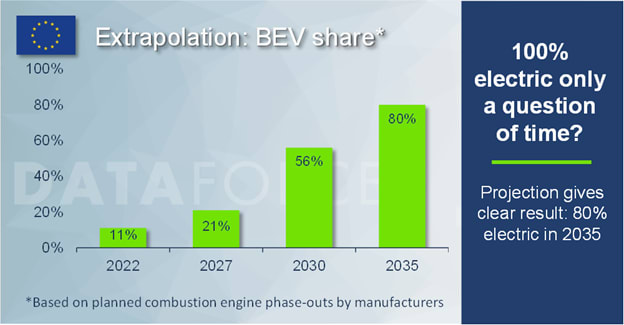
Based on data compiled from auto manufacturers, the study indicates three points in time at which a particularly large number of manufacturers want to exit the internal combustion engine market: 2027, 2030 and 2035. “For 2027, the extrapolation results in a BEV share of at least 21%. In 2030, the development is much faster with already 56% and in 2035 at least 80% will be reached,” the study reveals.
Photo: Dataforce
2 min to read
A new e-mobility study from automotive research firm Dataforce indicates the transportation future in Europe is electric, specifically battery electric vehicles (BEVs). One driving force is the EU plan to mandate only CO2-neutral new cars on the road beginning in 2035.
From January to May 2022, the share of fully electric vehicles in new registrations in 31 European countries, including the EU 28 nations, was 11.3%. The percentage was significantly higher in more progressive states, including the Netherlands (18%), Sweden (26.7 %) and the leader Norway (79.2%).
Noting that the plans of vehicle manufacturers are an important indicator, the Dataforce study reported “almost all brands have already publicly communicated plans and indicated time periods from which they want to offer exclusively fully electric vehicles.”
Other alternative power sources, such as e-fuels and hydrogen, “will hardly play a role in passenger cars, as available quantities are more likely to be needed for industrial purposes and large machines such as aircrafts,” according to the study.
Based on data compiled from auto manufacturers, the study indicates three points in time at which a particularly large number of manufacturers want to exit the internal combustion engine market: 2027, 2030 and 2035.
“For 2027, the extrapolation results in a BEV share of at least 21%. In 2030, the development is much faster with already 56% and in 2035 at least 80% will be reached,” the study reveals.
However, Dataforce notes, geopolitical influences can delay the BEV adoption. “For example, if the available quantities of lithium, cobalt and nickel needed for the construction of batteries are not available. A sufficient charging infrastructure must also be in place.”
Another factor favoring a purely electric future is the increasing number of new BEV-exclusive manufacturers entering the market, says Dataforce. While Tesla is the more prominent, Polestar and MG have been gaining market share. Other nascent e-car companies include Nio, Lucid, Xpeng, Rivian and some Asian companies. Together, the newcomers already account for a share of 18.7% of the total market.
The growing car subscription trend will also strengthen an electric future, the study reports. “Consumers use the flexible leasing offers to try out an electric car for themselves in everyday life. This allows them to minimize the risks of the new technology and to make up their own minds.”
More Global Fleet

GeoFencing Adds to Your Truck Security Arsenal
Geofencing is a familiar fleet tool today, but its early adoption marked a major shift in vehicle tracking, route monitoring, and the debate over employee privacy.
Read More →
Holman Takes Full Ownership of ARIZA in Mexico
Holman is bringing its Mexican fleet management operation fully under its own brand after more than 30 years as a joint venture. The change gives multinational fleet customers a single Holman operation across the U.S., Canada, and Mexico.
Read More →
5 Tire Maintenance Tips to Help Prevent Work Truck Downtime
Regular tire checks can do more than extend tread life. These five maintenance practices can help work truck fleets catch problems early, reduce costs, and prevent downtime.
Read More →

Proven Ways to Reduce Work Truck Downtime
The age-old problem of downtime will always be a reality, but with new strategies at hand, fleets have more ways to keep trucks on the road longer.
Read More →


Cameras, Safety and Insurance: From Reactive Claims to Real-Time Prevention (Part 2 of 2)
Part Two: Commercial auto remains one of the most challenging and costly lines of coverage for fleet operators and insurers alike. Continue learning more about how to effectively address these issues from Onur Aksan, Enterprise Business Development Executive, Geotab
Read More →
Cameras, Safety and Insurance: From Reactive Claims to Real-time Prevention
Commercial auto remains one of the most challenging and costly lines of coverage for fleet operators and insurers alike. Learn more about how to effectively address these issues from Onur Aksan, Enterprise Business Development Executive, Geotab.
Read More →
Fleet Costs Are Rising: Here’s How Leaders Are Responding
Fleet leaders are under pressure to reduce costs, adapt to economic uncertainty, and make smarter decisions. See how peers across North America are responding with real data, proven strategies, and forward-looking insights. Download the 2026 Market Pulse Report to benchmark your strategy and uncover where you can gain an edge.
Read More →
Enterprise Fleet Management Surpasses 900,000 Vehicles in U.S. & Canada
Enterprise Mobility connects with mobility solutions around the globe
Read More →