




Daimler Test Fleet Exploring Potential of Car-to-X Communication
STUTTGART, GERMANY – As part of “Project sim” (Safe and Intelligent Mobility), one of the largest-ever field trials of car-to-X communication (C2X) got under way this month on the roads of Germany.

M2XPro combines sensor data with GPS data. The GPS data acts as an external reference for determining the vehicle's absolute position. Image from Continental Corp.
STUTTGART, GERMANY – As part of “Project sim” (Safe and Intelligent Mobility), one of the largest-ever field trials of car-to-X communication (C2X) got under way this month on the roads of Germany.
The trial, headed by Daimler AG, consists of 120 vehicles traveling the roads of the Rhine-Main region until the end of the year. Each car has a network link to the others, as well as to the traffic infrastructure. They will keep each other updated about current traffic conditions. For example, if the tail end of a traffic jam on the A5 autobahn is hidden behind the crest of a hill, vehicles approaching the congested area can be alerted early, allowing a driver to take appropriate action.
In situations where drivers have difficulty seeing what’s happening on the road ahead of them, C2X technology can help to prevent pileups. C2X systems can also assist in controlling traffic light systems according to demand, thereby optimizing traffic flow.
Daimler is also engaged in C2X communication research in the U.S. At Daimler's site in Palo Alto, Calif., the automaker is fitting C2X systems to vehicles and carrying out tests.
The aim of the recently launched field trial in Germany is to test the systems’ suitability for everyday use in real-life traffic conditions.
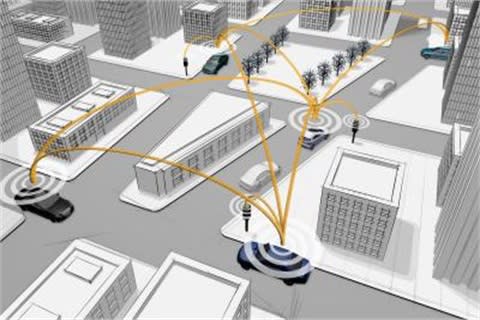
Each of the 120 cars in the trial has a network link to the others, as well as to the traffic infrastructure, and they will keep each other updated about the current traffic situation. Image from Daimler.
"We are convinced that C2X communication is going to play an important role in the mobility of the future," said sim project leader Dr. Christian Weiß, who is in charge of cooperating systems at Daimler Research and Advance Development. "C2X communication allows us to detect objects and hazardous situations far beyond the immediate environment of the vehicle. This is a significant step on the path towards accident-free driving."
Project sim is a collaborative effort involving German automakers, automotive suppliers, communications companies, research institutes and the public sector.
Continental Corp., an automotive supplier based in Germany, is among the project's partners.
"In recent years, driving has already become much safer thanks to advanced electronic driver assistance systems based on cameras, radar and infrared sensors that monitor a vehicle's surroundings," explained Dr. Peter E. Rieth, senior vice president of systems and technology in Continental's Chassis & Safety Division. "Car-to-X communication goes one step further, allowing us to see around corners, as it were, and consequently to drive even more foresightedly. This brings us a significant step closer to making the roads even safer."
Continental has developed the communication control unit (CCU) that enables information to be shared over different channels, such as a universal mobile telecommunications system (UMTS) or an automotive wireless local area network (WLAN). Positioning and time synchronization data can also be accessed via GPS. Together, the communication control unit and a vehicle application unit, which was developed by project partner Bosch within the sim project, form the intelligent transportation systems vehicle station that's installed in all sim test vehicles.
Continental is developing the M2XPro sensor and the Intelligent Antenna Module, two components that will create an inexpensive car-to-x system. The M2XPro sensor (Motion information 2 X Provider) can determine precisely which traffic lane a vehicle is located in, using driving dynamics sensors with GPS data. The sensor uses an intelligent fusion algorithm to provide other control units with a vehicle's motion information together with a precise time base – a key requirement for car-to-x communication.

M2XPro combines sensor data with GPS data. The GPS data acts as an external reference for determining the vehicle's absolute position. Image from Continental Corp.
More Safety

What’s Next for Fleet? Safety, AI & Industry Recognition | AF News Recap
Could your company's culture be encouraging distracted driving? This week, we're exploring how workplace expectations affect driver safety, what AI, EVs, and autonomous vehicles could mean for the future of fleet management, and how fleet professionals can strengthen their award nominations.
Read More →
Does Your Fleet's Culture Encourage Distracted Driving?
What happens when the people responsible for enforcing safety rules are the ones setting the wrong example? The answer may reveal why some of the biggest risks to fleet drivers have little to do with what's written in the employee handbook.
Read More →
Fleet Manager’s Ultimate Playbook: Navigating the New Standard in OEM Connectivity
Rising operating costs, driver safety concerns, and unplanned downtime are putting unprecedented pressure on modern fleets. Discover how fleet managers use embedded OEM connectivity and real-time vehicle data to cut TCO, prevent downtime, and protect drivers without aftermarket telematics hardware.
Read More →
From Driver Well-Being to EV Charging | AF News Recap
Mental health belongs in the fleet safety conversation. This week, we’re looking at five ways fleets can support employee well-being before a crisis, plus Holman’s expansion in Mexico, new one-day Fleet Forward passes, and why EV charging demand is outpacing infrastructure growth.
Read More →
Nexar-Nauto Merger Aims to Give Fleets Better Safety Intelligence Through Larger Driving Dataset
Stefan Heck tells Automotive Fleet that combining more than 10 billion miles of driving history with Nexar's AI models will give fleets deeper insights into driver risk and roadway conditions than either company could provide independently.
Read More →
Don't Wait for a Crisis: 5 Ways to Build Mental Health Into Your Fleet Safety Program
For Suicide Prevention Month, fleet and safety leaders have an opportunity to put mental health where it belongs: at the center of workplace safety.
Read More →
How Camera Data Can Strengthen a Fleet’s Insurance Renewal
Insights from a commercial insurance carrier and a broker show how fleets can turn video telematic data, driver coaching, and improved claims results into a stronger case at insurance renewal.
Read More →
The Safest Fleets Aren’t the Ones with the Most Technology
You’ve made the telematics investment. Here’s how to capture the other half of its value and build the safest fleet on the road.
Read More →
Hidden in Plain Sight: Fleet Compliance Risks
Fleet compliance isn't just about having policies — it's about consistently enforcing them. This practical guide reveals six hidden compliance risks common in public sector and shared fleet operations and outlines proven strategies to improve visibility, accountability, and audit readiness
Read More →
NETS Sets 2026 Fleet Safety Benchmark Conference for Indianapolis
The Sept. 15–17 program will feature fleet benchmarking data, case studies, emerging technologies, and implementation strategies while running alongside the NSC Safety Congress & Expo.
Read More →